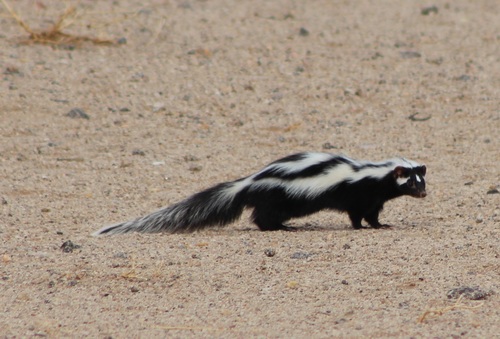
The striped polecat, also called the African polecat, zoril, zorille, zorilla, African muishond, striped muishond, Cape polecat, and African skunk, is a species of mammal native to sub-Saharan Africa. Despite bearing some resemblance to a skunk, it belongs in a separate family known as the Mustelidae, and genetic analysis suggests that its closest living relative is the African striped weasel. It is adaptable and lives in a wide range of habitats and elevations, preferring open environments with lower levels of shrubs. This species measures 30–38 cm (12–15 in) in length excluding the tail, with males growing larger than females. Its fur is mostly black, with distinctive white stripes running down its back and white patches on its face and tail, though the exact patterning is highly variable.
📌 Etymology
The generic name Ictonyx combines two Ancient Greek words, (, meaning "marten" or "weasel") and (, meaning "claw"). The specific name is a Latin word meaning "streaked", in reference to the patterns on the animal's back. Therefore, the scientific name of this animal can be interpreted as "streaked weasel claw" or "streaked marten claw".
This species has many vernacular names, one of the most common being "striped polecat". The origin of the English word polecat is unknown, but it was thought to come from a combination of the English word cat with the Middle French word or (meaning "cock"). This word was originally used for the European polecat, referencing its predation on poultry. Another commonly used name is zorilla, sometimes spelled as zorille, which comes from the Spanish word (meaning "skunk"), itself a diminutive form of the Spanish (meaning "fox"). The names "African skunk", "African muishond" and "striped muishond" have been used, though the former is inaccurate since this animal belongs in a separate family from true skunks.
📌 Taxonomy
published in the 1810 paper which first described the species, labeled as Bradypus striatus|left|thumb]]
The oldest scientific description of a striped polecat was published in 1810 by English naturalist George Perry, who described the animal based on an engraving made by English artist Thomas Lord Busby. The individual depicted was seen a few months earlier in London, where it was displayed alive in a travelling menagerie and claimed to be from South America. Soon after the engraving was made, the menagerie had left London, so Perry was unable to examine the living animal in detail. Based on the engraving, Perry could determine that the species was unknown to science, but was uncertain what type of animal it was. He believed it had some similarities to wombats, koalas, bears and weasels, but ultimately described it as a species of sloth in the genus Bradypus, giving it the scientific name Bradypus striatus and the common name "weasel sloth".
More specimens of striped polecats would be analyzed throughout the 19th century, with various authors establishing new species names based on them. They have since been found to represent the same species and the taxa erected based on them are thus considered synonymous. Later in 1829, German zoologist Johann Baptist Fischer described a species under the name Mustela zorilla based on specimens from Senegal and the Cape of Good Hope, South Africa, recognizing that it belongs in the family Mustelidae. This species was moved to the genus Putorius by Smith in 1834, renaming it as Putorius zorilla. The genus Ictonyx was established by German naturalist Johann Jakob Kaup in 1835 to contain a single species, which was given the name Ictonyx capensis, marking the first time the striped polecat was assigned to a newly established genus rather than one which already existed. Kaup described the species based on specimens from the Cape of Good Hope, South Africa, which is referenced in the specific name. The name Mephitis africana was erected for the striped polecat by German explorer Hinrich Lichtenstein in 1836, who believed like Smith that it is a species of skunk. However, along with Mustela zorilla, this name was synonymized in 1841 with Rhabdogale mustelina, a taxon established by Johann Andreas Wagner that year.
During the early 1900s, the striped polecat was commonly referred to under the scientific name Zorilla striata, with experts such as Édouard Louis Trouessart and William Lutley Sclater using it in their publications. This name was first used in 1861 by Edgar Leopold Layard. However, it was pointed out by American zoologist Arthur H. Howell in 1906 that this name is invalid; the specific name striata originates from an 1800 publication by George Shaw but is based on Viverra putorius and thus refers to the eastern spotted skunk, while the generic name Zorilla is preoccupied as it was already used by Lorenz Oken in 1816. Howell determined that the proper specific name of the animal should be capensis, as he thought it was the oldest given to it (by Smith in 1826). He concluded that its proper generic name should be Ictonyx since the animal does not belong in any of the other genera it was formerly placed in and requires its own genus, thus assigning it the binomial name Ictonyx capensis.
📌 Subspecies
A number of striped polecat subspecies have been proposed, though there is debate between different authors as to how many of these are valid. Some authors have categorized them under three groupings based on geography, namely I. s. striatus in southern Africa, I. s. erythrae in northeast and eastern Africa, and I. s. senegalensis in west Africa. However, others believe that the supposed subspecies cannot be consistently distinguished from each other or that their geographic ranges cannot be determined, such that the species is actually monotypic and all proposed subspecies should be considered invalid. The following 19 subspecies were recognized in the third edition of Mammal Species of the World published in 2005:
{| class="wikitable collapsible" font="90%"
|- style="background: #115a6c"
!Subspecies
!Trinomial authority
!Description
!Type locality
|-
|I. s. striatus (Nominate subspecies)
|Perry, 1810
|Largely black, with four white back stripes, a white forehead spot and white patches beneath the ears.
|Cape Province, South Africa
|Summit of Mount Lololokwi, Kenya
|Lambert's Bay, South Africa
|-
|I. s. elgonis
|Granvik, 1924
|Similar to I. s. albescens but slightly smaller, and the white patterns of the cheeks and forehead are separated by black bars.
|Mount Elgon, Kenya
|Habr Heshi, Somaliland
|Gemsbok Pan, South Africa
|Mooivlei, South Africa
|Luuq, Somalia
|Addis Ababa, Ethiopia
|-
|I. s. shortridgei
|Roberts, 1932
|Very large subspecies, the black dorsal stripes are narrower in the front part of the body, tail is whiter than in the South African subspecies.
|Maschi River at the border of the Caprivi Strip, Namibia
|-
|}
📌 Evolution
]]
The striped polecat is the type species of the genus Ictonyx, and belongs to the subfamily Ictonychinae (which the genus lends its name to) within the family Mustelidae. Members of Ictonychinae can be split into two tribes, namely Ictonychini and Lyncodontini. This species is part of the former tribe, which it shares with the African striped weasel, Saharan striped polecat and marbled polecat. Genetic analysis has revealed that the closest living relative of the striped polecat is the African striped weasel, with multiple studies recovering the two as sister taxa. A study published in 2008 proposed that the lineages of these two species diverged between 2.7 and 2.2 million years ago, whereas a later study from 2012 suggested an earlier date between 4.3 and 3.4 million years ago for this divergence. Among the oldest specimens originate from the Sea Harvest Site in Saldanha Bay, and likely date back to a cooler phase of the Last Interglacial, between 128,000 and 74,000 years ago. An extinct species known from fossils found in Laetoli, Tanzania has been named Ictonyx harrisoni, and would have lived 3.85 to 3.63 million years ago during the Early Pliocene epoch. Though smaller than the striped polecat and differing in tooth structure, I. harrisoni is mostly similar to the extant animal and is therefore placed in the same genus. Another fossil species was formerly assigned to Ictonyx and named Ictonyx bolti in 1985, as it was believed at the time that the striped polecat is its closest living relative. However, further analysis has shown that it is more closely related to the African striped weasel, so in 1987 it was moved to its own separate genus named Propoecilogale.
📌 Physical characteristics
The striped polecat grows about in length excluding the tail (which adds an additional ), and weighs from . The head is mostly black, with two large white cheek patches stretching from below the ears to the back of the eyes, a white spot on the forehead, and white fringes on the ears, though the exact extent and size of these facial patterns is highly variable. The cheek patches and the forehead spot are usually distinctly separate, but may be merged into a single white band in some West African individuals.
The fur on the back is silky and long, growing in length, while that on the head is shorter and only . The tail fur is particularly long, reaching , giving the tail a bushy appearance. All claws and digits touch the ground when the animal is walking, and their impressions can be seen in the footprints. Five digits are present on each of the four limbs, with each digit bearing a claw. The claws of the front limbs are longer and more curved than those of the hind limbs, with the former growing about while the latter tend to only measure . The front paws are larger than the hind paws, and the soles of all four paws are hairless. Each paw is narrow and most of the digits are spread wide apart, though the third and fourth digits of each hind paw are close together. Every digit has an oval-shaped pad, and each paw has a four-lobed pad forming a shape with a notch in the back, with each front paw having two additional carpal pads on the wrist area. All of these pads have coarse grooves.
The skull is heavily built, with a braincase that is wide at the back and becomes narrower towards the front, and a short, blunt snout. The palate is wide in its hind portion, becoming narrower past where the molar teeth are. The eyes are near the front of the head, with the distance between the front edges of the eye sockets and the tip of the maxilla being only a quarter the length of the entire skull. There is no sagittal crest in this species, though two low ridges serving as attachments for the temporalis muscles are visible from the supraoccipital crests (at the back of the skull) to the postorbital processes (behind the eye sockets). The auditory bullae (bony structures containing the middle and inner ears) are wide and flat, and the zygomatic arches (arch-like bones in the cheeks) are wider at their bases than at their centers. The dentition has a dental formula of , that is, three incisors, one canine and three premolars in each half of either jaw, with each half of the upper jaw having one molar while that of the lower jaw has two, giving a total of 34 teeth. The canines are short and robust, with the lower canines bending backwards at their tips, and the outer incisors of the upper jaw are longer than the inner incisors, being used alongside the canines to subdue prey. The molars have broad grinding surfaces, allowing the animal to crush food, especially insects.
📌 Distribution and habitat
, South Africa|right|thumb]]
Endemic to Africa, the striped polecat is an adaptable animal and very widespread across the continent. It inhabits most of Sub-Saharan Africa, ranging from Mauritania across to southeastern Egypt in the north, and stretching down south to South Africa. It can inhabit dry areas if scrub cover is present, having been recorded from the hummocks and sand dunes of the Namib Desert, but can be found in regions with high rainfall. The striped polecat occurs in a wide range of elevations, from sea level up to as high as above sea level as evidenced by sightings on Mount Kenya. It is not confined to natural environments and even enters areas developed by human activity such as plantations and gardens.
📌 Behaviour and biology
The striped polecat is a generally solitary creature, though it is sometimes seen in pairs, and groups with more than two individuals are often small family groups consisting of a mother and her young. Males and females mostly remain separate and tolerate each other's presence during mating, whereas adult males are hostile towards one another. This may be because the males are more active and willing to approach unfamiliar objects, making them more easily surveyed. Burrow usage is often temporary, though mothers with young tend to stick to one burrow unless there is disturbance.
📌 Reproduction
The breeding season of the striped polecat has a long duration, though the exact time of year varies between different populations. In KwaZulu-Natal, it lasts from spring to the end of summer, with the testes of the male remaining large from September to April (spring to early autumn) and being shrunken for the rest of the year.
Though usually hostile towards males, a female is more tolerant of them when she is receptive, crouching in front of males and allowing them to smell her vulva, sometimes taking a submissive stance with the neck extended, mouth open and head turned to the side. The male then pulls her into a covered area by the back of her neck. This process may repeat several times before copulation, during which the male mounts the female, occasionally biting the back of her neck, while his forelimbs are clasped around her lumbar area as she remains crouched. Copulation may last between 25 and 106 minutes, during which the male thrusts his pelvis with pauses in between, while the female makes loud yapping and shrieking sounds. After conception, the gestation period for a striped polecat is about 36 days.
The newborns are altricial and completely vulnerable; they are born blind, deaf, and almost hairless. They are only long and weigh about at birth, and while eye slits and external ear flaps are visible, both are closed. They appear mostly pink because their skin is visible, though dark stripes are already present at this age. The mother carries her newborns in her mouth by their shoulders or back, and when they reach three weeks old she lifts them by the scruff of the neck instead. At an age of ten days, white hair grows to cover the young, and they begin crawling short distances. The distinctive black and white stripes become visible between 19 and 21 days after birth, and at 39 days they start to walk. The eyes start to open when they are 35 days old, and are fully open after another week. Lower milk canine teeth erupt at 32 days, at which point the young begin eating the soft parts of prey killed by their mother, and permanent canines grow in before the milk canines are all shed. Young which have begun eating solid food suckle less, and by an age of eight weeks are weaned.
📌 Defense mechanisms
, South Africa|right|thumb]]
When threatened, the striped polecat commonly flees by quickly entering its burrow. If unable to do so, it takes a deimatic (threat display) stance with its back arched, rear end facing the opponent, and tail straight up in the air or curled over its back, sometimes making a squeal-like noise. If the threat has still not been warded off, the polecat sprays a foul-smelling fluid from glands near its anus. This fluid is made up of a light, yellow oil and a translucent, colourless water-like phase. It is nauseating and very irritating to the eyes, serving as a defense against predators, in a similar manner to skunks. The odour effectively repels most mammalian predators, though birds tend to be more tolerant of scents. Considering that the sprays of skunks repel hawks successfully, and that the striped polecat's spray likely has a similar composition, this method of defence may still work against birds of prey.
On occasion, the striped polecat feigns death when faced by predators. When doing so, it lies limp on the ground with its back facing upwards, displaying its stripes to the threats. This patterning is an example of aposematism, warning that the polecat can defend itself with its spray and that it tastes foul. The noxious spray contaminates some of the animal's fur, especially that of the tail, deterring any predators which try to bite it while it feigns death. A striped polecat may continue feigning death for over 30 minutes while waiting for its attacker to lose interest and leave.
📌 Communication
Striped polecats communicate with each other using myriad verbal signals and calls. Growls act as a warning to possible predators, competitors, or other enemies to back off. High-amplitude screams signify situations of high aggression, sometimes preceding the spraying of anal emissions or combat. An undulating high- to low-pitched scream conveys surrender or submission to an adversary, accompanying the subsequent release of the loser. Conversely, a faster, lower-amplitude undulating call has been interpreted as a friendly salutation. Mating calls are common forms of communication between the sexes. Adolescent polecats have a specific set of calls and signals, either signifying distress when separated from their mother or to contact her when she enters their shared burrow.
Visual communication is used by the striped polecat. When angered or startled, the hair on its back and tail automatically become erect, making the animal appear larger. During friendly interactions with others of its kind, a striped polecat presents its black underbelly, contrasting how it displays the stripes on its back when threatened. Olfactic communication involving the fluids of the anal glands likely plays a part in regulating social interactions.
📌 Ecology
===Diet and feeding===
Like other mustelids, the striped polecat is a predator. It has 34 sharp teeth for shearing flesh and grinding meat, and a broad generalist diet including various small animals. It can hunt by both vision and smell, and may dig into soil or dung to reach burrowing prey. Most prey species taken are small, though larger animals up to the size of a hare are eaten. However, egg breaking is not innate, and captive individuals often show little interest in unbroken chicken eggs or fail to break the shells, though they lap up the contents of eggs and recognize them as food after learning to break them by biting or rolling them against hard objects. Although the striped polecat consumes most amphibians it encounters, it notably does not eat bufonid toads, likely as they are poisonous and unpalatable. The striped polecat has a high metabolic rate and a short gut between 3.2 and 4.3 times the length of its body (excluding the tail), such that food passes through quickly and is excreted via defecation about 165 minutes after consumption. The animal must therefore actively forage throughout the night to meet its energy requirements.
This species does not drink water frequently, instead obtaining most of its required moisture through its food. When it does drink, it laps water up using its tongue. A male kept in a cage during winter for two weeks did not drink at all during this time, and only drank small amounts of water occasionally when the weather was hot. Captive females with nursing young have been observed dipping their necks or entire undersides into water during very hot weather, possibly to both cool themselves and carry water to their young.
📌 Mortality and disease
carcass in Botswana]]
The lifespan of a striped polecat is short, commonly only four or five years in the wild, though captive individuals may survive for over 13 years. Most predators avoid targeting this species due to its pungent and irritating spray, and it makes no effort to conceal itself when foraging, though domestic dogs do attack them. Road collisions likely cause more striped polecat deaths than any other factors in modern times. Multiple members of a family group often end up killed on roads as they do not leave the area when one member is run over. Compared to the bodies of other animals such as antelopes and hares, the carcasses of striped polecats attract very few scavengers, with only vultures occasionally feeding on them. Therefore, roadkill bodies of striped polecats tend to remain on the road for much greater durations. Dissections of 21 striped polecat carcasses from KwaZulu-Natal revealed that four of these individuals had parasitic nematodes in their stomachs. Rabies has been recorded in this mustelid. Ixodid ticks are known exoparasites of this mammal, with the species Haemaphysalis zumpti and possibly Haemaphysalis leachi having been found on two individuals from South Africa.
📌 Competitors
Throughout most of Africa, the ecological niches of small carnivores are mostly occupied by mongooses, and genets are also present, both of which overlap considerably with the striped polecat in range and diet. Though competition with these animals could occur, the striped polecat may largely avoid this in having slightly different habits; its diet consist of more mammals and birds than those of mongooses, and less plant matter than those of genets. Another species of small mustelid, the African striped weasel, coexists with the striped polecat, and tends to be the rarer of the two in regions where they overlap. However, the African striped weasel has a very specialized diet made up almost entirely of small rodents, with birds being taken occasionally, and enters burrows to reach its prey. In contrast, the striped polecat has a more generalist diet which includes more insects and reptiles, and it catches rodents above ground. This niche partitioning reduces competition between these two mustelids.
📌 Conservation
The IUCN listed the striped polecat as Least Concern in 1996, 2008 and 2015, as it is widespread across Africa including in multiple protected areas. Though sightings of it are rare, this can be attributed to its nocturnal habits, making it unlikely to cross paths with people. Easily tamed even as adults, humans sometimes collect this species as a pet, occasionally removing the fluid glands near the anus to make it more suitable as such, though there are reports of this fluid being harvested for use as a perfume. Some striped polecats are killed by humans for preying on poultry, and increasing numbers of humans and free-ranging dogs in rural areas may be causing local population declines in this animal, but these threats are not believed to be significant to the species as a whole.