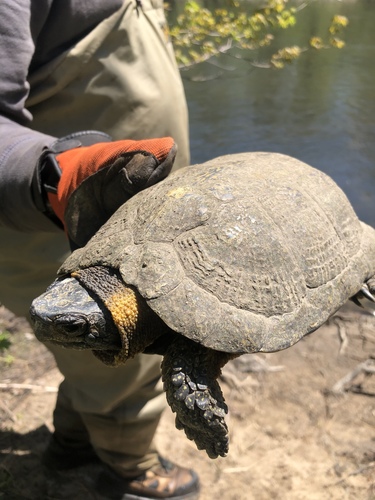
The wood turtle is a semi-aquatic turtle species in the family Emydidae. The species inhabits the northeastern United States and Canada. The wood turtle exists in a broad geographic range extending from Nova Scotia in the north across the Great Lakes region to Minnesota in the west, and Virginia in the south. In the past, it was forced south by encroaching glaciers: skeletal remains have been found as far south as Georgia.
🛡️ Conservation Status
endangered
en
📌 Taxonomy
Formerly in the genus Clemmys, the wood turtle is now a member of the genus Glyptemys, a classification that the wood turtle shares with only the bog turtle. Today, there are several prominent common names for the wood turtle, including sculptured tortoise, red-legged tortoise, and redleg.
📌 Distribution and habitat
in New Jersey on April 28, 2022]]
The wood turtle is found in most New England states, Nova Scotia, west to Michigan, northern Indiana and Minnesota,
In the western portion of its range, wood turtles are more aquatic. In the east, wood turtles are decidedly more terrestrial, especially during the summer. During this time, they can be found in wooded areas with wide open canopies. However, even here, they are never far from water and will enter it every few days.
📌 Evolutionary history
In the past, wood turtle populations were forced south by extending glaciers. Remains from the Rancholabrean period (300,000 to 11,000 years ago) have been found in states such as Georgia and Tennessee, both of which are well south of their current range. (areas like New Brunswick and Nova Scotia).
📌 Nesting behavior
The wood turtle is oviparous. It produces offspring by laying eggs, and does not provide parental care outside of nest-building. Thus, the location and quality of nesting sites determine the offspring survival and fitness; so females invest significant time and energy into nest site selection and construction. Females select nest sites based on soil temperature (preferring warmer temperature nest sites), but not soil composition. Average nest size is four inches wide and three inches deep. Also, females build nests in elevated areas in order to avoid flooding and predation. After laying eggs, female wood turtles will cover the nest with leaves or dirt in order to hide the unhatched eggs from predators, and then the female will leave the nest location until the next mating season. Nesting sites can be used by the same female for multiple years. Because nest building occurs along rivers, females tend to spend more time along river areas, compared to male turtles.
📌 Ecology and behavior
During the spring, the wood turtle is active during the daytime (usually between about 7:00 a.m. and 7:00 p.m.) In order to maintain its body temperatures through thermoregulation, it spends a considerable amount of time basking, most of which takes place in the late morning and late afternoon. The wood turtle reaches a peak body temperature of after basking. During times of extreme heat, it has been known to estivate. Several reports mention individuals resting under vegetation, fallen debris and in shallow puddles. During the summer, the wood turtle is considered a largely terrestrial animal. At night, its average body temperature drops to between
Males are known to be aggressive, with larger and older turtles being more dominant. Larger males rank higher on the social hierarchy often created by wood turtle colonies. In the wild, the submissive turtle is either forced to flee, or is bombarded with physical abuses, which include biting, shoving, and ramming. Larger and more dominant males will sometimes try to remove a subordinate male while he is mating with a female. The defender will, if he does not successfully fight for his position, lose the female to the larger male. Therefore, among males, there is a direct relationship between copulation opportunities and social rank. When hunting, the wood turtle pokes its head into such areas as dead and decaying logs, the bottoms of bushes, and in other vegetation. In the water, it exhibits similar behavior, searching algae beds and cavities along the sides of the stream or river.
📌 Movement
The wood turtle can travel at a relatively fast speed (upwards of ); it also travels long distances during the months that it is active. In one instance, of nine turtles studied, the average distance covered in a 24-hour period was , with a net displacement of .
The wood turtle, an intelligent animal, has homing capabilities. Its mental capacity for directional movement was discovered after the completion of an experiment that involved an individual finding food in a maze. The results proved that these turtles have locating abilities similar to that of a rat. This was also proved by another, separate experiment. One male wood turtle was displaced after being captured, and within five weeks, it returned to the original location. The homing ability of the wood turtle does not vary among sexes, age groups, or directions of travel.
📌 Life cycle
The wood turtle takes a long time to reach sexual maturity, has a low fecundity (ability to reproduce), but has a high adult survival rate. However, the high survival rates are not true of juveniles or hatchlings. Although males establish hierarchies, they are not territorial. In one rare instance, a female wood turtle hybridized with a male Blanding's turtle.
Nesting occurs from May until July. Nesting areas receive ample sunlight, contain soft soil, are free from flooding, and are devoid of rocks and disruptively large vegetation. Female wood turtles in general lay one clutch per year and tend to congregate around optimal nesting areas.
The wood turtle is the only known turtle species in existence that has been observed performing same-sex intercourse. Same-sex behavior in tortoises is known in more than one species.
The wood turtle exhibits genetic sex determination, in contrast to the temperature-dependent sex determination of most turtles.
📌 Mating system
Specific mating courtship occurs more often in the Fall and usually from 11:00 to 13:00 when many of the turtles are feeding. Mating is based on a male competitive hierarchy where a few higher ranked males gain the majority of mates in the population. Male wood turtles fight to gain access to female mates. These fights involve aggressive behaviors such as biting or chasing one another, and the males defend themselves by retreating their heads into their hard shells. The higher ranked winning males in the hierarchy system have a greater number of offspring than the lower ranked male individuals, increasing the dominant male's fitness. Female wood turtles mate with multiple males and are able to store sperm from multiple mates.
📌 Conservation
Despite many sightings and a seemingly large and diverse distribution, wood turtle numbers are in decline. Many deaths caused by humans result from: habitat destruction, farming accidents, and road traffic. Also, it is commonly collected illegally for the international pet trade. These combined threats have caused many areas where they live to enact laws protecting it.
For proper protection of the wood turtle, in-depth land surveys of its habitat to establish population numbers are needed. One emerging solution to the highway mortality problem, which primarily affects nesting females,
While considered nationally as threatened by the Committee on the Status of Endangered Wildlife in Canada (COSEWIC), the wood turtle is listed as vulnerable within the province of Nova Scotia under the Species at Risk Act. The species is highly susceptible to human land use activities, and special management practices for woodlands, rivers and farmland areas as well as motor vehicle use restrictions and general disruption protection during critical times such as nesting and movement to overwintering habitat is closely monitored. Since 2012, the Clean Annapolis River Project (CARP) has provided research and stewardship for this species including the identification of crucial habitats, distribution and movement estimation, and outreach.