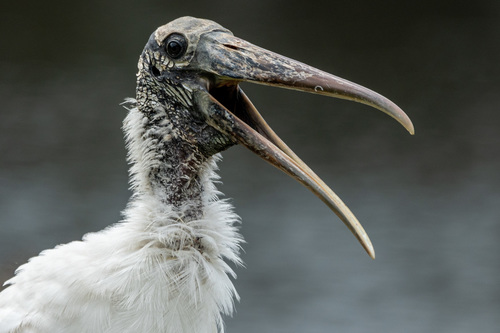
The wood stork is a large wading bird in the family Ciconiidae (storks). Originally described in 1758 by Carl Linnaeus, this stork is native to the subtropics and tropics of the Americas, where it persists in habitats with fluctuating water levels. It is the only stork species that breeds in North America. The head and neck are bare of feathers, and dark grey in colour. The plumage is mostly white, with the exception of the tail and some of the wing feathers, which are black with a greenish-purplish sheen.
📌 Taxonomy and etymology
The wood stork was first formally given its binomial name Mycteria americana by Linnaeus in 1758. Linnaeus originally named two separate species, M. americana and Tantalus loculator, based on different and slightly erroneous accounts, in his book Systema Naturae. It was later identified that these binomials referred to the same species, making M. americana and T. loculator synonymous. M. americana takes priority as it occurs before T. loculator.
The accepted generic name Mycteria derives from the Greek μυκτήρ : myktēr, meaning snout or trunk, and the species name americana references the distribution of this stork. It also has been given the name of the "American wood stork", because it is found in the Americas.
The wood stork is classified within the tribe Mycteriini (which encompasses all species of genera Anastomus and Mycteria) based on morphology and behaviour.
📌 Distribution and habitat
The current range of the wood stork includes the Southeastern United States, Mexico, Central America, Cuba, and South America.
Within the United States, small breeding populations exist in Florida, Georgia, and North and South Carolina.
In Mexico, nonbreeding birds can be found along both the Pacific and Atlantic Coasts, while breeding colonies are restricted to the Pacific Coast. Most descriptions of wood stork breeding colonies in western Mexico are over 35 years old, but recent sources have confirmed active nesting colonies in the southwestern states of Oaxaca and Colima. Both colonies exist in important wetlands - Zapata Swamp and the Sabana-Camaguey Archipelago. Outside of Cuba, sightings of wood storks are rare in the Caribbean, as the birds were extirpated from Hispaniola and are vagrants on other Caribbean islands.
In South America, the wood stork is found south to northern Argentina. Most breeding colonies in Brazil are concentrated in the Pantanal wetland and the northern coastal region. Birds that breed in west-central Brazil often disperse to southern Brazil and northern Argentina after breeding.
The wood stork is able to adapt to a variety of tropical and subtropical wetland habitats It nests in trees that are over water or surrounded by water. In freshwater habitats, it primarily nests in forests dominated by trees of the genus Taxodium (in the U.S.), while in estuaries, it generally nests on trees in the mangrove forests. To feed, the wood stork uses freshwater marshes in habitats with an abundance of Taxodium trees, while in areas with mangrove forests, it uses brackish water. Areas with more lakes attract feeding on lake, stream, and river edges.
📌 Behaviour and ecology
=== Breeding ===
A resident breeder in lowland wetlands, the wood stork builds large, nests in trees. For Taxodium trees, it generally nests near the top branches, frequently between above the ground.
The nest is built by the male When complete, the nest is about in diameter,
Breeding is initiated by a drop in the water level combined with an increased density of fish (with the former likely triggering the latter). This is because a decrease in the water level and an increased density of fish allows for an adequate amount of food for the nestlings.This bird lays one clutch of three to five cream-coloured eggs that are about in size. by both sexes. The eggs hatch in the order in which they were laid, with an interval of a few days between when each egg hatches. and reach sexual maturity at 4 years of age, although they usually do not successfully fledge chicks until their fifth year. Overall, about 31% of nests produce at least one fledged bird. Raccoons and caracaras, especially crested caracaras, are prominent predators of eggs and chicks. Other causes of nesting failure is the falling of nests, thus breaking the eggs inside. This can be caused by many events, the most prominent being poor nest construction and fights between adults.
📌 Diet and feeding
During the dry season, the wood stork eats mostly fish, supplemented by insects. During the wet season, though, fish make up about half the diet, crabs make up about 30%, and insects and frogs make up the rest. The wood stork eats larger fish more often than smaller fish, even in some cases where the latter is more abundant. An adult wood stork needs an estimated per day to sustain itself. For a whole family, about are needed per breeding season.
Both parents feed the chicks by regurgitating food onto the nest floor. The chicks are mainly fed fish that are between in length, with the size of the fish typically increasing as the chicks get older. The amount of food that the chicks get changes over time, with more being fed daily from hatching to about 22 days, when food intake levels off. This continues until about 45 days, when food consumption starts to decrease. Overall, a chick eats about before it fledges.
📌 Predators and parasites
Raccoons are predators of wood stork chicks, especially during dry periods, when the water beneath nesting trees dries up. Other species of Haemoproteus also infect wood storks in Costa Rica, in addition to Syncuaria mycteriae, a nematode found in the gizzard of the wood stork.
In Florida, wood storks may be eaten by some growth stage of invasive snakes such as Burmese pythons, reticulated pythons, Central African rock pythons, Southern African rock pythons, boa constrictors, yellow anacondas, Bolivian anacondas, dark-spotted anacondas, and green anacondas.
📌 Flight
When flying, this bird uses two different techniques. When it is not sufficiently warm and clear, such as in the late afternoon or on cloudy days, this stork alternates between flapping its wings and gliding for short periods. When weather is warm and clear, this bird glides after it gains an altitude of at least through continuously flapping its wings. It can then glide for distances ranging from . It does not have to flap its wings during this time because the thermals are strong enough to support its weight.
📌 Excretion and thermoregulation
During the breeding season, the wood stork commonly defecates over the edge of its nest, while the chicks usually defecate inside. In hot weather, breeding adults will also shade their chicks with their wings.
📌 Evolution
=== Fossil record ===
The species most likely evolved in tropical regions and its North American presence probably postdates the last ice age. A fossil fragment from the Touro Passo Formation found at Arroio Touro Passo (Rio Grande do Sul, Brazil) might be of the living species; it is at most from the Late Pleistocene age, a few tens of thousands of years ago. North American fossils from that time are of an extinct larger relative, M. wetmorei, which would be distinguished from the wood stork on the basis of size and on the basis of M. wetmorei's less curved mandible. This was probably a sister species; both occurred sympatrically on Cuba at the end of the Pleistocene.
📌 Phylogenetics
{{Cladogram|caption=Phylogeny of extant Mycteria.
📌 Genome
The wood stork has 72 chromosomes (2n = 72; 35 pairs of autosomes and one pair of sex chromosomes) as determined by karyotype analysis. Like all birds, the wood stork has a ZW sex-determination system in which males have a pair of similar chromosomes, ZZ, and females have a pair of dissimilar chromosomes, ZW. Thus, females are the heterogametic sex, while males are the homogametic sex. A highly contiguous genome assembly of the wood stork has been produced with 31 autosomal pairs and both sex chromosomes identified.
📌 Conservation status
in the Pantanal, Brazil]]
Globally, the wood stork is considered least concern by the International Union for Conservation of Nature due to its large range. Similarly, in the state of Santa Catarina, Brazil, its decline seems to have been reversed; after an absence between the late 1960s and the mid-1990s, the species is now again regularly encountered there, in particular in the Tubarão River region. The Paraná River region's wetlands likely served as a stronghold of the species, from where it is now recolonizing some of its former habitats.
📌 Threats
Hunting and egg collecting by humans has been implicated as a factor in the decline of South American wood storks. Humans also cause nest failures through ecotourism; disturbance by tourists can have an effect on nesting success, with a study finding that nests that had boats passing by them within about had an average of 0.1 chicks fledging, compared to the normal rate for that area of about 0.9 chicks fledging per nest. Pedestrians watching from a distance of at least did not significantly affect nesting success.
Habitat alteration has been implicated as the main threat to wood stork populations in the United States. In the Everglades, levee and drainage systems have caused the timing of water fluctuations to change, thus shifting the timing of nesting and consequently a decrease in population.