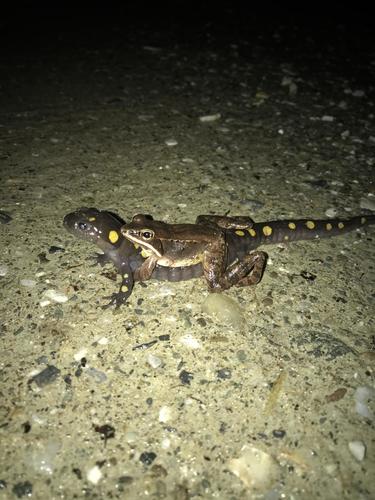
Lithobates sylvaticus or Rana sylvatica, commonly known as the wood frog, is a frog species that has a broad distribution over North America, extending from the boreal forest of the north to the southern Appalachians, with several notable disjunct populations including lowland eastern North Carolina. The wood frog has garnered attention from biologists because of its freeze tolerance, relatively great degree of terrestrialism, interesting habitat associations, and relatively long-range movements.
π Geographic range
The contiguous wood frog range is from northern Georgia and northeastern Canada in the east to Alaska and southern British Columbia in the west. It is the most widely distributed frog in Alaska. It is also found in the Medicine Bow National Forest.
π Feeding
, Minnesota]]
Wood frogs eat a variety of small, forest-floor invertebrates, with a diet primarily consisting of insects. The tadpoles are omnivorous, feeding on plant detritus and algae along with other tadpoles of their own and other species.
The feeding pattern of the wood frog is similar to that of other ranids. It is triggered by prey movement and consists of a bodily lunge that terminates with the mouth opening and an extension of the tongue onto the prey. The ranid tongue is attached to the floor of the mouth near the tip of the jaw, and when the mouth is closed, the tongue lies flat, extended posteriorly from its point of attachment.
In the feeding strike, the tongue is swung forward as though on a hinge, so some portion of the normally dorsal and posterior tongue surface makes contact with the prey. At this point in the feeding strike, the wood frog differs markedly from more aquatic Lithobates species, such as the green frog, leopard frog, and bullfrog. The wood frog makes contact with the prey with just the tip of its tongue, much like a toad. A more extensive amount of tongue surface is applied in the feeding strikes of these other frog species, with the result that usually the prey is engulfed by the fleshy tongue and considerable tongue surface contacts the surrounding substrate.
π Cold tolerance
]]
Similar to other northern frogs that enter dormancy close to the surface in soil and/or leaf litter, wood frogs can tolerate the freezing of their blood and other tissues. The wood frog has evolved various physiological adaptations that allow it to tolerate the freezing of 65β70% of its total body water. When water freezes, ice crystals form in cells and break up the structure, so that when the ice thaws the cells are damaged. Frozen frogs also need to endure the interruption of oxygen delivery to their tissues as well as strong dehydration and shrinkage of their cells when water is drawn out of cells to freeze. The wood frog has evolved traits that prevent their cells from being damaged when frozen and thawed out. The wood frog has developed various adaptations that allow it to effectively combat prolonged ischemia/anoxia and extreme cellular dehydration. One crucial mechanism utilized by the wood frog is the accumulation of high amounts of glucose that act as a cryoprotectant.
Frogs can survive many freeze/thaw events during winter if no more than about 65%-70% of the total body water freezes. Wood frogs have a series of seven amino acid substitutions in the sarco/endoplasmic reticulum Ca2+-ATPase 1 (SERCA 1) enzyme ATP binding site that allows this pump to function at lower temperatures relative to less cold-tolerant species (e.g. Lithobates clamitans). compared to those in more temperate zones of its range. These conspecifics also showed higher glycogen phosphorylase enzymatic activity, which facilitates their adaptation to freezing.
The phenomenon of cold resistance is observed in other anuran species. The Japanese tree frog shows even greater cold tolerance than the wood frog, surviving in temperatures as low as for up to 120 days.
π Reproduction
]]
L. sylvaticus primarily breeds in ephemeral pools rather than permanent water bodies such as ponds or lakes. Males actively search for mates by swimming around the pool and calling. Females, on the other hand, will stay under the water and rarely surface, most likely to avoid sexual harassment. A male approaches a female and clasps her from behind her forearms before hooking his thumbs together in a hold called "amplexus", which is continued until the female deposits the eggs. Another study has found increased tolerance to salt with higher concentrations, though the authors caution against over-extrapolating from short-term, high concentration studies to longer-term, lower concentration conditions, as contradictory outcomes occur.
Following metamorphosis, a small percentage (less than 20%) of juveniles will disperse, permanently leaving the vicinity of their natal pools. The majority of offspring are philopatric, returning to their natal pool to breed.
π Conservation status
Although the wood frog is not endangered or threatened, in many parts of its range, urbanization is fragmenting populations. Several studies have shown, under certain thresholds of forest cover loss or over certain thresholds of road density, wood frogs and other common amphibians begin to "drop out" of formerly occupied habitats. Another conservation concern is that wood frogs are primarily dependent on smaller, "geographically isolated" wetlands for breeding. At least in the United States, these wetlands are largely unprotected by federal law, leaving it up to states to tackle the problem of conserving pool-breeding amphibians.