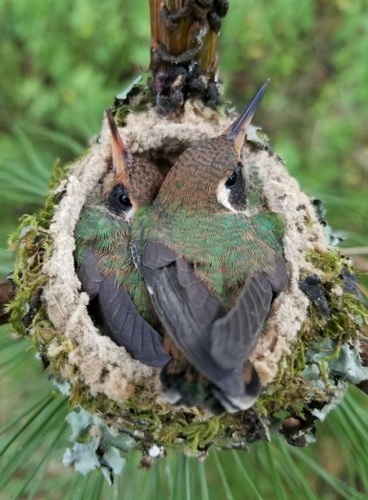
The white-eared hummingbird is a species of hummingbird in the "emeralds", tribe Trochilini of subfamily Trochilinae. It is found from the southwestern U.S. to Nicaragua.
📌 Taxonomy and systematics
The white-eared hummingbird was originally placed in genus Trochilus and then moved to Hylocharis. A study published in 2014 determined that both were in error and it was moved to Basilinna. The species has three subspecies, the nominate B. l. leucotis, B. l. borealis, and B. l. pygmaea.
📌 Distribution and habitat
The white-eared hummingbird's B. l. borealis subspecies occurs from southern Arizona into the Mexican states of Sonora, Chihuahua, and Tamaulipas. It is an occasional visitor to New Mexico and Texas and has occurred as a vagrant further north and east in the U.S. The nominate subspecies B. l. leucotis is found from central and southern Mexico into Guatemala. B. l. pygmaea is found in El Salvador, Honduras, and Nicaragua. The white-eared hummingbird is a species of montane regions where it inhabits the interior, clearings, and edges of pine, pine-oak, and pine-evergreen forest. In elevation it ranges between .
📌 Behavior
===Movement===
In most of its range the white-eared hummingbird is a year-round resident. It withdraws south from the U.S. and far northern Mexico after the breeding season, and the southernmost populations might make seasonal elevational movements.
📌 Feeding
The white-eared hummingbird forages for nectar at a very wide variety of flowering plants and shrubs, mainly feeding in the low to mid-levels of the vegetation. It defends feeding territories from others of its species, smaller species, and even somewhat larger species such as the broad-tailed hummingbird (Selasphorus platycercus). It also makes "secretive low approaches" to feed in the territories of significantly larger species like Rivoli's hummingbird (Eugenes fulgens). In addition to nectar, it also feeds on small insects.
📌 Breeding
The white-eared hummingbird's breeding seasons vary with latitude, from March to August in the north to October through December in El Salvador. Males court in leks where they sing and display for females. The nest is a cup made of plant down with lichens on the outside. It is typically placed up to above the ground in a tree or shrub, and several nests may be short distances apart. The female incubates the clutch of two eggs for 14 to 16 days and fledging occurs 23 to 28 days after hatch. The species occasionally raises two broods in a season.
📌 Vocalization
The white-eared hummingbird's song is "a tedious, metallic chipping chi'tink chi'tink chi'tink ..., or chi'dit chi'dit chi'dit ..., or simply tink tink." Its calls have been described as "fairly hard, dry chips, at times repeated steadily, [that] may break into short, quiet gurgles" and "a sharp metallic tchik or tink".
📌 Status
The IUCN has assessed the white-eared hummingbird as being of Least Concern. It has a very large range but its population size and trend are not known. No immediate threats have been identified. It is considered fairly common to common in most of its range. Because it uses forest edges, "it is less vulnerable [to habitat fragmentation] than are many other species of montane forests."