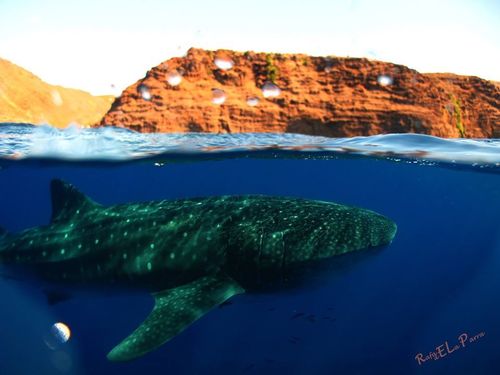
The whale shark is a slow-moving, filter-feeding carpet shark and the largest known extant fish species. The largest confirmed individual had a length of 18.8 m (61.7 ft). The whale shark holds many records for size in the animal kingdom, most notably being by far the most massive living non-cetacean animal. It is the only living species of the genus Rhincodon and the only extant member of the family Rhincodontidae, which belongs to the subclass Elasmobranchii in the class Chondrichthyes. Before 1984 it was classified as Rhiniodon into Rhinodontidae. An extinct species, Rhincodon ferriolensis was described in Europe, in Late Burdigalian stage.
🛡️ Conservation Status
endangered
en
📌 Evolution
The whale shark is one of the most ancient shark species still extant today, with the earliest fossil teeth known from the Late Oligocene of South Carolina, US. Their teeth become more geographically widespread from the Early Miocene onwards, where they are known from other parts of the eastern United States, southern France, and Costa Rica.
📌 Size
The whale shark is the largest non-cetacean animal in the world. However, the maximum size and growth patterns of the species are not well understood.
Various studies have aimed to estimate the growth and longevity of whale sharks, either by analyzing evidence from vertebral growth rings or measurements taken from re-sighted sharks over several years. This information is used to model growth curves, which can predict asymptotic length. The growth curves produced from these studies have estimated asymptotic lengths ranging from .
Most previous growth studies have had data predominately from males and none have data from sharks over ~. Not all previous studies created separate growth curves for males and females, instead combining data from both sexes. Those studies that made sex-specific growth curves have estimated large asymptotic length estimates for males, with lengths of or more. However, mostly immature males were available in these studies, with few adults to constrain the upper portion of the growth curves.
📌 Reports of large whale sharks
Since the 1800s, there have been accounts of very large whale sharks. Some of these are as follows:
In 1868, the Irish natural scientist Edward Perceval Wright obtained several small whale shark specimens in the Seychelles. Wright was informed of one whale shark that was measured as exceeding . Wright claimed to have observed specimens over and was told of specimens upwards of .
Hugh M. Smith described a huge animal caught in a bamboo fish trap in Thailand in 1919. The shark was too heavy to pull ashore, and no measurements were taken. Smith learned through independent sources that it was at least 10 wa (a Thai unit of length measuring between a person's outstretched arms). Smith noted that one wa could be interpreted as either or the approximate average of , based on the local fishermen. Later sources have stated this whale shark as approximately , but the accuracy of the estimate has been questioned.
Scott A. Eckert & Brent S. Stewart reported on satellite tracking of whale sharks from 1994 to 1996. Out of the 15 individuals tracked, two females were reported as measuring and . A long whale shark was reported as being stranded along the Ratnagiri coast in 1995. A female individual with a standard length of and an estimated total length at was reported from the Arabian Sea in 2001. In a 2015 study reviewing the size of marine megafauna, McClain and colleagues considered this female as being the most reliable and accurately measured.
File:Rhincodon typus jaws.jpg|Jaws
File:Rhincodon typus teeth.jpg|Teeth
File:Oeil et spiracle requin-baleine.JPG|Eye
File:Journal.pone.0235342.g001--B-Crop-Extract.jpg| Close up showing eyeball denticles
File:Walhai 3.jpg|Top of head
📌 Distribution and habitat
The whale shark inhabits all tropical and warm-temperate seas. The fish is primarily pelagic, and can be found in both coastal and oceanic habitats.
The whale shark is migratory Taiwan, southern China
In 2009, more than 400 whale sharks gathered off the Yucatan Coast. It was one of the largest gatherings of whale sharks recorded. Aggregations in that area are among the most reliable seasonal gatherings known for whale sharks, with large numbers occurring in most years between May and September. Associated ecotourism has grown rapidly to unsustainable levels.
📌 Growth and reproduction
Growth, longevity, and reproduction of the whale shark are poorly understood.
Vertebral growth bands have been used to estimate the age, growth, and longevity of whale sharks. However, there was uncertainty as to whether vertebrae growth bands are formed annually or biannually. Mating in this species was filmed for the first time in whale sharks off Ningaloo Reef via airplane in Australia in 2019, when a larger male unsuccessfully attempted to mate with a smaller, immature female.
The capture of a ~ female in July 1996 that was pregnant with ~300 pups indicated that whale sharks are ovoviviparous. The eggs remain in the body and the females give birth to live young which are long. Evidence indicates the pups are not all born at once, but rather the female retains sperm from one mating and produces a steady stream of pups over a prolonged period.
On 7 March 2009, marine scientists in the Philippines discovered what is believed to be the smallest living specimen of the whale shark. The young shark, measuring only , was found with its tail tied to a stake at a beach in Pilar, Sorsogon, Philippines, and was released into the wild. Based on this discovery, some scientists no longer believe this area is just a feeding ground; this site may be a birthing ground, as well. Both young whale sharks and pregnant females have been seen in the waters of St Helena in the South Atlantic Ocean, where numerous whale sharks can be spotted during the summer.
In a report from Rappler last August 2019, whale sharks were sighted during WWF Philippines' photo identification activities in the first half of the year. There were a total 168 sightings – 64 of them "re-sightings" or reappearances of previously recorded whale sharks. WWF noted that "very young whale shark juveniles" were identified among the 168 individuals spotted in the first half of 2019. Their presence suggests that the Ticao Pass may be a pupping ground for whale sharks, further increasing the ecological significance of the area.
Large adult females, often pregnant, are a seasonal presence around the Galapagos Islands, which may have reproductive significance. One study between 2011 and 2013 found that 91.5% of the whale sharks observed around Darwin Island were adult females.
📌 Relationship with humans
===Behavior toward divers===
, whale sharks are fed shrimp to return every morning for tourists and divers.]]
Despite their great size, whale sharks pose no danger to humans. Younger whale sharks are gentle and can play with divers. Underwater photographers such as Fiona Ayerst have photographed them swimming close to humans without any danger. Although whale sharks are docile fish, touching or riding the sharks is strictly forbidden and fineable in most countries, as it can cause serious harm to the animal.
The shark is seen by divers in many places, including the Bay Islands in Honduras, Thailand, Indonesia (Bone Bolango, Cendrawasih Bay), the Philippines, the Maldives close to Maamigili (South Ari Atoll), the Red Sea, Western Australia (Ningaloo Reef, Christmas Island), Taiwan, Panama (Coiba Island), Belize, Tofo Beach in Mozambique, Sodwana Bay (Greater St. Lucia Wetland Park) in South Africa, Juveniles can be found near the shore in the Gulf of Tadjoura, near Djibouti, in the Horn of Africa.
📌 Conservation status
Estimating the exact number of whale sharks globally is challenging due to their migratory nature and the vastness of their habitat. Current estimates suggest that approximately 130,000 to 200,000 whale sharks inhabit the world's oceans. However, these numbers are declining. Over the past 75 years, the global whale shark population has decreased by about 50%, with declines of approximately 63% in the Indian and Pacific Oceans and over 30% in the Atlantic Ocean. This decline is attributed to threats such as fishing bycatch, vessel strikes, and pollution. Consequently, the International Union for Conservation of Nature (IUCN) has listed the whale shark as an endangered species. In June 2018 the New Zealand Department of Conservation classified the whale shark as "Migrant" with the qualifier "Secure Overseas" under the New Zealand Threat Classification System.
It is listed, along with six other species of sharks, under the CMS Memorandum of Understanding on the Conservation of Migratory Sharks. In 1998, the Philippines banned all fishing, selling, importing, and exporting of whale sharks for commercial purposes, followed by India in May 2001 and Taiwan in May 2007.
In 2010, the Gulf of Mexico oil spill resulted in of oil flowing into an area south of the Mississippi River Delta, where one-third of all whale shark sightings in the northern part of the gulf have occurred in recent years. Sightings confirmed that the whale sharks were unable to avoid the oil slick, which was situated on the surface of the sea where the whale sharks feed for several hours at a time. No dead whale sharks were found.
This species was also added to Appendix II of the Convention on International Trade in Endangered Species of Wild Fauna and Flora (CITES) in 2003 to regulate the international trade of live specimens and its parts.
It was reported in 2014 that hundreds of whale sharks were illegally killed every year in China for their fins, skins, and oil.
📌 In captivity
|alt=Aquarium photograph of a whale shark in profile with human-shaped shadows in foreground]]
The whale shark is popular in the few public aquariums that keep it, but its large size means that a very large tank is required and it has specialized feeding requirements. Their large size and iconic status have also fueled an opposition to keeping the species in captivity, especially after the early death of some whale sharks in captivity and certain aquariums keeping the species in relatively small tanks.
, Japan]]
The first attempt at keeping whale sharks in captivity was in 1934 when an individual was kept for about four months in a netted-off natural bay in Izu, Japan. The first attempt of keeping whale sharks in an aquarium was initiated in 1980 by the Okinawa Churaumi Aquarium (then known as Okinawa Ocean Expo Aquarium) in Japan.
Since the mid-1990s, several other aquariums have kept the species in Japan (Kagoshima Aquarium, Kinosaki Marine World, Notojima Aquarium, Oita Marine Palace Aquarium, and Yokohama Hakkeijima Sea Paradise), South Korea (Aqua Planet Jeju), China (Chimelong Ocean Kingdom, Dalian Aquarium, Guangzhou Aquarium in Guangzhou Zoo, Qingdao Polar Ocean World and Yantai Aquarium), Taiwan (National Museum of Marine Biology and Aquarium), India (Thiruvananthapuram Aquarium) and Dubai (Atlantis, The Palm), with some maintaining whale sharks for years and others only for a very short period. Marine Life Park in Singapore had planned on keeping whale sharks but scrapped this idea in 2009.
Outside Asia, the first and so far only place to keep whale sharks is Georgia Aquarium in Atlanta, United States. Two earlier males at Georgia Aquarium, Ralph and Norton, both died in 2007. Taiwan closed this fishery entirely in 2008.
📌 Human culture
In Madagascar, whale sharks are called in Malagasy, meaning "many stars", after the appearance of the markings on the shark's back.
In the Philippines, it is called and . The whale shark is featured on the reverse of the Philippine 100-peso bill. By law snorkelers must maintain a distance of from the sharks and there is a fine and possible prison sentence for anyone who touches the animals.
Whale sharks are also known as in Japan (because the markings resemble patterns typically seen on ); (roughly "star from the East") in Indonesia; and (literally "sir fish") in Vietnam.
The whale shark is also featured on the latest 2015–2017 edition of the Maldivian 1000 rufiyaa banknote, along with the green turtle.
📌 Whale shark experts
* Simon J Pierce
* Alistair Dove