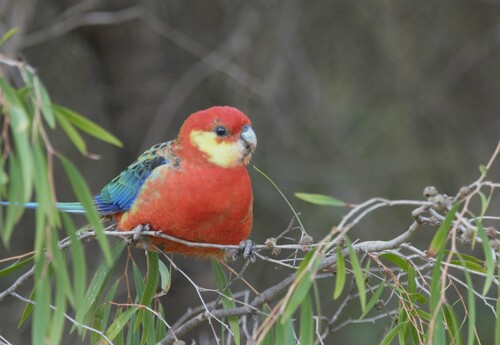
The western rosella, or moyadong, is a species of parrot endemic to southwestern Australia. The head and underparts are bright red, and the back is mottled black; a yellow patch at the cheek distinguishes it from others of the genus Platycercus. Adults of the species exhibit sexual dimorphism with the females duller overall; juveniles lack the striking colours of mature birds and the characteristic patterning is not as easily distinguished. Their communication call is a softly delivered pink-pink sound, and much of their behaviour is comparatively unobtrusive. Their habitat is in eucalypt forests and woodlands, where they often remain unobserved until they appear to feed on seeds at nearby cleared areas.
📌 Taxonomy
The first description of the species was published by C. J. Temminck and Heinrich Kuhl in 1820 as Psittacus icterotis, using a collection obtained at King George Sound (Albany, Western Australia). Kuhl was once mistakenly given sole authorship for the description; this was later corrected to include Temminck; The names of Moore and other authors were reviewed and published in Serventy and Whittell Birds of Western Australia (1948, & eds.), those recorded at "Perth", Good-un-goodt-un, Guddanang-uddan and Guldanguldan, and at "Avon River", Moy-a-duk and Moyadong, the second location referring to the district at Avon River. A recommended orthography and pronunciation list (Abbott, 2009) of Nyungar avian nomenclature, with broad cultural consultation, has proposed moyadong [moy’a’dawng] and kootonkooton [koot’awn’koot’awn] be adopted to complement the systematic nomenclature.
📌 Vocalisations
The regular vocalisation is a rapid series of melodious notes delivered at a low volume.
The vocalisation of sister species of other regions is notably louder and more frequently heard in raucous exchanges with other individuals or species.
The transliterations of the soft and musical sounds include ching-ching-ching (Morcombe, et al), chink-chink (Serventy, Simpson) and pink-pink (Johnstone, et al), although they more often remain quiet and unheard. Gould (1848) reported the whistling of the notes as a feeble, piping sound and the rich variation in the series might be regarded "as almost to assume the character of a song". Other sources identify two vocalisations, a resonant and high frequency quink, quink, quink, quink and the softer voiced call of whip-a-whee.
The contact call is similar to, although louder than the mulga parrot (Psephotellus varius).
📌 Distribution and habitat
The western rosella is endemic to the southwest of Australia, isolated from sister species of the north and east of the country. Moderately common, it is usually sedentary, frequenting forest and many other types of wooded country or kwongan. It also occurs in farmland or at other feeding opportunities, and is most often observed at sites cleared of vegetation. The captive occurrence in Australia and several other continents began before 1830 in England.
, first depiction of the species by Edward Lear, November to December 1830, entitled "Platycercus Stanleyii / Stanley Parrakeet", named for the patron Lord Stanley]]
The two subspecies are geographically adjacent—P. icterotis xanthogenys at the wheatbelt region, inland to the north and east of the range and P. icterotis icterotis occurring at coastal areas in the south and west. The inland boundary of the species' range extends from the area between the lower part of the Swan River and the Arrowsmith River at the western coast. From there it passes to the east and south before Southern Cross, the Fraser Range, Esperance, Stirling Ranges and Kojonup. The line of demarcation between the inland and coastal subspecies begins east of King George Sound and lies to the northwest via Mount Barker and the Kojonup region toward the Bannister River.
The species is less common on the Swan Coastal Plain than in southern areas of the wheatbelt, where it is more frequently observed around Narrogin and Katanning at remnant wandoo woodland, They occur throughout the conservation area at Dryandra Woodland. Authors came to express doubts on the status of the subspecies, and compiled observations show no geographical separation.
The historical records of the species indicate it relatively uncommon, although it has been noted more often in southern regions. The northernmost extent of the distribution range is near Moora, with records extending toward the east around Norseman. The population of the species has declined significantly since colonisation, especially the inland P. icterotis xenogenys after the 1970s. It became locally extinct in shires where it had previously been recorded, these include: Coorow, Dandaragan, Moora, Dalwallinu, Merredin, Quairading, Serpentine-Jarrahdale and the Shire of Murray. Population declines have also been recorded in the shires of Swan, Kalamunda, Northam, York, Armadale-Kelmscott, Capel and Dumbleyung. This disappearance at northern and eastern parts of the Wheatbelt is the result of habitat removal, and no shires show an increase in records. The adaptation to introduced agricultural crops has been comparatively limited when contrasted with the range of seeds harvested by ringnecks Barnardius zonarius and others species. This is likely to have restricted their success in migration to or re-population of greatly altered landscapes. The suggested movement after breeding toward the coast during the austral summer, from areas in the north of the range, lacked evidence of large-scale seasonal movement in occurrence data,
The distribution of P. icterotis icterotis is restricted to humid and subhumid regions, an area south of Dandaragan and lower reaches of the Moore River, and to the west of: Wannamal, Muchea, Mundaring, Jarrahdale, Marrinup, Collie, Boyup Brook, Hay River (upper), and from the ranges of Porongurups and Green Range. Records for P. icterotis xanthogenys are from the southern interior of Western Australia, semiarid climatic zones, that formerly included Wongan Hills and occurrences at: Kununoppin, Moorine Rock, Parker Range, Yardina Rock and Ten Mile Rocks. The range extends to the west at: Toodyay, Dale River, Mt Saddleback and Kojonup and north of the Stirling Range, Fitzgerald River (lower), Ravensthorpe, Frank Hann National Park and Red Lake. The occurrence farther north is termed casual, the locations are: Mt Jackson, Karalee and Gnarlbine Rock.
A significant change in abundance was noted at Grass Patch, where it was common in the mid-20th century and reappeared after a fifteen-year absence in later decades. The erroneous locations reported by Mathews, Point Cloates and Shark Bay, were later admitted to have been incorrect by the author; he also identifies the obvious error in Gould's protologue (1837) in extending the range from King George Sound to "… New South Wales. etc.". The species was later reported by Gould (1848) as only known at the Swan River Colony, a location where it is now uncommon.
They favour woodland habitat with sheoak (Allocasuarina), wurak (Eucalyptus salmonophloia) and wandoo (Eucalyptus wandoo, et al), but have sometimes flourished at areas cleared for introduced grain crops in the region's Wheatbelt. They also appear at other cleared areas adjoining bushland, such as roadsides, golf courses and reserves, to harvest grasses or weeds. The subspecies occur in differing types of vegetation, living in communities associated with their woody upper-storey plants. The coastal subspecies P. icterotis icterotis is seen amongst the eucalypts and paperbarks of the high rainfall area from Jurien to Green Range, east of Manypeaks, namely marri (Corymbia calophylla), karri (Eucalyptus diversicolor), moitch (E. rudis) and the paperbark (Melaleuca). They are known to feed on the fruit of Bossiaea linophylla and Leucopogon obovatus, the flowers of marris and fleshy part of the seed of Macrozamia riedlei. The subspecies feeds both on the ground and in trees.
The wooded scrub of the lower rainfall inland region inhabited by P. icterotis xanthogenys is generalised as eucalypt and sheoak, the trees moitch, wandoo (Eucalyptus wandoo), wurak and in tall mallee country or the habitat at the rock, or sighing, sheoak (Allocasuarina huegeliana). This subspecies feeds at seeding wandoo, Acacia huegeliana, Glischrocaryon flavescens and Olearia revoluta and flowering Eucalyptus eremophila and Melaleuca acuminata.
📌 Behaviour
The western rosella usually socialises in pairs, but congregates in groups of twenty or so to forage when the season or opportunity permits; numbers in a flock are occasionally recorded up to twenty-six. The birds are discreet in their behaviours—more so than other rosellas—and will remain unobserved when feeding on the ground beneath the understory of a woodland or sheltering during the day in the dense foliage of trees. The usual tendency of individuals is to remain sedentary, although birds may venture out to abundant sources of seed. Individuals feeding in the open are not usually disturbed by human presence and can be approached quite closely. They appear to move with ease as they walk, and in their undulating flight, when the wing is drawn to their side. Their flight is more 'buoyant' than the laden efforts of the other larger species of the genus.
📌 Breeding
The breeding habits of the western rosella have not been well-studied; females enter nesting hollows from July, with males doing so from mid-August. Eggs are laid from late August to late September and hatch late September to late October. Young birds fledge (leave the nest) late October to mid-November. The group in a study at Wickepin and Dudinin (Kulin Shire) was observed to begin occupancy of nest sites in July, the routine of the female being fed by the male being established in the week before laying the brood. The nest site is typically a spout shaped entrance, between in width, at a hollow between in depth leading to a green limb.
One brood is usually reared per breeding season, though often two are in captivity. The clutch size is between two and seven (rarely nine) eggs, with the average being around six. The shell has a slight gloss, and the shape is elliptical. The average size of eggs is . Measurements from a sample of 29 eggs gave a size range of × . Only the female incubates the eggs, leaving the nest in the morning and afternoon to eat food found by the male. The male remains close to the site, feeding at ground level and moving to an upper branch to call when catering to the brooding female.
The young emerge from the egg after an incubation period of 23 to 25 days, and leave the nest approximately five weeks after that. The nestlings have yellowish bills and display down at the rear that is pale grey, after they emerge from their egg. The success rate of egg numbers surviving to become independent individuals, while assumed to be seasonally variable, was measured in one survey to be 72%.
📌 Feeding
The diet consists primarily of seeds, often those of introduced weeds and crops, although typically from eucalypt, sheoak and other native plants of the wooded environment. This is supplemented with nectar and insects especially during the breeding and feeding of young. The harvesting of introduced species includes the capeweed (Arctotheca calendula), thistles (Carduus spp.), flatweed (Hypochaeris spp.) and the subterranean clover (Trifolium subterraneum). Nectar, insects and their larvae, and fruit are also eaten, especially during the breeding season.
They exhibit little caution in rural areas, gleaning seeds at paddocks after harvests or inside buildings and animal pens. The habit of visiting colonial farmland for seed and soft fruit, and lack of concern at human presence, was first reported by Gould in the years immediately following the region's settlement by the English. Tom Carter later extended this familiarity of the species to its casual entrance into buildings in search of food. A 1984 study of three parrots of the Southwest, all of which were observed to feed mainly on seed and fruit of introduced species, noted that the impact on soft fruit crops was less than red-capped parrot and Port Lincoln Barnardius zonarius parrot species. The damage to crops is regarded as minimal, appearing to eat fruit in orchards already damaged by those parrots and mainly gleaning for seed when feeding near protea flower crops.
📌 Conservation status
For the perceived impact on agriculture, the species had been declared vermin by the Western Australian state in 1921. The western rosella remained a declared agricultural pest until 1998, when it was instead declared to be a 'protected native species' and its destruction was prohibited. The state's governmental response was to warn of prosecution and issue general advice and licensing for the use of non-lethal firearms and netting over trees for deterrence; licenses for the extermination of the species were available on application in 2009. The conservation status of the species is as protected fauna, and of the inland subspecies is one of "likely to become extinct". The 2013 assessment by the International Union for Conservation of Nature (IUCN) on their IUCN redlist assigns a status of species of least concern. It notes the species has become less common and locally extinct and the population trend is declining due to removal of habitat.
P. icterotis was used in a comparative study of tolerance in some Australian birds to sodium fluoroacetate, a highly toxic substance that occurs in plants of the southwest and commercially branded as "1080", to evaluate their sensitivity against the exposure and mobility of other species. This species and the red-capped parrot—both endemic—express a high tolerance of the potentially lethal salt.
📌 Captivity
[[File:Lear plate 24 Platycercus stanleyii juv.jpg|thumb|Plate 24 of Lear's Illustrations (1830), depicting a captive specimen in England.