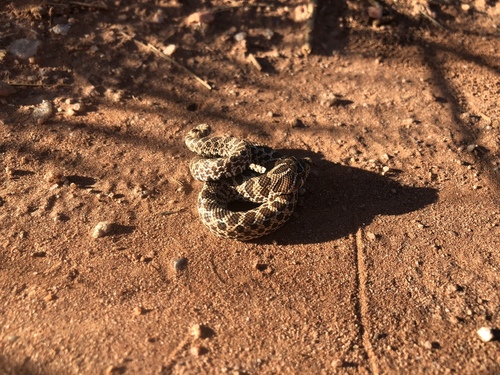
The western hognose snake is a species of snake in the family Colubridae. The species is endemic to North America. There are three subspecies that are recognized as being valid, including the nominotypical subspecies.
π Etymology
The specific name, nasicus, is derived from the Latin nasus ("nose"), a reference to the snake's upturned snout.
The dusky hognose's subspecific name, gloydi, is in honor of American herpetologist Howard K. Gloyd (1902β1978).
The Mexican hognose's subspecific (or specific) name, kennerlyi, is in honor of American naturalist Caleb Burwell Rowan Kennerly.
π Common names
Common names for Heterodon nasicus include blow snake, bluffer, plains hognose snake, prairie hognose snake, spoonbill snake, spreadhead snake, Texas hognose snake, Texas rooter, and western hognose snake.
π Taxonomy
Some authors elevate the subspecies Heterodon nasicus kennerlyi, also known as the Mexican hognose snake, to species level. Those same authors have subsumed H. n. gloydi into H. nasicus so that there are only two species (H. nasicus and H. kennerlyi) and no subspecies.
π Distribution and habitat
The western hognose snake occurs from southern Canada throughout the United States to northern Mexico. It frequents areas with sandy or gravelly soils, including prairies, river floodplains, scrub and grasslands, semi-deserts, and some semiagricultural areas. It has been found at elevations of up to .
π Ecology
===Behavior===
The western hognose snake is primarily diurnal. It is typically a docile snake (though known to be highly defensive in some individuals). If threatened (or perceiving a threat), it may flatten its neck (much like a cobra), hiss, and make 'mock' or 'bluff' strikes if harassed, which are strikes made at an intruder but with the snakes' mouth closed. Subsequently, even when further harassed, western hognose snakes virtually never bite as a self defense mechanism, but will instead usually resort to playing dead.
Although it is more common that it will flatten its head, some individuals may puff up, filling the throat with air. This is more common with adolescent males.
π Reproduction
Adult western hognose snakes have been observed in copulation as early as February and March. The species is oviparous, with females laying 4β23 elongate, thin-shelled eggs in JuneβAugust. The eggs take approximately 60 days to hatch. Each hatchling is in total length, and reaches sexual maturity after approximately two years (this is predominantly based on size, not so much age).
π Subspecies
{|cellspacing=0 cellpadding=2 border=1 style="border-collapse: collapse;"
!bgcolor="#f0f0f0"|Subspecies
!bgcolor="#f0f0f0"|Authority
|-
|H. n. gloydi
|Edgren, 1952
|Gloyd's hog-nosed snake
|style="width:40%"|United States: southeastern Kansas and southeastern Missouri, eastern Oklahoma and all of Texas excluding the panhandle, the Trans-Pecos and the extreme southern Rio Grande Valley.
|-
|H. n. kennerlyi
|Kennicott, 1860
|Mexican hog-nosed snake
|Mexico from Tamaulipas and central San Luis PotosΓ, north and west along the Sierra Madre Occidental, entering the United States in the extreme southern Rio Grande Valley, the Trans-Pecos, southwestern New Mexico and southeastern Arizona.
|-
|H. n. nasicus
|Baird & Girard, 1852
|Plains hog-nosed snake
|The Texas panhandle and adjacent New Mexico, north through western Oklahoma and Kansas to southwestern Manitoba and southeastern Saskatchewan in Canada. Also occurs in prairie regions of Minnesota and prairie relicts of Illinois.
|-
|}
π Conservation
Although some local declines have been reported, the species Heterodon nasicus is widespread, has a large overall population size (> 100,000), and is effectively protected by a variety of conservation programs. It is therefore currently classified as Least Concern by the IUCN. The eastern hognose snake (Heterodon platirhinos) is classified as a threatened species in some regions of its range and is therefore protected under those states' laws.