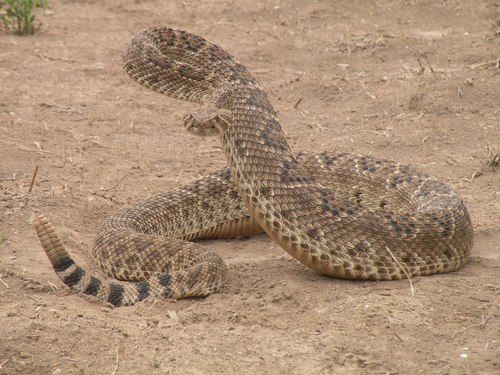
The western diamondback rattlesnake or western diamond-backed rattlesnake, is a rattlesnake species and member of the viper family, found in the southwestern United States and Mexico. Like all other rattlesnakes and all other vipers, it is venomous. It is likely responsible for the majority of snakebite fatalities in northern Mexico and the greatest number of snakebites in the U.S. No subspecies are currently recognized.
📌 Common names
Other common names for this species include western diamond-backed rattlesnake, adobe snake, Arizona diamond rattlesnake, coon tail, desert diamond-back, desert diamond rattlesnake, sand tail, fierce rattlesnake, spitting rattlesnake, buzz tail, Texan rattlesnake, Texas diamond-back, Texas bark and Texas rattler.
📌 Distribution
===Geographic range===
It is found in the United States from central Arkansas to southeastern and Central California, south into Mexico as far as northern Sinaloa, Hidalgo and northern Veracruz. Disjunct populations exist in southern Veracruz and southeastern Oaxaca. The type locality given is "Indianola" (Indianola, Calhoun County, Texas).
In the United States, it occurs in central and western Arkansas, Oklahoma excluding the northeast, north-central region and the panhandle, Texas excluding the northern panhandle and the east, southern and central New Mexico and Arizona, extreme southern Nevada, and in southeastern California on either side of the Chocolate Mountains. Records from extreme southern Kansas (Cowley and Sumner Counties) may be based on a natural occurrence of the species, while multiple records from near Kanopolis Reservoir in Ellsworth County seem to indicate a viable (although isolated) population.
This species has also been reported on a number of islands in the Gulf of California, including San Pedro Mártir, Santa María (Sinaloa), Tíburon and the Turner Islands. The Tortuga Island diamond rattlesnake is also a subspecies.
📌 Behavior
C. atrox is solitary except during the mating season, when males of the species are single-minded and aggressive in pursuing females. Usually inactive between late October and early March, these ectotherms occasionally may be seen basking in the sun on warm winter days. In the winter, they hibernate or brumate in caves or burrows, sometimes with many other species of snakes. Active, alert, and large (most adults are between four and a half and five feet long), the western diamondback can administer a large amount of venom in its bite; it is not inclined to give ground when confronted.
Among rattlesnakes, C. atrox may be the most adaptable to semi-urban transitional habitat. In developing areas where they are common, such as the Phoenix and Tucson metro areas in Arizona, the western diamondback rattlesnake can be found thriving deep within developed areas, and encountered by homeowners more often as a result.
📌 Prey
, in Mexico]]
A comprehensive study by Beavers (1976) on the prey of C. atrox in Texas showed, by weight, 94.8% of their prey consisted of small mammals.
Birds, lizards, amphibians, fish, invertebrates, and mice are also preyed upon, with lizards mostly being eaten by young snakes. Avian prey include mockingbirds (Mimidae), quail, a nearly full-grown Gambel's quail, a burrowing owl (Athene cunicularia),
A key participant in the food chain, it is an important predator of many small rodents, rabbits, and birds. In turn, it is preyed upon by a variety of larger mammals and birds, such as coyotes, foxes, hawks, and owls. Crotalus atrox can be active at any time of the day or night when conditions are favorable. It is primarily diurnal and crepuscular in spring and fall and becomes primarily nocturnal and crepuscular during the hot summer months. It is also an intermediate host of an intestinal acanthocephalan parasitic worm, Pachysentis canicola.
They are one of the few species of snakes that engage in scavenging behavior.
📌 Venom
Like that of most other American pit vipers, the venom contains proteolytic enzymes. Proteolytic venoms are concentrated secretions that destroy structural tissues and proteins via catabolism, which help in disabling prey. The venom of C. atrox is primarily hemotoxic, affecting mainly the blood vessels, blood cells and the heart. The venom contains hemorrhagic components called zinc metalloproteinases. The venom also contains cytotoxins and myotoxins which destroy cells and muscles, adding to the damage to the cardiovascular system. In addition to hemorrhage, venom metalloproteinases induce myonecrosis (skeletal muscle damage), which seems to be secondary to the ischemia that ensues in muscle tissue as a consequence of bleeding and reduced perfusion. Microvascular disruption by metalloproteinases also impairs skeletal muscle regeneration, being thereby responsible for fibrosis and permanent tissue loss. General local effects include pain, heavy internal bleeding, severe swelling, severe muscle damage, bruising, blistering, and necrosis; systemic effects are variable and not specific, but may include headache, nausea, vomiting, abdominal pain, diarrhea, dizziness, and convulsions. Bleeding caused by hemorrhagins is a major clinical effect that can be fatal.
This species has values of 2.72 mg/kg intravenous, 20 mg/kg intramuscular and 18.5 mg/kg subcutaneous, which is far less toxic than many other rattlesnakes. However, because of its large venom glands and specialized fangs, the western diamondback rattlesnake can deliver a large amount of venom in a single bite. The average venom yield per bite is usually between 250 and 350 mg, with a maximum of 700–800 mg. Severe envenomation is rare but possible, and can be lethal. Mortality rate of untreated bites is between 10 and 20%.
📌 Reproduction
s called hemipenes, used for reproduction]]
Rattlesnakes, including C. atrox, are viviparous. Gestation lasts six or seven months, and broods average about a dozen young. However, the young stay with the mother for only a few hours before they set off on their own to hunt and find cover, so that the mortality rate is very high. Mating occurs in the fall, and the females give birth to as many as 25 young, which may be as long as . The young can deliver a venomous bite from the moment they are born.
📌 Conservation status
This species is classified as Least Concern on the IUCN Red List (v3.1, 2001).
They are also heavily collected from the wild, frequently being drawn out of their hiding places with gasoline and used in rattlesnake roundups, where they are killed for food, skins and entertainment.
This Western diamondback rattlesnake may be the most common rattlesnake species found in homes and in direct conflict with human development in the American Southwest, particularly in the rapidly expanding metro areas of Phoenix and Tucson. Relocation of animals is seen as a sometimes controversial management solution.