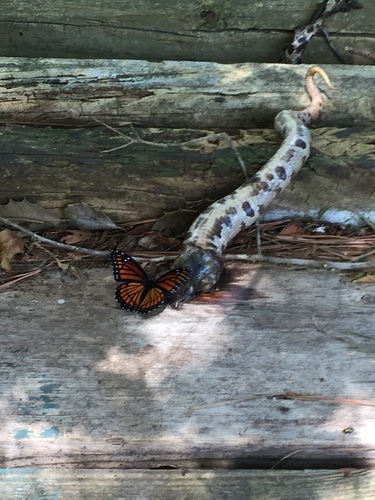
The viceroy is a North American butterfly. It was long thought to be a Batesian mimic of the monarch butterfly, but since the viceroy is also distasteful to predators, it is now considered a Müllerian mimic instead.
📌 Distribution and habitat
The viceroy ranges through most of the contiguous United States as well as parts of Canada and Mexico. The westernmost portion of its range extends from the Northwest Territories along the eastern edges of the Cascade Range and Sierra Nevada mountains, southward into central Mexico. Its easternmost range extends along the Atlantic and Gulf coasts of North America from Nova Scotia into Texas. It has been possibly extirpated from California.
📌 Life stages
File:Viceroy 2.jpg|Adult
File:Limenitis archippus larva.jpg|Caterpillar
File:Limenitis archippus pupa.jpg|Pupa
📌 Evolution of admiral butterflies (''Limenitis'')
Limenitis butterfly wing patterns are much more diverse in the Nearctic realm (North America) than in the Palearctic (Eurasia and North Africa). Three lineages of mimetic butterflies occur in North America and the evolution of mimicry may have played a large role in the diversification of this group. For butterflies to travel from the Palearctic region to the Nearctic region of the world, the migration must have occurred during a time period when Beringia, the land bridge between Eurasia and North America, was still above water. Based on crude divergence rate calculations, the colonization of the Nearctic Leminitis dates back approximately four million years. established itself in North America and resulted in several major lineages, three of which involved mimicry independently of each other. Given the present monophyly of the Nearctic species, it is likely that a single migration and subsequent expansion of the population was the foundation of the Nearctic butterflies.
📌 Predators and avoidance
Color warnings in viceroy butterflies have been shaped by natural selection in an evolutionary relationship between prey and predator. The viceroy's main predators – like many other butterflies – consist mostly of birds.
📌 Batesian mimicry
The viceroy's wing color ranges from tawny orange (resembling monarchs) in the north to dark mahogany (resembling queens) in the south. It has been argued that selective pressures from predators have given rise to "model switching" In addition, when given the choice between a mimic and non-mimic after being exposed to an unpalatable model, avian predators never ate the viceroy mimic.
]]
📌 The Müllerian mimicry dispute
Research has argued that the viceroy may be unpalatable to avian predators. If that is the case, then the viceroy butterfly displays Müllerian mimicry, and both viceroy and monarch are co-mimics of each other.
Some literature suggests that the queen-viceroy may not be a good model-mimic pair for Batesian mimicry. Experimental evidence has shown that avian predators express aversion to the queen butterfly after being exposed to viceroys. That the avian predators avoided the queen butterfly implies that the queen does not serve as a model and the viceroy as a parasitic mimic; rather, they may be Müllerian co-mimics.
When avian predators were exposed to butterfly abdomina without the wings, many avian predators rejected the viceroy after a single peck. Furthermore, they exhibited distress behavior similar to that displayed when eating other, known, unpalatable species.
When palatability was measured by looking at avian responses to butterfly abdomen, it was found that the viceroy butterfly was significantly more unpalatable than the queen. The queen-viceroy relationship is too asymmetrical for them to be considered real co-mimics of each other. Instead, mathematical models have suggested that the queen enjoys the benefits of mimicry at the viceroy's expense, and that the model-mimic dynamic between the two should be switched.
In light of this new interpretation, it has been speculated that different food plants in different geographical locations influence the palatability of the viceroy. Further investigation is needed to clarify the relationship between the viceroy and its purported models.
📌 Evolution of viceroy mimicry
Based on phylogenic evidence, it is known that mimicry in the North American admirals was a driver of speciation. An essential condition for the evolution of mimicry was the presence and abundance of unpalatable models. Mimetic evolution also involved direct selection with the model acting as a "starting block" for the mimic to evolve against. The drive behind this type of evolution must be predation. Eventually, the mimetic population undergoes phenotypic fixation, usually at a point where the wing pattern and colors of the mimic have reached the closest superficial resemblance of its model.
A fascinating feature of pattern genetics is that the dramatic phenotypic changes are primarily due to small changes in the gene that determines the sizes and positions of pattern elements. Different genomic rearrangements have tightened the genetic linkage between different color and pattern loci with complete suppression of recombination in experimental crosses in a 400,000 base section containing at least 18 genes. This single supergene locus controls differences in a complex phenotype like wing coloration that can involve modifications of wing pattern, shape, and body color. Mimetic patterns have high fitness correlated to locally abundant wing patterns and low fitness when the offspring have recombinant, non-mimetic phenotypes. This tight-linked area of wing pattern genes explains how mimetic phenotypes are not broken up during recombination during sexual reproduction.
📌 Polymorphism
Viceroys display geographic color polymorphism, which occurs when the viceroy butterflies are observed having different color forms in different regions of their territory. Color polymorphism is hypothesized to be affected by interaction between the viceroy, monarch and queen's overlapping environments. In the northern areas of their region, where monarchs predominate, viceroys are lighter, while in southern Florida, they are darker due to queens being more abundant than monarchs.