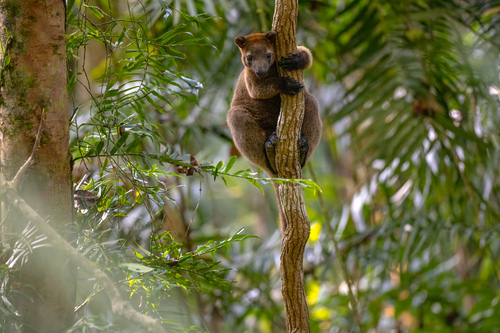
Tree-kangaroos are marsupials of the genus Dendrolagus, adapted for arboreal locomotion. They inhabit the tropical rainforests of New Guinea and far northeastern Queensland, Australia along with some of the islands in the region. Most species of tree-kangaroo are considered threatened due to hunting and habitat destruction. They are the only true arboreal macropods.
π‘οΈ Conservation Status
near threatened
nt
π Evolutionary history
The evolutionary history of tree-kangaroos possibly begins with a rainforest floor-dwelling pademelon-like ancestor. which forced the ancestral pademelons to begin living in a drier, rockier environment. After some generations of adaptation to the new environment, the pademelons may have evolved into rock-wallabies (Petrogale spp.), This generalist strategy allowed the rock-wallabies to easily adapt to Malesian rainforest types that were introduced to Australia from Asia during the mid-Miocene. Global cooling during the Pleistocene caused continent-wide drying and rainforest retractions in Australia and New Guinea.
The rainforest contractions isolated populations of Bohra which resulted in the evolution of today's tree-kangaroos (Dendrolagus spp.), as they adapted to lifestyles in geographically small and diverse rainforest fragments, and became further specialized for a canopy-dwelling lifestyle.
π Taxonomy
===Species===
These species are assigned to the genus Dendrolagus:||
|-
|}
Seri's tree-kangaroo (Dendrolagus stellarum) has been described as a subspecies of Doria's tree-kangaroo (D. dorianus stellarum), but some recent authorities have treated it as a separate species based on its absolute diagnostability.
The Wondiwoi tree-kangaroo is among the 25 "most wanted lost" species that are the focus of Global Wildlife Conservation's "Search for Lost Species" initiative.
The extinct species D. noibano from the Pleistocene of Chimbu Province, Papua New Guinea is substantially larger than living species. However, it has since been suggested to be a larger extinct form of Doria's tree-kangaroo.
The case for the golden-mantled tree-kangaroo (D. pulcherrimus) is comparable to that of D. stellarum; it was first described as a subspecies of D. goodfellowi,
π Distribution and habitat
Tree-kangaroos inhabit the tropical rainforests of New Guinea, far northeastern Australia, and some of the islands in the region, in particular, the Schouten Islands and the Raja Ampat Islands. Although most species are found in mountainous areas, several also occur in lowlands, such as the aptly named lowlands tree-kangaroo. Most tree-kangaroos are considered threatened due to hunting and habitat destruction. Because much of their lifestyle involves climbing and jumping between trees, they have evolved an appropriate method of locomotion. Tree-kangaroos thrive in the treetops, as opposed to terrestrial kangaroos which survive on mainland Australia. Two species of tree-kangaroos are found in Australia, Bennett's (D. bennetianus), which is found north of the Daintree River and Lumholtz's (D. lumholtzi). Tree-kangaroos have adapted better to regions of high altitudes. Tree-kangaroos must find places comfortable and well-adapted for breeding, as they only give birth to one joey per year. They are known to have one of the most relaxed and leisurely birthing seasons. They breed cautiously in the treetops during the monsoon season. Their habitats are breeding grounds for danger, as they can easily fall prey to their natural predator, the amethystine python, which also climbs and lives in the treetops. Tree-kangaroos are known to be able to live in both mountainous regions and lowland locations.
π Behaviour
===Locomotion===
Tree-kangaroos are slow and clumsy on the ground. They move at approximately human walking pace and hop awkwardly, leaning their body far forward to balance the heavy tail. However, in trees, they are bold and agile. They climb by wrapping their forelimbs around the trunk of a tree and, while allowing the forelimbs to slide, hop up the tree using their powerful hind legs. They are expert leapers; downward jumps from one tree to another have been recorded and they have the extraordinary ability to jump to the ground from or more without being hurt.
π Reproduction
Little is known about the reproduction of tree-kangaroos in the wild. The only published data are from captive individuals. Female tree-kangaroos reach sexual maturity as early as 2.04 years of age and males at 4.6 years. The female's fertile period is estimated to be approximately two months. They have one of the longest marsupial offspring development/maturation periods; pouch life for the young is 246β275 days long and weaning occurs 87β240 days later.
π Threats
The two most significant threats to tree-kangaroos are habitat loss and hunting. Tree-kangaroo habitats are being destroyed or replaced by logging and timber production, along with coffee, rice and wheat production. This habitat loss can make tree-kangaroos more exposed to predators, such as feral domestic dogs. Being hunted by local community members also contributes markedly to the declines in tree-kangaroo populations.
π Captivity
As of 2021 five of the species are held in captivity. These include populations of Goodfellow's (D. goodfellowi) and Matschie's (D. matschiei), with smaller numbers of Lumholtz's (D. lumholtzi), Grizzled (D. inustus), and Doria's (D. dorianus) tree kangaroos. These are being kept in a variety of facilities across North America, Oceania, and Europe, with smaller holdings in Asia. The World Association of Zoos and Aquariums coordinates with regional zoological associations to ensure the coordination of breeding programs to maintain viable breeding populations and genetic diversity outside of the wild populations.
In November 2014 at the Adelaide Zoo, an orphaned tree-kangaroo joey was transferred to the pouch of a yellow-footed rock-wallaby when his mother was killed by a falling branch. The joey survived, having been successfully reared by the surrogate mother rock-wallaby.
On April 29, 2022, the Bronx Zoo announced the birth of a Matschie's tree kangaroo joey, the first of its species born at the zoo since 2008. The joey was the size of a human thumbnail at birth.