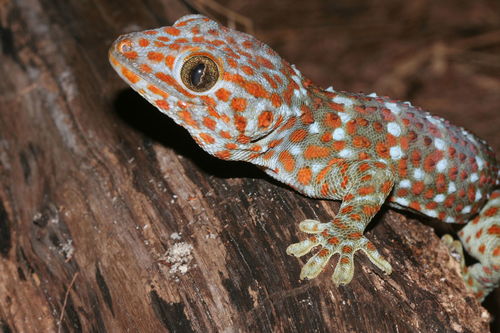
The tokay gecko is a nocturnal arboreal gecko in the genus Gekko, the true geckos. It is native to Asia and some Pacific Islands.
📌 Etymology
The word "tokay" () is an onomatopoeia of the sound made by males of this species. The common and scientific names, as well as the family name Gekkonidae and the generic term "gecko" come from this species, too, from gekok in Java Malay, corresponding to tokek in Batavian Malay and to tĕkek and gokek in Peninsular Malay.
📌 Subspecies
Two subspecies are currently recognized:
*G. g. gecko (Linnaeus, 1758) occurs in tropical Asia from northeastern India to eastern Indonesia.
*G. g. azhari (Mertens, 1955) is found only in Bangladesh.
📌 Distribution and habitat
This species is found in northeast India, Bhutan, Nepal, and Bangladesh; throughout Southeast Asia, including Cambodia, Thailand, the Philippines, Malaysia, Vietnam and Indonesia; and toward western New Guinea. Its native habitat is rainforests, where it lives on trees and cliffs, and it frequently adapts to rural human habitations, roaming walls and ceilings at night in search of insect prey. This is an introduced species in some areas outside its native range. It is established in Florida in the United States, Martinique, the islands of Belize, and possibly Hawaii. Increasing urbanization is reducing its range.
Whether the species is native but very uncommon in Taiwan or whether the rare reports of individuals since the 1920s are based on repeated anthropogenic translocations that may or may not have resulted in established populations by now is unclear.
📌 Behaviour
Tokay geckos are generally aggressive and territorial, and can inflict a strong bite. Though common in the pet trade, the strong bite of the tokay gecko makes it ill-suited for inexperienced keepers. In addition, the strength of the bite depends on the gecko's size; larger (usually male) tokay geckos are capable of piercing skin, which often results in immediate bleeding.
Females lay clutches of one or two hard-shelled eggs and guard them until they hatch. Communal nesting has been observed in Cambodia with as many as four adults guarding the clutch of about eleven eggs.
When breeding, pairs form temporary family groups and care for their young. They can distinguish their mates and offspring from other geckos by their smell.
File:Tokay Gecko, Kaziranga National Park, Assam 782136, India imported from iNaturalist photo 600096172.jpg|Appearance during the day, in Assam, India
File:Tokay Gecko, Nong Bon, Prawet, Bangkok 10250, Thailand imported from iNaturalist photo 225639352.jpg|Showing the size of a large defensive tokay gecko
File:Gekko gecko 192144888.jpg|Adults fighting
File:Gekko gecko 221285.jpg|Juvenile underneath an adult
File:Gekko gecko 86791002.jpg|Female guarding eggs
📌 Call
The male's mating call, a loud croak, is variously described as sounding like token, gekk-gekk, tuck-too, túc-key, tou-kay or tokay.
Light and temperature can affect its vocalizations. The most frequent calling occurs in May at dusk, and the second peak of call frequency occurs in May at dawn. Vocalizations and associated behavior were strongly affected by ambient temperature in both the lab and field and could thus play a role in regulating animal energetic metabolism
📌 Conservation and relationship with humans
The tokay gecko is culturally significant in many East Asian countries. Regional folklore has attributed supernatural powers to the gecko. In Southeast Asia it is a symbol of good luck and fertility.
This species is poached for the medicinal trades in parts of Asia. The tokay gecko is an ingredient in traditional Chinese medicine, known as Ge Jie (蛤蚧). It is believed to nourish the kidneys and lungs, beliefs that are not substantiated by medical science. The animal remains highly sought after in China, Hong Kong, Taiwan, Vietnam, Malaysia, Singapore and other parts of Asia with Chinese communities, to the point where unscrupulous merchants have taken to disfiguring monitor lizards with prosthetics to pass them off as colossal tokay gecko specimens.
The tokay gecko is quickly becoming a threatened species in the Philippines because of indiscriminate hunting. Collecting, transporting and trading in geckos without a license can be punishable by up to 12 years in jail and a fine of up to ₱1 million under Republic Act 9147, in addition to other applicable international laws. However, the trade runs unchecked because of the sheer number of illegal traders and reports of lucrative deals. Chinese buyers and other foreign nationals are rumored to pay thousands of dollars for large specimens, because of their alleged medicinal value or as commodities in the illegal wildlife trade.
The species is protected under Appendix II of the Convention on International Trade in Endangered Species (CITES) meaning international trade (including in parts and derivatives) is subject to the CITES permitting system.
File:Tokay Gecko, Covington St, Oakland, CA, US imported from iNaturalist photo 62772342.jpg|Dried tokay gecko (dorsal view)
File:Tokay Gecko, Covington St, Oakland, CA, US imported from iNaturalist photo 62772333 (cropped).jpg|Dried tokay gecko (ventral view)
File:Gekko medicine.jpg|Dried tokay geckos, in Hong Kong
File:Xi'an traditionnal medecine market (18).JPG|Ready-to-drink macerated medicinal liquor with goji berry, tokay gecko, and ginseng, for sale at a traditional medicine market in Xi'an, China.
📌 Captivity
Tokay geckos are becoming more popular as pets because of their striking colors and large size. Most of them are wild-caught imports, but captive-bred ones are becoming more common. Wild-caught adults are simple to keep in captivity, as the husbandry requirements can be fulfilled with standard hardware that is widely available from pet-supply vendors. Wild-caught tokay geckos can be difficult to handle because of their aggressive nature and powerful bite, but it has been commonly reported among hobbyists that captive-bred (those hatched in captivity from eggs laid by either wild-caught adults or by captive-raised adult progeny) tokay geckos can be less aggressive.
When well cared for, tokay geckos can live up to 15–20 years.