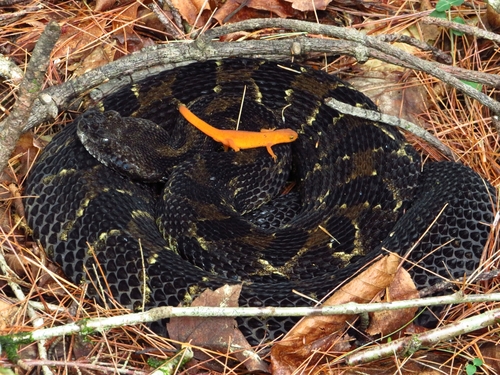
The timber rattlesnake, also known commonly as the canebrake rattlesnake and the banded rattlesnake, is a species of pit viper in the family Viperidae. The species is native to the eastern United States. Like all other pit vipers, it is venomous, with a very toxic bite. Its venom is extremely potent, and both hemorrhagic and neurotoxic venom are present depending on population and location. C. horridus is the only rattlesnake species in most of the populous Northeastern United States and is second only to its relatives to the west, the prairie rattlesnake, as the most northerly distributed venomous snake in North America. There are no subspecies that are recognized as being valid.
📌 Taxonomy
The timber rattlesnake was one of the many reptile species originally described by Carl Linnaeus in the landmark 1758 10th edition of his Systema Naturae, and still bears its original name Crotalus horridus.
The subspecies C. h. atricaudatus (Latreille in Sonnini and Latreille, 1802), often referred to as the canebrake rattlesnake, Previously, it was recognized by Gloyd (1936) and Klauber (1936). Based on an analysis of geographic variation, Pisani et al. (1972) concluded no subspecies should be recognized. This was rejected by Conant (1975), but followed by Collins and Knight (1980). Brown and Ernst (1986) found evidence for retaining the two subspecies, but stating them apart without having more information than usual is not possible, including adult size, color pattern, the number of dorsal scale rows, and the number of ventral scales. Dundee and Rossman (1989) recognized C. h. atricaudatus, but others take a more neutral point of view.
📌 Etymology
The name Crotalus is Latin for a rattle or, crŏtălisso to rattle or the sound of the castanet. Horridus is Latin, meaning horrid or dreadful, presumably in reference to its potentially lethal venom. Although southern populations are generally no longer recognized as a valid subspecies, the name canebrake rattlesnake (Crotalus horridus atricaudatus) is occasionally still used and commonly encountered in older literature. Atricaudatus is Latin meaning black-tailed ( = black, and = tailed).
📌 Distribution and habitat
.]]
individual from Pennsylvania]]
Timber rattlesnakes are present in the eastern United States from southern Minnesota and southern New Hampshire, south to East Texas and North Florida. One hundred and fifteen rattlesnakes have been marked within Brown County State Park in Indiana, one of the few places where they can be found in the state.
Its historic range includes southern Ontario and southern Quebec in Canada, A Canadian government sponsored recovery strategy is under study to support the reintroducing of this predator of many pests to its former Canadian habitat.
Many were present in some of the thick forest areas of central and southeastern Iowa, mostly within the Mississippi, Skunk, Iowa, and Des Moines River valleys, in several places in these areas; bites from timber rattlesnakes have been widespread, especially in a localized area of Geode State Park, in southeastern Henry County, along Credit Island Park, in southern Scott County, and in the forested areas of southern Clinton County. The museum at Amana Colony, Iowa, asserts that one founding family lost their firstborn, a daughter, at the age of three, due to a rattlesnake bite she received while playing on a woodpile in the 19th century.
In Pennsylvania, it is not present west of Chestnut Ridge, which is in the Laurel Highlands, nor is it present in the urban areas of the southeastern corner of the state. Thus, its range does not include Philadelphia and Pittsburgh, the two largest cities in Pennsylvania.
📌 Behavior
Female timber rattlers often bask in the sun before giving birth, in open rocky areas known as "basking knolls".
During the winter, timber rattlesnakes brumate in dens and limestone crevices, often together with copperheads (Agkistrodon contortrix) and rat snakes (Pantherophis alleghaniensis, P. obsoletus, and P. spiloides). Timber rattlesnakes occupying the same hibernaculum (especially juveniles and pregnant females) have been reported to be more closely related to each other than to the rattlesnakes in neighboring dens; studies have suggested this behavior may be related to juveniles' ability to track chemical cues from relatives. Timber rattlesnakes have also been found to leave dens multiple times in midwinter to briefly bask.
Males often mate farther away from winter hibernacula than females.
📌 Reproduction
A lifetime reproduction study of a population in the Adirondack Mountains of New York found that the first reproduction occurs at a mean age of 9.6 years. The mean length of reproductive cycles is 4.2 years, the mean reproductive life span is 9.6 years, and the average fecundity is 7.7 offspring per litter. Nonviable offspring were found in 20% of the field litters. Most females only reproduced once in a lifetime.
Macrogeographic differences were observed within the population and may have correlated resource levels influencing growth rates and additionally human encounters could influence survival.
📌 Venom
Potentially, this is one of North America's most dangerous snakes, due to its long fangs, impressive size, and high venom yield. This is to some degree offset by its relatively mild disposition and long brumation period. Before striking, they often perform a good deal of preliminary rattling and feinting. Cist (1845) described how he lived in western Pennsylvania for many years, and the species was quite common there, but in all that time, he heard of only a single death resulting from its bite. Type B is hemorrhagic and proteolytic, and is found consistently in the north and in parts of the southeast. Type A + B is found in areas where the aforementioned types apparently intergrade in southwestern Arkansas and northern Louisiana. Type C venom has none of the above components and is relatively weak.
📌 Symbol
The timber rattlesnake was designated the state reptile of West Virginia in 2008. That state's legislature praised "...a proud contribution by the eighth grade class at Romney Middle School, from West Virginia's oldest county, in West Virginia's oldest town, to have been instrumental in making the timber rattlesnake the state reptile..."
This snake became a prominent symbol of American anger and resolve during the American Revolution due to its fearsome reputation. In the 18th century, European-trained doctors and scientists had little firsthand experience with or information on timber rattlesnakes, and treatment of their bites was poorly effective. The motto Nemo me impune lacesset (with the verb in the future tense) appears above a Crotalus horridus on a 1778 $20 bill from Georgia as an early example of the colonial use of the coiled rattlesnake symbol, which later became famous on the Gadsden flag, a flag that has been used by advocates of libertarianism, individualism, and small government.
📌 Conservation status
This species is classified as least concern on the IUCN Red List (assessed in 2007).
Crotalus horridus has been extirpated from many areas, particularly in the northern part of its range, and is classified as endangered in six states and threatened in five others. The timber rattlesnake is listed as endangered in New Jersey, Ohio, Vermont, Connecticut, Massachusetts, Virginia, Indiana, and New Hampshire. The species is listed as threatened in Illinois and New York
In New York, timber rattlesnakes are "extirpated at 26% of historically known dens, and nearly extirpated at another 5%". Brown (1984, 1988) suggested denning populations in New York have been reduced by 50–75% of their historical numbers.
In Massachusetts, the snakes are active from mid-May to mid-October. Early settlers were afraid of the snake, as its population was widespread throughout the state. The town of Westborough paid 13 men two shillings per day to rid a local hill of snakes in 1680. The hill had so many rattlesnakes, it was named "Boston Hill" because the number of snakes killed rivaled the population of the young city of Boston. In Milford, men would hunt the rattlesnakes between May and early June. According to Adin Ballou, when he arrived in town in 1824, snakes were still abundant, and by 1881 they were still reported in some areas of town. Since that time their habitat has been reduced to the Blue Hills south of Boston, the Berkshires in Western Massachusetts, and parts of the Connecticut River Valley, notably in the area of the Holyoke Range. In September 2021, a five-foot-long timber rattlesnake was recorded on video on a trail in the Blue Hills Reservation.
Timber rattlesnakes have already been extirpated in Maine and Rhode Island and only one population remains in New Hampshire. They are protected in many of the Appalachian states, but their populations continue to decline. While C. horridus was historically abundant throughout New England, there has been a recent decline in the last known population in New Hampshire that is heading toward extinction because of genetic isolation, inbreeding, and stochastic weather events that render the population susceptible to opportunistic pathogens.
File:Crotalus horridus atricaudatus Genève 24102014 1.jpg|The pit between the eye and nostril is sensitive to infrared radiation for locating prey.
File:Crotalus horridus Stanton 1 (cropped).jpg|Frontal view of the head of a melanistic timber rattlesnake from Pennsylvania
File:CHorridus (cropped).jpg|A black headed timber rattlesnake from West Virginia
File:Canebrake Rattlesnake.jpg|An unusual redheaded canebrake rattlesnake from north Florida