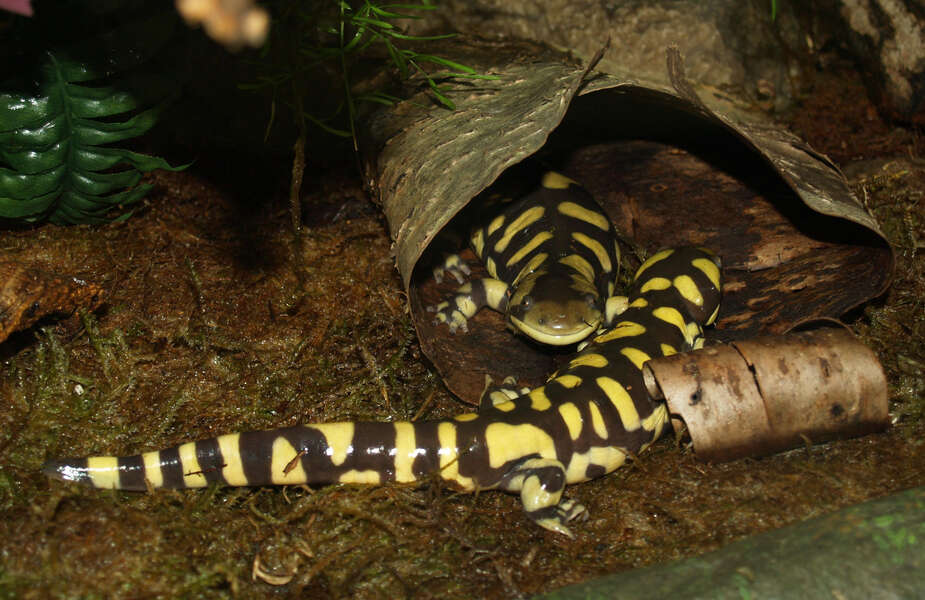
The tiger salamander is a species of mole salamander and one of the largest terrestrial salamanders in North America.
π Neoteny
Some individuals, typically when their aquatic environment is well suited, will retain their larval characteristics and forego metamorphosis. This is known as facultative paedomorphosis. These paedomorphic individuals retain their gills and remain aquatic.
π Biology
Their diet consists largely of small insects, snails, slugs, frogs, and worms, although it is not rare for an adult to turn cannibalistic and consume its own kind. Cannibalism in these salamanders can almost always be traced back to a large volume of competing predators and lack of prey in the area. If the opportunity presents itself, tiger salamanders will even feed on other smaller salamander species, lizards, snakelets (baby snakes), and newborn mice.
When threatened, these salamanders will display their tail, which will then secrete a thick, white, poisonous substance from their granular skin glands to warn predators. Pads on their feet help them dig through loose soil.
π Breeding
Like all ambystomatids, they are extremely loyal to their birthplaces, and will travel long distances to reach them. Tiger salamanders have been shown to travel up to 255 meters after their breeding cycles are complete, which is likely them returning to their original home ranges. Some research has shown that females will travel farther than males. However, a single tiger salamander has only a 50% chance of breeding more than once in its lifetime. In a study conducted in South Carolina, breeding migrations of adult tiger salamanders began in late October or November for males and November through February for females. The tiger salamander's ideal breeding period is somewhere between the late winter and early spring, once the ground is warm enough and the water is thawed. There appears to be no relation between size and mating success. However, females prefer mates with longer tails over mates with shorter tails. She carefully attaches the eggs to secure twigs, grass, and leaves at the bottom of the pool to ensure her eggs safety. In about 12β15 days time, the eggs will be fully hatched and ready to mature in the pool. Large-scale captive breeding of tiger salamanders has not been accomplished, for unknown reasons.
The larva is entirely aquatic, and is characterized by large external gills and are used extensively in the fishing bait and pet trades. Some populations may not metamorphose at all, and become sexually mature while in their larval form. These are called neotenes, and are particularly common where terrestrial conditions are poor. Aquatic individuals of the eastern tiger salamander have been shown to prefer deeper water when compared to other salamander species.
π In captivity
Tiger salamanders are popular as pets, and suitable for beginner amphibian enthusiasts due to its manageable care requirements and generally docile nature. For those interested in keeping a tiger salamander, the first step is to establish an appropriate habitat.
The enclosure size depends on the number of salamanders being kept. A single Tiger Salamander requires a minimum of a 15-gallon tank, while a 20-gallon tank or larger is recommended for housing multiple individuals to provide adequate space for exploration. Although Tiger Salamanders are non-territorial and can cohabitate peacefully, it is important to monitor them closely for signs of stress or aggression.
The enclosure should be well-ventilated and secured with a screened lid to prevent escapes. The optimal temperature range for the habitat is between 60Β°F and 75Β°F (15.5Β°C to 24Β°C).Direct sunlight should be avoided, as it can raise the temperature to harmful levels. A thermometer should be used to ensure that the temperature does not exceed 78Β°F (25.5Β°C), as overheating can cause stress and illness. While not strictly necessary, UV lighting can be beneficial, offering a natural light cycle and providing low levels of ultraviolet radiation.
Humidity levels should be maintained at approximately 70%, which can be monitored using a hygrometer. To achieve and sustain proper humidity, the substrate should be misted daily with water. The substrate should be moist but not saturated. If it becomes overly wet, increased ventilation is recommended. A shallow dish of water should be available at all times, large enough for the salamander to soak in. This water should be cleaned, disinfected, and replaced daily to ensure proper hygiene.
A substrate depth of at least 3β4 inches (7.6β10 cm) is recommended to accommodate the salamander's burrowing behavior.Ideally, half of the substrate should remain dry while the other half is slightly moist, allowing the salamander to choose its preferred environment. Suitable substrate materials include cypress mulch, coconut husk fiber, and sphagnum moss. Inappropriate substrates such as sand, gravel, or small bark pieces should be avoided due to the risk of ingestion and internal injury. Reptile carpet is also discouraged, as it can cause skin irritation or abrasions.
Handling should be kept to a minimum, as excessive handling can cause stress. When necessary, handlers should wear latex gloves to protect the salamander from the oils and bacteria present on human skin, which can be harmful to amphibians.
Tiger Salamanders require a varied diet composed primarily of gut-loaded insects and worms. Juveniles should be fed daily to support growth and development, while adults typically require feeding two to three times per week. Care should be taken to avoid overfeeding, particularly with high-fat insects like waxworms, as Tiger Salamanders are prone to obesity. Common food items include crickets, earthworms, roaches, beetles, superworms, waxworms (occasionally), silkworms, hornworms, phoenix worms, and white worms. A varied diet helps ensure balanced nutrition and prevents dietary deficiencies.
π Diseases
Although immune themselves, tiger salamanders transmit the fungus Batrachochytrium dendrobatidis, which is a major worldwide threat to most frog species by causing the disease chytridiomycosis. Tiger salamanders also carry ranaviruses, which infect reptiles, amphibians, and fish. Using tiger salamander larvae as fishing bait appears to be a major source of exposure and transport to wild populations. One of these ranaviruses is even named the Ambystoma tigrinum virus (ATV). This ranavirus only transmits to other salamanders and was not found in fish or other amphibians. Severe mortality of tiger salamander larvae sometimes occurs from recurring ranavirus infections.
π Conservation status
In the southeastern United States, tiger salamander populations are experiencing declines, largely due to deforestation and the destruction of wetland environments. Research conducted by Harte and Hoffman in the Colorado Rockies suggests acid rain could be a contributing factor. Additional threats include road mortality and contamination of their aquatic habitats.
π Related species
The California tiger salamander (Ambystoma californiense) (listed at Vulnerable), the barred tiger salamander (A. mavortium), and the plateau tiger salamander (A. velasci) were all once considered subspecies of A. tigrinum, but are now considered separate species. Genetic studies made it necessary to break up the original A. tigrinum population, though some hybridization between groups occurs.
The California tiger salamander is now federally listed as an endangered species mostly due to habitat loss; however, very few studies have been performed on this species.
The axolotl is also a relative of the tiger salamander. Axolotls live in a paedomorphic state, retaining most characteristics of their larval stage for their entire lifespans. While they never metamorphose under natural conditions, metamorphosis can be induced in them, resulting in a form very similar to the plateau tiger salamander. This is not, however, their natural condition, and dramatically shortens their lifespan. Recently, introgressed tiger salamander (A. tigrinum) DNA was detected in the laboratory axolotl population.
π In society and culture
On February 2, 2005, Representative Bob Biggins introduced a bill to make the tiger salamander the official state amphibian of Illinois and to make the painted turtle the official state reptile. The bill was signed into law by Governor Rod Blagojevich on July 19, 2005.
Wyoming's official state amphibian is the blotched tiger salamander. (Ambystoma mavortium melanostictum) The blotched tiger salamander became Wyoming's official state amphibian on February 19, 2019.