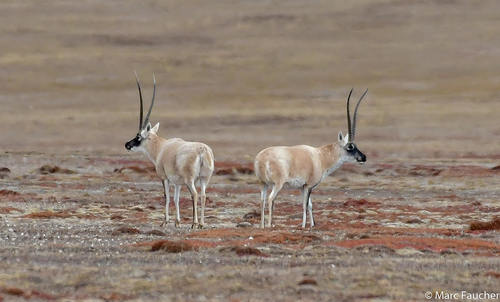
The Tibetan antelope or chiru is a medium-sized bovid native to the northeastern Tibetan Plateau. Most of the population live within the Chinese border, while some scatter across India and Bhutan in the high-altitude plains, hill plateau and montane valley. Fewer than 150,000 mature individuals are left in the wild, but the population is currently thought to be increasing.
🛡️ Conservation Status
near threatened
nt
📌 Classification
The Tibetan antelope is the sole species in the genus Pantholops, named after the Greek for "all antelope". It was formerly classified in the then-subfamily Antilopinae (now thought to be the tribe Antilopini), but morphological and molecular evidence led to it being placed in its own subfamily, Pantholopinae, closely allied to goat-antelopes of the then-subfamily Caprinae. However, this has been disputed, and most authorities now consider the Tibetan antelope to be a true member of the Caprinae, or the tribe Caprini. Phylogenetic evidence indicates that Pantholops is the most basal member of the Caprinae / Caprini, and belongs to its own tribe or subtribe, Pantholopini or Pantholopina.
Although the genus Pantholops is currently monotypic, a fossil species, P. hundesiensis, is known from the Pleistocene of Tibet. It was slightly smaller than the living species, with a narrower skull. In addition, the fossil genus Qurliqnoria, from the Miocene of China, is thought to be an early member of the Pantholopini, which diverged from the goat-antelopes around this time.
📌 Distribution and habitat
Endemic to the Tibetan Plateau, the Tibetan antelope inhabits open alpine and cold steppe environments between elevation. They prefer flat, open terrain, with sparse vegetation cover. They are found almost entirely in China, where they inhabit Tibet, southern Xinjiang, and western Qinghai; a few are also found across the border in Ladakh, India. The westernmost population of Tibetan antelope is in Depsang Plains, where they are found at altitudes of up to 5500 m. Today, the majority are found within the Chang Tang Nature Reserve of northern Tibet. The first specimens to be described, in 1826, were from Nepal; the species has apparently since been extirpated from the region.
A special adaptation of the species to its high-altitude habitat is the retention of the fetal version of hemoglobin even in adult animals, which provides higher oxygen affinity. The Tibetan antelope is the only species of mammal where this adaptation has been documented.
📌 Behaviour
The Tibetan antelope feeds on forbs, grasses, and sedges, often digging through the snow to obtain food in winter. Their natural predators include wolves, lynx, snow leopards, and red foxes are known to prey on young calves.
Tibetan antelope are gregarious, sometimes congregating in herds hundreds strong when moving between summer and winter pastures, although they are more usually found in much smaller groups, with no more than 20 individuals.
📌 Reproduction
The rutting season lasts from November to December. Males form harems of up to 12 females, although one to four is more common, and drive off other males primarily by making displays or chasing them with head down, rather than sparring directly with their horns. Courtship and mating are both brief, without most of the behaviour typically seen in other antelope species, although males do commonly skim the thighs of females with a kick of their fore legs. it is probably around 10 years.
📌 Conservation
Since 1979, Tibetan antelope has had legal protection under the Convention on International Trade in Endangered Species (CITES). Killing, harming or trading in the animal is illegal worldwide, as more than 160 countries are CITES signatories. It also used to be listed as Endangered by the World Conservation Union and the United States Fish and Wildlife Service due to commercial poaching for their underwool, competition with local domesticated herds, and the development of their rangeland for gold mining. Tibetan antelopes' underfur (down hair), being extremely soft, fine and warm, is known as shahtoosh and has traditionally been woven by craftsmen and women in Kashmir into shawls in high demand in India as girls' dowry and in Europe as a symbol of wealth and status. Such demands resulted in massive illegal poaching in the second half of the 20th century. In consequence, the population of this species has suffered a severe decline from nearly a million (estimated) at the turn of the 20th century to less than 75,000 in the 1990s. A 2009 assessment estimated an increased population of 150,000. Researchers of the Chinese Academy of Sciences wrote in a 17 April 2008 letter to Nature, that despite the impression given by the faked photo, the antelopes are getting used to the railway.
In the Karakoram regions of Pakistan-administered Kashmir it is listed as an endangered species.