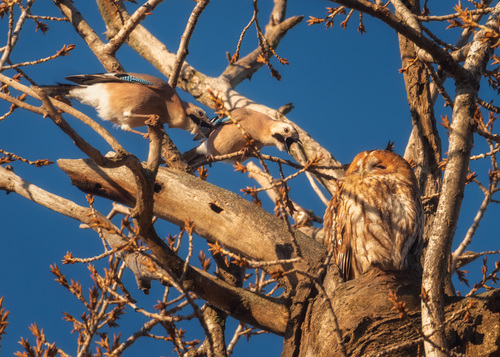
The tawny owl, also called the brown owl, is a stocky, medium-sized owl in the family Strigidae. It is commonly found in woodlands across Europe, as well as western Siberia, and has seven recognized subspecies. The tawny owl's underparts are pale with dark streaks, whilst its upper body may be either brown or grey. The tawny owl typically makes its nest in a tree hole where it can protect its eggs and young against potential predators. It is non-migratory and highly territorial: as a result, when young birds grow up and leave the parental nest, if they cannot find a vacant territory to claim as their own, they will often starve.
📌 Geographical variation
Although both colour morphs occur in much of the European range, brown birds predominate in the more humid climate of western Europe, with the grey morph becoming more common further east; in the northernmost regions, all the owls are a cold-grey colour. The Siberian and Scandinavian subspecies are 12% larger and 40% heavier, and have 13% longer wings than western European birds, in accordance with Bergmann's rule which predicts that northern forms will typically be bigger than their southern counterparts.
The plumage colour is genetically controlled, and studies in Finland and Italy indicate that grey-morph tawny owls have more reproductive success, better immune resistance, and fewer parasites than brown birds. Although this might suggest that eventually the brown morph could disappear, the owls show no colour preference when choosing a mate, so the selection pressure in favour of the grey morph is reduced. There are also environmental factors involved. The Italian study showed that brown-morph birds were found in denser woodland, and in Finland, Gloger's rule would suggest that paler birds would in any case predominate in the colder climate.
📌 Taxonomy
The species was given its current scientific name Strix aluco by Carl Linnaeus in the tenth edition of his Systema Naturae in 1758. The binomial derives from the Greek strix "owl" and Italian allocco "tawny owl" (which in turn comes from the Latin ulucus "screech-owl").
The tawny owl is a member of the wood-owl genus Strix, part of the typical owl family Strigidae, which contains all species of owl other than the barn owls. Within its genus, the tawny owl's closest relatives are Hume's owl (S. butleri, formerly considered to be conspecific), the Himalayan owl (S. nivicolum, sometimes considered conspecific), its larger northern neighbour, the Ural owl (S. uralensis), and the North American barred owl (S. varia).
The tawny owl subspecies are often poorly differentiated, and may be at a flexible stage of subspecies formation with features related to the ambient temperature, the colour tone of the local habitat, and the size of available prey. Consequently, various authors have historically described between 10 and 15 subspecies.
{|class="wikitable" width=57%
!width=15% | Subspecies
!width=25% | Range
!width=17% | Described by (parentheses indicate originally in a different genus)
|-
| S. a. aluco
| north and central Europe from Scandinavia to the Mediterranean and Black Sea
| Linnaeus, 1758
|-
| S. a. biddulphi
| northwest India and Pakistan
| Scully, 1881
|-
| S. a. harmsi
| Kazakhstan, Uzbekistan and Kyrgyzstan
| (Zarudny, 1911)
|-
| S. a. sanctinicolai
| west Iran, northeast Iraq
| (Zarudny, 1905)
|-
| S. a. siberiae
| central Russia from Urals to west Siberia
| Dementiev, 1934
|-
| S. a. sylvatica
| west and southern Europe, west Turkey
| Shaw, 1809
|-
| S. a. willkonskii
| northeast Turkey and northwest Iran to Turkmenistan
| (Menzbier, 1896)
|-
|}
📌 Distribution and habitat
The tawny owl is non-migratory and has a distribution stretching discontinuously across temperate Europe, from Great Britain and the Iberian Peninsula eastwards to western Siberia. It is absent from Ireland - probably because of competition from the long-eared owl (Asio otus) - and only a rare vagrant to the Balearic and Canary Islands. The tawny owl is mainly a lowland bird in the colder parts of its range, but breeds to in Scotland, in the Alps, in Turkey, This species has expanded its range in Belgium, the Netherlands, Norway and Ukraine, and populations are stable or increasing in most European countries. Declines have occurred in Finland, Estonia, Italy and Albania. Tawny owls are listed in Appendix II of the Convention on International Trade in Endangered Species (CITES) meaning international trade (including in parts and derivatives) is regulated.
📌 Behaviour
===Breeding===
Tawny owls pair off from the age of one year, and stay together in a usually monogamous relationship for life. An established pair's territory is defended year-round and maintained with little, if any, boundary change from year to year. The pair sit in cover on a branch close to a tree trunk during the day, and usually roost separately from July to October.
The tawny owl typically nests in a hole in a tree, but will also use old European magpie nests, squirrel drey or holes in buildings, and readily takes to nest boxes. It nests from February onwards in the south of its range, but rarely before mid-March in Scandinavia. The young usually leave the nest up to ten days before fledging, and hide on nearby branches.
The parents care for young birds for two or three months after they fledge, but from August to November the juveniles disperse to find a territory of their own to occupy. If they fail to find a vacant territory, they usually starve.
This species is increasingly affected by avian malaria, the incidence of which has tripled in the last 70 years, in parallel with increasing global temperatures. An increase of one degree Celsius produces a two- to three-fold increase in the rate of malaria. In 2010, the incidence in British tawny owls was 60%, compared to 2–3% in 1996.
File:Tawny owl at night (42511916510).jpg|Tawny owls are quite nocturnal
File:Strix aluco 3young.jpg|Young leave the nest before fledging
File:Strix aluco sylvatica MHNT.ZOO.2010.11.153.6.jpg|Strix aluco sylvatica egg - MHNT
📌 Feeding
is a common prey]]
The tawny owl hunts almost entirely at night, watching from a perch before dropping or gliding silently down to its victim, but very occasionally it will hunt in daylight when it has young to feed. This species takes a wide range of prey, mainly woodland rodents, but also other mammals up to the size of a young rabbit, and birds, earthworms and beetles. In urban areas, birds make up a larger proportion of the diet, and species as unlikely as mallard and kittiwake have been killed and eaten.
Less powerful woodland owls such as the little owl and the long-eared owl cannot usually co-exist with the stronger tawny owls, which may take them as food items, and are found in different habitats; in Ireland the absence of the tawny owl allowed the long-eared owl to become the dominant owl. Similarly, where the tawny owl has moved into built-up areas, it tends to displace barn owls from their traditional nesting sites in buildings.
📌 In culture
The tawny owl, like its relatives, has often been seen as an omen of bad luck; William Shakespeare used it as such in Julius Caesar (Act 1 Scene 3): "And yesterday the bird of night did sit/ Even at noon-day upon the market-place/ Hooting and shrieking." John Ruskin is quoted as saying "Whatever wise people may say of them, I at least have found the owl's cry always prophetic of mischief to me".
William Wordsworth described the technique for calling an owl in his poem "There Was a Boy".
And there, with fingers interwoven, both hands
Pressed closely palm to palm and to his mouth
Uplifted, he, as through an instrument,
Blew mimic hootings to the silent owls,
That they might answer him.—And they would shout
Across the watery vale, and shout again,
Responsive to his call,—with quivering peals,
And long halloos, and screams, and echoes loud
Redoubled and redoubled; concourse wild
Of jocund din!