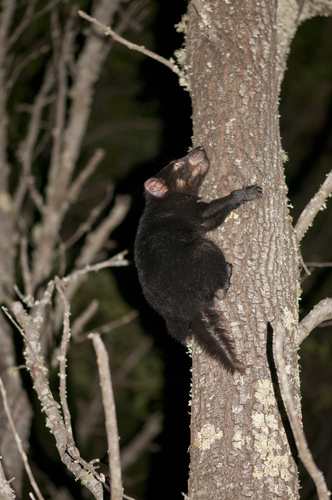
The Tasmanian devil is a carnivorous marsupial of the family Dasyuridae. It was formerly present across mainland Australia, but became extinct there around 3,500 years ago; it is now confined to the island of Tasmania. The size of a small dog, the Tasmanian devil became the largest carnivorous marsupial in the world following the extinction of the thylacine in 1936. It is related to quolls, and distantly related to the thylacine. It is characterised by its stocky and muscular build, black fur, pungent odour, extremely loud and disturbing screech, keen sense of smell, and ferocity when feeding. The Tasmanian devil's large head and neck allow it to generate among the strongest bites per unit body mass of any extant predatory land mammal. It hunts prey and scavenges on carrion.
π‘οΈ Conservation Status
endangered
en
π Taxonomy
Believing it to be a type of opossum, naturalist George Harris wrote the first published description of the Tasmanian devil in 1807, naming it Didelphis ursina, He had earlier made a presentation on the topic at the Zoological Society of London. In 1838, a specimen was named Dasyurus laniarius by Richard Owen, but by 1877 he had relegated it to Sarcophilus. The modern Tasmanian devil was named Sarcophilus harrisii ("Harris's flesh-lover") by French naturalist Pierre Boitard in 1841.
A later revision of the devil's taxonomy, published in 1987, attempted to change the species name to Sarcophilus laniarius based on mainland fossil records of only a few animals. the explorers first encountered the animal by hearing its far-reaching vocalisations at night. Related names that were used in the 19th century were Sarcophilus satanicus ("Satanic flesh-lover") and Diabolus ursinus ("bear devil"), all due to early misconceptions of the species as implacably vicious. The specific lineage of the Tasmanian devil is theorised to have emerged during the Miocene, molecular evidence suggesting a split from the ancestors of quolls between 10 and 15 million years ago, when severe climate change came to bear in Australia, transforming the climate from warm and moist to an arid, dry ice age, resulting in mass extinctions. ]] Fossil deposits in limestone caves at Naracoorte, South Australia, dating to the Miocene include specimens of S. laniarius, which were around 15% larger and 50% heavier than modern devils. Older specimens believed to be 50β70,000 years old were found in Darling Downs in Queensland and in Western Australia. Richard Owen argued for the latter hypothesis in the 19th century, based on fossils found in 1877 in New South Wales. As the devil and thylacine are similar, the extinction of the co-existing thylacine genera has been cited as evidence for an analogous history for the devils. It has been speculated that the smaller size of S. laniarius and S. moornaensis allowed them to adapt to the changing conditions more effectively and survive longer than the corresponding thylacines. Critics of this theory point out that as indigenous Australians only developed boomerangs and spears for hunting around 10,000 years ago, a critical fall in numbers due to systematic hunting is unlikely. They also point out that caves inhabited by Aborigines have a low proportion of bones and rock paintings of devils, and suggest that this is an indication that it was not a large part of indigenous lifestyle. A scientific report in 1910 claimed that Aborigines preferred the meat of herbivores rather than carnivores. The other main theory for the extinction was that it was due to the climate change brought on by the most recent ice age.
π Genetics
of male Tasmanian devil]]
The Tasmanian devil's genome was sequenced in 2010 by the Wellcome Trust Sanger Institute. Like all dasyurids, the devil has 14 chromosomes. Devils have a low genetic diversity compared to other Australian marsupials and placental carnivores; this is consistent with a founder effect as allelic size ranges were low and nearly continuous throughout all subpopulations measured. Allelic diversity was measured at 2.7β3.3 in the subpopulations sampled, and heterozygosity was in the range 0.386β0.467. but there is some exchange between the two groups.
One strand conformation polymorphism analysis (OSCP) on the major histocompatibility complex (MHC) class I domain taken from various locations across Tasmania showed 25 different types, and showed a different pattern of MHC types in north-western Tasmania to eastern Tasmania. Those devils in the east of the state have less MHC diversity; 30% are of the same type as the tumour (type 1), and 24% are of type A.
π Distribution and habitat
The Tasmanian devil was formerly present across mainland Australia, but became extinct there 3,500 years ago, co-incident with the extinction of the Thylacine from the region. A number of causal factors for the extinction have been proposed, including the introduction of the dingo, intensification of human activity, as well as climatic change.
Devils are found in all habitats on the island of Tasmania, including the outskirts of urban areas, and are distributed throughout the Tasmanian mainland and on Robbins Island (which is connected to mainland Tasmania at low tide). A study has modelled the reintroduction of DFTD-free Tasmanian devils to the Australian mainland in areas where dingoes are sparse. It is proposed that devils would have fewer impacts on both livestock and native fauna than dingoes, and that the mainland population could act as an additional insurance population. In September 2015, 20 immunised captive-bred devils were released into Narawntapu National Park, Tasmania. Two later died from being hit by cars.
The "core habitat" of the devils is considered to be within the "low to moderate annual rainfall zone of eastern and north-western Tasmania". 26 adult devils were released into the protected area, and by late April 2021, seven joeys had been born, with up to 20 expected by the end of the year.
π Ecology and behaviour
ring from fighting is visible next to this devil's left eye.|alt=A devil lying belly down on dry scrub grass and dead leaves. It has stretched its front legs out in front of its face.]]
The Tasmanian devil is a keystone species in the ecosystem of Tasmania. It is a nocturnal and crepuscular hunter, spending the days in dense bush or in a hole. Devils can scale trees of trunk diameter larger than , which tend to have no small side branches to hang onto, up to a height of around . Devils that are yet to reach maturity can climb shrubs to a height of , and can climb a tree to if it is not vertical. Devils can also swim and have been observed crossing rivers that are in width, including icy cold waterways, apparently enthusiastically.
Tasmanian devils do not form packs, but rather spend most of their time alone once weaned. They are considered to be non-territorial in general, but females are territorial around their dens. In a period of between two and four weeks, devils' home ranges are estimated to vary between , with an average of . changing dens every 1β3 days and travelling a mean distance of every night. However, there are also reports that an upper bound can be per night. They choose to travel through lowlands, saddles and along the banks of creeks, particularly preferring carved-out tracks and livestock paths and eschewing steep slopes and rocky terrain.
While the dasyurids have similar diet and anatomy, differing body sizes affect thermoregulation and thus behaviour. In ambient temperatures between , the devil was able to maintain a body temperature between . When the temperature was raised to , and the humidity to 50%, the devil's body temperature spiked upwards by within 60 minutes, but then steadily decreased back to the starting temperature after a further two hours, and remained there for two more hours. During this time, the devil drank water and showed no visible signs of discomfort, leading scientists to believe that sweating and evaporative cooling is its primary means of heat dissipation. A later study found that devils pant but do not sweat to release heat. As the smaller animals have to live in hotter and more arid conditions to which they are less well-adapted, they take up a nocturnal lifestyle and drop their body temperatures during the day, whereas the devil is active in the day and its body temperature varies by from its minimum at night to the maximum in the middle of the day.
The standard metabolic rate of a Tasmanian devil is 141 kJ/kg (15.3 kcal/lb) per day, many times lower than smaller marsupials. A devil uses per day. The field metabolic rate is 407 kJ/kg (44.1 kcal/lb). The diet is protein-based with 70% water content. For every of insects consumed, of energy are produced, while a corresponding amount of wallaby meat generated . In terms of its body mass, the devil eats only a quarter of the eastern quoll's intake, allowing it to survive longer during food shortages.
π Feeding
Tasmanian devils can take prey up to the size of a small kangaroo, but in practice they are opportunistic and eat carrion more often than they hunt live prey. Although the devil favours wombats because of the ease of predation and high fat content, it will eat all small native mammals such as wallabies, bettong and potoroos, domestic mammals (including sheep and rabbits), fish, fruit, vegetable matter, insects, tadpoles, frogs and reptiles. Their diet is widely varied and depends on the food available. Before the extinction of the thylacine, the Tasmanian devil ate thylacine joeys left alone in dens when their parents were away. This may have helped to hasten the extinction of the thylacine, which also ate devils. Devils can bite through metal traps, and tend to reserve their strong jaws for escaping captivity rather than breaking into food storage. In this respect, devils have earned the gratitude of Tasmanian farmers, as the speed at which they clean a carcass helps prevent the spread of insects that might otherwise harm livestock. Some of these dead animals are disposed of when the devils haul off the excess feed back to their residence to continue eating at a later time. in addition to small vertebrates and invertebrates, juveniles climb trees to eat grubs and birds' eggs. it can often be heard several kilometres away. This has been interpreted as notifications to colleagues to share in the meal, so that food is not wasted by rot and energy is saved. Typically, the dominant animal eats until it is satiated and leaves, fighting off any challengers in the meantime. Defeated animals run into the bush with their hair and tail erect, their conqueror in pursuit and biting their victim's rear where possible. Disputes are less common as the food source increases as the motive appears to be getting sufficient food rather than oppressing other devils. although fighting does occur. and scarring is common. They can also stand on their hind legs and push each other's shoulders with their front legs and heads, similar to sumo wrestling. Devils are known to return to the same places to defecate, and to do so at a communal location, called a devil latrine. It is believed that the communal defecation may be a means of communication that is not well understood. Wedge-tailed eagles have a similar carrion-based diet to the devils and are regarded as competitors. Quolls and devils are also seen as being in direct competition in Tasmania. Jones believed that the quoll has evolved into its current state in just 100β200 generations of around two years as determined by the equal spacing effect on the devil, the largest species, the spotted-tail quoll, and the smallest species, the eastern quoll. Both the Tasmanian devil and the quolls appears to have evolved up to 50 times faster than the average evolutionary rate amongst mammals.
π Reproduction
Females start to breed when they reach sexual maturity, typically in their second year. At this point, they become fertile once a year, producing multiple ova while in heat.
Occurring in March, mating takes places in sheltered locations during both day and night. Males fight over females in the breeding season, and female devils will mate with the dominant male. Females can ovulate up to three times in a 21-day period, and copulation can take five days; one instance of a couple being in the mating den for eight days has been recorded. The pregnancy rate is high; 80% of two-year-old females were observed with newborns in their pouches during the mating season. or "imps". When the young are born, competition is fierce as they move from the vagina in a sticky flow of mucus to the pouch. Once inside the pouch, they each remain attached to a nipple for the next 100 days. The female Tasmanian devil's pouch, like that of the wombat, opens to the rear, so it is physically difficult for the female to interact with young inside the pouch. Despite the large litter at birth, the female has only four nipples, so there are never more than four babies nursing in the pouch, and the older a female devil gets, the smaller her litters will become. Once the young have made contact with the nipple, it expands, resulting in the oversized nipple being firmly clamped inside the newborn and ensuring that the newborn does not fall out of the pouch. Milk replacements are often used for devils that have been bred in captivity, for orphaned devils or young who are born to diseased mothers. Little is known about the composition of the devil's milk compared to other marsupials. The milk contains a higher amount of iron than the milk of placental mammals. In Guiler's 1970 study, no females died while rearing their offspring in the pouch. After leaving the pouch, the devils grow by around a month until they are six months old. While most pups will survive to be weaned, Guiler reported that up to three fifths of devils do not reach maturity. As juveniles are more crepuscular than adults, their appearance in the open during summer gives the impression to humans of a population boom. A study into the success of translocated devils that were orphaned and raised in captivity found that young devils who had consistently engaged with new experiences while they were in captivity survived better than young who had not.
π Conservation status
by George Harris|alt=A black and white drawing of a devil, which is in the upper half of the picture, facing right, and a thylacine in the lower half, facing left. Both are shown in profile and depicted on a matting of grass or other vegetation.]]
The cause of the devil's disappearance from the mainland is unclear, but their decline seems to coincide with an abrupt change in climate and the expansion across the mainland of indigenous Australians and dingoes. However, whether it was direct hunting by people, competition with dingoes, changes brought about by the increasing human population, who by 3000 years ago were using all habitat types across the continent, or a combination of all three, is unknown; devils had coexisted with dingoes on the mainland for around 3000 years. carnivorous marsupials were still active when Europeans arrived. The extermination of the thylacine after the arrival of the Europeans is well known, but the Tasmanian devil was threatened as well. Cancer in general is a common cause of death in devils. In 2008, high levels of potentially carcinogenic flame retardant chemicals were found in Tasmanian devils. Preliminary results of tests ordered by the Tasmanian government on chemicals found in fat tissue from 16 devils have revealed high levels of hexabromobiphenyl (BB153) and "reasonably high" levels of decabromodiphenyl ether (BDE209). The Save the Tasmanian Devil Appeal is the official fundraising entity for the Save the Tasmanian Devil Program. The priority is to ensure the survival of the Tasmanian devil in the wild.
π Population declines
At least two major population declines, possibly due to disease epidemics, have occurred in recorded history: in 1909 and 1950.
The species was listed as vulnerable under the Tasmanian Threatened Species Protection Act 1995 in 2005 and the Australian Environment Protection and Biodiversity Conservation Act 1999 The IUCN classified the Tasmanian devil in the lower risk/least concern category in 1996, but in 2009 they reclassified it as endangered. Appropriate wildlife refuges such as Savage River National Park in North West Tasmania provide hope for their survival.
π Culling
The first European Tasmanian settlers ate Tasmanian devil, which they described as tasting like veal. As it was believed devils would hunt and kill livestock, possibly due to strong imagery of packs of devils eating weak sheep, a bounty scheme to remove the devil from rural properties was introduced as early as 1830. However, Guiler's research contended that the real cause of livestock losses was poor land management policies and feral dogs. Over the next 100 years, trapping and poisoning brought them to the brink of extinction.
After the death of the last thylacine in 1936, the Tasmanian devil was protected by law in June 1941 and the population slowly recovered. During this time environmentalists also became more outspoken, particularly as scientific studies provided new data suggesting the threat of devils to livestock had been vastly exaggerated. Numbers may have peaked in the early 1970s after a population boom; in 1975 they were reported to be lower, possibly due to overpopulation and consequent lack of food. Another report of overpopulation and livestock damage was reported in 1987. The following year, Trichinella spiralis, a parasite which kills animals and can infect humans, was found in devils and minor panic broke out before scientists assured the public that 30% of devils had it but that they could not transmit it to other species. Control permits were ended in the 1990s, but illegal killing continues to a limited extent, albeit "locally intense". This is not considered a substantial problem for the survival of the devil. Approximately 10,000 devils were killed per year in the mid-1990s. A selective culling program has taken place to remove individuals affected with DFTD, and has been shown to not slow the rate of disease progression or reduced the number of animals dying. A model has been tested to find out whether culling devils infected with DFTD would assist in the survival of the species, and it has found that culling would not be a suitable strategy to employ.
π Road mortality
Motor vehicles are a threat to localised populations of non-abundant Tasmanian mammals, On 25 September 2015, 20 immunised devils were microchipped and released in Narawntapu National Park. By 5 October four had been hit by cars, prompting Samantha Fox, leader of Save the Tasmanian Devil, to describe roadkill as being the biggest threat to the Tasmanian devil after DFTD. A series of solar-powered alarms have been trialled that make noises and flash lights when cars are approaching, warning the animals. The trial ran for 18 months and the trial area had two-thirds less deaths than the control.
π Devil facial tumour disease
First seen in 1996 in Mount William in northeastern Tasmania, devil facial tumour disease (DFTD) has ravaged Tasmania's wild devils, and estimates of the impact range from 20% to as much as an 80% decline in the devil population, with over 65% of the state affected. The state's west coast area and far north-west are the only places where devils are tumour free. Individual devils die within months of infection. The disease is an example of transmissible cancer, which means that it is contagious and passed from one animal to another. This tumour is able to pass between hosts without inducing a response from the host's immune system. Dominant devils who engage in more biting behaviour are more exposed to the disease.
Wild Tasmanian devil populations are being monitored to track the spread of the disease and to identify changes in disease prevalence. Field monitoring involves trapping devils within a defined area to check for the presence of the disease and determine the number of affected animals. The same area is visited repeatedly to characterise the spread of the disease over time. So far, it has been established that the short-term effects of the disease in an area can be severe. Long-term monitoring at replicated sites will be essential to assess whether these effects remain, or whether populations can recover. In 2020 it was reported that one of the last DFTD-free wild population of Tasmanian devils was suffering from inbreeding depression and has undergone a significant decline in reproductive success in recent years.
π Relationship with humans
At Lake Nitchie in western New South Wales in 1970, a male human skeleton wearing a necklace of 178 teeth from 49 different devils was found. The skeleton is estimated to be 7000 years old, and the necklace is believed to be much older than the skeleton. Archaeologist Josephine Flood believes the devil was hunted for its teeth and that this contributed to its extinction on mainland Australia. Owen and Pemberton note that few such necklaces have been found. Middens that contain devil bones are rareβtwo notable examples are Devil's Lair in the south-western part of Western Australia and Tower Hill in Victoria. In Tasmania, local Indigenous Australians and devils sheltered in the same caves. Tasmanian Aboriginal names for the devil recorded by Europeans include "tarrabah", "poirinnah", and "par-loo-mer-rer". Variations also exist, such as "Taraba" and "purinina".
It is a common belief that devils will eat humans. While they are known to eat dead bodies, there are prevalent myths that they eat living humans who wander into the bush. Despite outdated beliefs and exaggerations regarding their disposition, many, although not all, devils will remain still when in the presence of a human; some will also shake nervously. They can bite and scratch out of fear when held by a human, but a firm grip will cause them to remain still. Although they can be tamed, they are asocial, and are not considered appropriate as pets;
Until recently, the devil was not studied much by academics and naturalists. In the mid-1960s, Professor Guiler assembled a team of researchers and started a decade of systematic fieldwork on the devil. This is seen as the start of modern scientific study of it. However, the devil was still negatively depicted, including in tourism material.
π In captivity
, Victoria|alt=A devil with red ears and white patches under its neck, is standing on some bark chips, in front of some grass and behind a rock of the size of its body.]]
Early attempts to breed Tasmanian devils in captivity had limited success. Mary Roberts bred a pair at Beaumaris Zoo (which she named Billy and Truganini) in 1913. However, although advised to remove Billy, Roberts found Truganini too distressed by his absence, and returned him. The first litter was presumed eaten by Billy, but a second litter in 1914 survived, after Billy was removed. Roberts wrote an article on keeping and breeding the devils for the London Zoological Society. Even by 1934, successful breeding of the devil was rare. In a study on the growth of young devils in captivity, some developmental stages were very different from those reported by Guiler. The pinnae were free on day 36, and eyes opened later, on days 115β121. In the 1950s several animals were given to European zoos. In October 2005 the Tasmanian government sent four devils, two male and two female, to the Copenhagen Zoo, following the birth of the first son of King Frederik X of Denmark and his Tasmanian-born wife Mary. Due to restrictions on their export by the Australian government, at the time these were the only devils known to be living outside Australia. San Diego Zoo Wildlife Alliance and Albuquerque Biopark were selected to participate in the program, and Wellington Zoo and Auckland Zoo soon followed. In the United States, four additional zoos have since been selected as part of the Australian government's Save the Tasmanian Devil program, the zoos selected were: the Fort Wayne Children's Zoo, the Los Angeles Zoo, the Saint Louis Zoo, and the Toledo Zoo. Captive devils are usually forced to stay awake during the day to cater to visitors, rather than following their natural nocturnal style.
π In popular culture
The devil is an iconic animal within Australia, and particularly associated with Tasmania. The animal is used as the emblem of the Tasmanian National Parks and Wildlife Service, The Hobart Devils were once part of the National Basketball League. The devil has appeared on several commemorative coins in Australia over the years. Cascade Brewery in Tasmania sells a ginger beer with a Tasmanian devil on the label. In 2015, the Tasmanian devil was chosen as Tasmania's state emblem.
Tasmanian devils are popular with tourists, and the director of the Tasmanian Devil Conservation Park has described their possible extinction as "a really significant blow for Australian and Tasmanian tourism". There has also been a multimillion-dollar proposal to build a giant 19 m-high, 35 m-long devil in Launceston in northern Tasmania as a tourist attraction. Devils began to be used as ecotourism in the 1970s, when studies showed that the animals were often the only things known about Tasmania overseas, and suggested that they should therefore be the centrepiece of marketing efforts, resulting in some devils being taken on promotional tours.
The Tasmanian devil is probably best known internationally as the inspiration for the Looney Tunes cartoon character the Tasmanian Devil, or "Taz" in 1954. Little known at the time, the loud hyperactive cartoon character has little in common with the real life animal. After a few shorts between 1957 and 1964, the character was retired until the 1990s, when he gained his own show, Taz-Mania, and again became popular. In 1997, a newspaper report noted that Warner Bros. had "trademarked the character and registered the name Tasmanian Devil", and that this trademark "was policed", including an eight-year legal case to allow a Tasmanian company to call a fishing lure "Tasmanian Devil". Debate followed, and a delegation from the Tasmanian government met with Warner Bros. Ray Groom, the Tourism Minister, later announced that a "verbal agreement" had been reached. An annual fee would be paid to Warner Bros. in return for the Government of Tasmania being able to use the image of Taz for "marketing purposes". This agreement later disappeared. In 2006, Warner Bros. permitted the Government of Tasmania to sell stuffed toys of Taz with profits funnelled into research on DFTD.