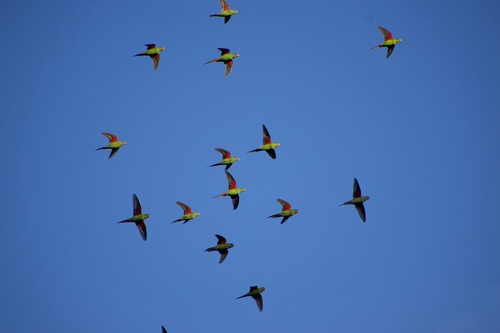
The swift parrot, also known by the palawa kani name swift waylitja, is a species of broad-tailed parrot, found only in southeastern Australia. The species breeds in Tasmania during the summer and migrates north to southeastern mainland Australia from Griffith-Warialda in New South Wales and west to Adelaide in the winter. It is a nomadic migrant, and it settles in an area only when there is food available. The Swift Parrot was voted 2023 Bird of the Year in The Guardian Australia and BirdLife Australia's biennial poll.
π‘οΈ Conservation Status
critically endangered
cr
π Denominations
The swift parrot's name is related to its speed during the flight and wing.
The name swift waylitja is derived from the palawa kani word waylitja which means parrot.
π Taxonomy
The surgeon John White described the swift parrot in 1790 as the red-shouldered paroquet (Psittacus discolor). It was placed in the genus Lathamus by René Primevère Lesson in 1830.
Despite their superficial resemblance to lorikeets in appearance and behaviour, the swift parrot belongs to tribe Platycercini, making them more closely related to rosellas than to lorikeets. Like lorikeets, they possess brush-tipped tongues, although the "bristles" or papillae are shorter and more localised. Their close resemblance to more distantly-related genera is an example of convergent evolution.
A 2011 genetic study including nuclear and mitochondrial DNA found that the swift parrot was an early offshoot from a lineage giving rise to the genera Prosopeia, Eunymphicus and Cyanoramphus, diverging around 14 million years ago.
"Swift parrot" has been designated the official common name by the International Ornithologists' Union (IOC).
π Breeding
The species breeds in Tasmania from September to February. It nests in tree cavities, but is highly selective in the types of cavities it uses as nests. It prefers cavities with small entrances, deep chambers and wide floors. Tree cavities with these traits are rare and comprise only 5% of the available cavities in Tasmanian forests. These characteristics of tree cavities are important for passive defense of their nests against native Tasmanian predators. Tree cavities suitable for nesting are highly vulnerable to disturbance. Wildfire caused the collapse of 62.8% of known swift parrot nest cavities (and 48.6% of nesting trees). Deforestation (primarily driven by native forest logging) has been an important contemporary cause of habitat loss for swift parrots. In just one area of swift parrot breeding habitat, the southern forests, 33% of total forest cover was lost/disturbed by logging between 1996β2016, and 23% of potential swift parrot nesting habitat was logged over this same time period.
Swift parrots select where to breed in Tasmania based on the local availability of both food and nesting sites. The parrots settle wherever in Tasmania their preferred food (nectar from flowering Eucalyptus globulus and Eucalyptus ovata) is abundant, but birds can only breed where suitable nesting sites are also available nearby. Successful swift parrot nests have a mean clutch sizes of 3.8 eggs, and produce 3.2 fledglings, equating to breeding success of 86.9%. are a major nest predator of swift parrots. On offshore islands where sugar gliders are absent, swift parrots have higher breeding success.
π Distribution
Genetic evidence has shown that the swift parrot is a single, genetically mixed and nomadic population that moves around the landscape each year. Because they are nomadic, swift parrots can occur across a very large potential area, but settlement at a given location depends on the local availability of food. However, in the Tasmanian breeding range, swift parrots need both food and suitable nesting sites to occur in close proximity in order to nest at a given site. The swift parrot migrates each year across Bass Strait between Tasmania and the mainland of Australia. They arrive in Tasmania during September and return to south-eastern Australia during March and April. They can be found as far north as south-eastern Queensland and as far west as Adelaide in South Australia, although recent sightings have been restricted to the south-eastern part of the state. Because swift parrots are nomadic migrants, their occurrence at any one location are difficult to predict. Although they will repeatedly return to the same locations, local occurrence may only happen intermittently depending on whether or not food (flowering trees) is available in a given year.
π Important Bird Areas
BirdLife International has identified the following sites as being important for swift parrots:
; New South Wales
* Brisbane Water
* Capertee Valley
* Hastings-Macleay
* Hunter Valley
* Lake Macquarie
* Richmond Woodlands
* South-west Slopes of NSW
* Tuggerah
* Ulladulla to Merimbula
; Victoria
* Bendigo Box-Ironbark Region
* Maryborough-Dunolly Box-Ironbark Region
* Puckapunyal
* Rushworth Box-Ironbark Region
* St Arnaud Box-Ironbark Region
* Warby-Chiltern Box-Ironbark Region
; Tasmania
* Bruny Island
* Maria Island
* South-east Tasmania
π Conservation status
Modelling of demographic data predicted that the swift parrot is Critically Endangered. extensive genetic evidence suggests this is overly optimistic, and that the (minimum) census size of the population may be around 300β500 individuals. Logging has already had severe impacts on habitat availability in recent decades
Matthew Webb and Dejan Stojanovic, two of the Eureka prize finalists from the Australian National University's Difficult Bird Research Group, say governments have stalled on management plans that would protect known feeding and nesting habitat in Tasmania. The researchers analysed logging in Tasmania's southern forests during the 20-year course of the previous regional forest agreement. They found that a third of the eucalypt forest in this area had been logged between 1997 and 2016 and a quarter of old growth trees that provide nesting habitat for swift parrots had been cleared. "It is very clear that critical breeding habitat is being logged and that current logging regimes are not sustainable," the paper states.
π Australia
Swift parrots are listed as Endangered on the Australian Environment Protection and Biodiversity Conservation Act 1999 (EPBC Act), which has been criticised for failing to protect them and other threatened species.
π Victoria
The swift parrot is listed as threatened on the Victorian Flora and Fauna Guarantee Act (1988). Under this Act, an Action Statement for the recovery and future management of this species has been prepared.
* On the 2007 advisory list of threatened vertebrate fauna in Victoria, the swift parrot was listed as Endangered.