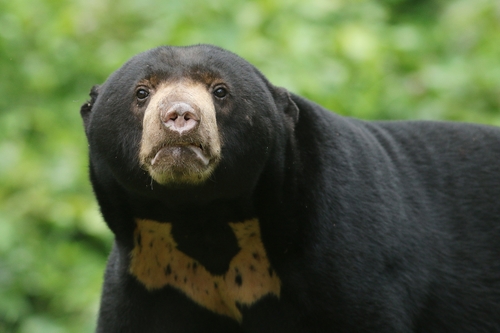
The sun bear is a bear species in the family Ursidae found in the tropical forests of Southeast Asia. It is the only species in the genus Helarctos and the smallest bear species, standing nearly 70 cm (28 in) at the shoulder and weighing 25–65 kg (55–143 lb). It is stockily built, with large paws, strongly curved claws, small, rounded ears and a short snout. The fur is generally short and jet black, but can vary from grey to red. The sun bear gets its name from its characteristic orange to cream-coloured chest patch.
🛡️ Conservation Status
vulnerable
vu
📌 Etymology
The generic name Helarctos comes from two Greek words: (, related to the sun) and (, bear). Another name is "honey bear", in Malay and Indonesian, in reference to its habit of feeding on honey from honeycombs.
📌 Taxonomy and phylogeny
The scientific name Ursus malayanus was proposed by Stamford Raffles in 1821 when he first described a sun bear from Sumatra. In 1825, Thomas Horsfield placed the species in a genus of its own, Helarctos, when describing a sun bear from Borneo.
📌 Subspecies and distribution
{| class="wikitable"
|+
!Image
!Name
!Distribution
!Description/Comments
|-
|
|Malayan sun bear (H. m. malayanus)
|The Malayan sun bear occurs in mainland Southeast Asia, Bangladesh and Sumatra.
|Smallest member of the bear family.
|-
|
|Bornean sun bear (H. m. euryspilus)
|The Bornean sun bear occurs only in Borneo.
|Its skull is smaller than that of the Malayan sun bear.
|}
H. annamiticus, described by Pierre Marie Heude in 1901 from Annam, is not considered a distinct species, but is subordinated as a junior synonym to H. m. malayanus. Genetic differences between the two subspecies are obscure and some consider the species monotypic.
📌 Phylogeny
The phylogenetic relationships among ursid species have remained ambiguous over the years. Noting the production of fertile hybrids between sun bears and sloth bears (Melursus ursinus), it was proposed that Helarctos be treated as a synonym of Melursus. However, studies differed on whether the two species were closely related. The brown bear/polar bear genetic lineage was estimated to have genetically diverged from the two black bears/sun bear lineage around (mya); the sun bear appears to have diverged from the two black bears between 6.26 and 5.09 mya. and 5.89–3.51 mya.
Nuclear gene sequencing of bear species revealed that the sloth bear and the sun bear were the first Ursinae bears that radiated and are not included in the monophyletic Ursus group; moreover, all relationships between the bears were well resolved.
📌 Characteristics
]]
The sun bear is named so for its characteristic orange- to cream-coloured, crescent-like chest patch.
It is the smallest of all bear species. It is stockily built, with large paws, strongly curved claws, small rounded ears and a short snout. The head-and-body length is between , and the shoulder height is nearly . Males tend to be larger than females by roughly 10-20%. Adults weigh . The snout is grey, silver, or orange. The fur is generally jet black, but can vary from grey to red. The hair is silky and fine, and is the shortest of all bear species, suiting its hot tropical habitat. The edges of the paws are tan or brown, and the soles are fur-less, which possibly is an adaptation for climbing trees. The claws are sickle-shaped; the front claws are long and heavy. The tail is long. The sympatric Asian black bear has cream-coloured chest markings of a similar shape as those of sun bears and different claw markings.
During feeding, the sun bear can extend its exceptionally long tongue to extract insects and honey. The teeth are very large, especially the canines, and the bite force quotient is high relative to its body size for reasons not well understood; a possible explanation could be its frequent opening of tropical hardwood trees with its powerful jaws and claws in pursuit of insects, larvae, or honey. The bite force is high for its size: a sun bear weighing bites with a maximum force of 1907.3–2020.6 Newtons on the rear molar. The head is large, broad and heavy in proportion to the body, but the ears are proportionately smaller; the palate is wide in proportion to the skull. The overall unique morphology of this bear, such as its inward-turned front feet, flattened chest, and powerful fore limbs with large claws, indicates adaptations for extensive climbing.
📌 Distribution and habitat
(Malaysia)]]
The sun bear is native to the tropical forests of Southeast Asia; its range is bound by northeastern India to the north and extends south to Bangladesh, Myanmar, Thailand, Cambodia, Laos, and Vietnam to Brunei, Indonesia, and Malaysia to the south. It is extinct in Singapore. However, sun bears have been seen in farmlands, plantations and orchards, where they may be considered vermin. A survey in Lower Kinabatangan Segama Wetlands showed that sun bears were feared but were not common in oil palm plantations; Bornean bearded pigs, elephants and macaques were far more damaging to crops.
Fossil remains suggest its occurrence farther north during the Pleistocene; it may have occurred as far south as Java in the middle to Late Pleistocene. Fossils also known from the Middle Pleistocene of Thailand along with Stegodon, gaur, wild water buffalo, and other living and extinct mammals. Today, it is locally extinct in the majority of its erstwhile range, especially in Thailand; populations are declining in most of the range countries. It disappeared from Singapore during the 1800s and 1900s, possibly due to extensive deforestation. Sun bear populations appear to decrease in size northward from Sundaland, and numbers are especially low in the northern and western extremes of the range. This has possibly been the case since prehistoric times, and is not a result of human interference.
📌 Ecology and behaviour
of bears.]]
The sun bear leads a particularly arboreal lifestyle among bears.
It is a capable climber; it sunbathes or sleeps in trees above the ground. Bedding sites consist mainly of fallen hollow logs, but they also rest in standing trees with cavities, underneath fallen logs or tree roots, and in tree branches high above the ground. It is also an efficient swimmer. It is noted for its intelligence; a captive bear observed sugar being stored in a cupboard locked by a key, and later used its claw to open the lock.
The sun bear has home ranges of varying sizes in different areas, ranging from in Borneo and Peninsular Malaysia; and in Ulu Segama Forest Reserve in Sabah.
The tiger is its major predator; dholes and leopards have also been recorded preying on sun bears, but cases are relatively few. In one incident, a tiger-sun bear interaction resulted in a prolonged altercation and in the death of both animals. In another incident, a wild female sun bear was swallowed by a large reticulated python in East Kalimantan.
Sun bears usually do not attack humans unless provoked to do so, or if they are injured or with their cubs; their timid nature led these bears to be often tamed and kept as pets in the past. Sun bears are fierce when surprised in the forest.
📌 Reproduction
The sun bear is polyoestrous; births occur throughout the year. Oestrus lasts five to seven days. Sun bears become sexually mature at two to four years of age. Reported lengths for Gestation varies from 95 to 240 days; pregnancy tends to be longer in zoos in temperate climate possibly due to delay in implantation or fertilisation. Births occur inside hollow tree cavities. A litter typically comprises one or two cubs weighing around each. Cubs are born deaf with eyes closed. The eyes open at nearly 25 days, but they remain blind till 50 days after birth; the sense of hearing improves over the first 50 days. Cubs younger than two months are dependent on external stimulation for defecation. Cubs are kept on buttress roots at the base of trees until they learn how to walk and climb properly. Mothers protect their cubs aggressively. Offspring remain with their mother for nearly the first three years of their lives. Lifespan in captivity is generally over 20 years; one individual has lived for 34 years.
📌 Threats
According to the IUCN Bear Specialist Group, sun bear populations have fallen by an estimated 35% since the 1990s. Numbers are especially low in Bangladesh and China, and populations in Vietnam are feared to decline severely by 50–80% in the next 30 years. Habitat fragmentation is on the rise, particularly in Borneo, Sumatra, and some areas of the mainland range. Heavy deforestation (due to agriculture, logging, and forest fires) and hunting for wildlife trade are severe threats throughout the range; human-bear conflicts are a relatively minor threat. A 2007 study in East Borneo recorded severe loss of habitat and food resources due to droughts and forest fires brought about by the El Niño.
Studies have found evidence of pet trade and sale of sun bear parts such as gall bladders in traditional Chinese medicine (TCM) shops in Sabah and Sarawak. In 2018 and 2019, 128 TCM outlets in 24 locations across Sabah and Sarawak were surveyed and bear parts and derivatives were recorded for sale in 25% of the outlets surveyed, many of which would have been derived from locally sourced sun bears. Sun bears were killed by shooting or administering poison to protect coconut and snakefruit plantations in east Kalimantan. A report published by TRAFFIC in 2011 showed that sun bears, along with Asian black bears and brown bears, are specifically targeted for the bear bile trade in Southeast Asia, and are kept in bear farms in Laos, Vietnam, and Myanmar. Poaching is common in several countries in the region.
Hunting pressure is rising even in some protected areas; in the Nam Ha National Protected Area in Laos, hunter snares have been found that specifically target bears. A study in Nagaland (northeastern India) recorded a sparse distribution of sun bears in Fakim and Ntangki National Parks, and reported extensive illegal hunting for food and trade in bear parts. Protective laws have shown little success in controlling these threats, especially due to poor execution and high potential for gains by the trade.
📌 Conservation
|thumb]]
The sun bear is listed as vulnerable on the IUCN Red List, and is included in CITES Appendix I.
📌 In captivity
The Malayan sun bear is part of an international captive-breeding program and a Species Survival Plan under the Association of Zoos and Aquariums since late 1994. Since that same year, the European breed registry for the sun bear is kept in the Cologne Zoological Garden, Germany.
The Bornean Sun Bear Conservation Centre, founded in 2008, aims to work for the welfare of sun bears rescued from poor conditions in captivity and spread awareness about their conservation.
Several sanctuaries in Southeast Asia aim to reduce the illegal trade in sun bears and offer opportunities for rehabilitation, research and improved public awareness. A conservation action plan was published in 2019.