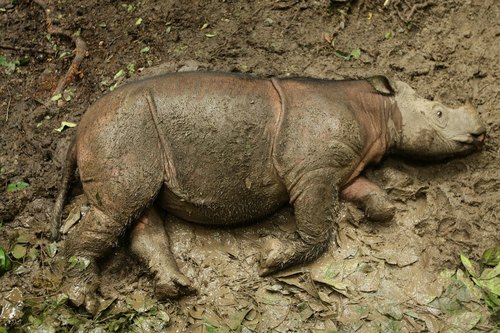
The Sumatran rhinoceros, also known as the Sumatran rhino, hairy rhinoceros or Asian two-horned rhinoceros, is a rare member of the family Rhinocerotidae and one of five extant species of rhinoceros; it is the only extant species of the genus Dicerorhinus. It is the smallest rhinoceros, although it is still a large mammal; it stands 112–145 cm (44–57 in) high at the shoulder, with a head-and-body length of 2.36–3.18 m and a tail of 35–70 cm (14–28 in). The weight is reported to range from 500–1,000 kg (1,100–2,200 lb), averaging 700–800 kg (1,540–1,760 lb). Like both African species, it has two horns; the larger is the nasal horn, typically 15–25 cm (5.9–9.8 in), while the other horn is typically a stub. A coat of reddish-brown hair covers most of the Sumatran rhino's body.
🛡️ Conservation Status
critically endangered
cr
📌 Taxonomy and naming
The first documented Sumatran rhinoceros was shot outside Fort Marlborough, near the west coast of Sumatra, in 1793. Drawings of the animal, and a written description, were sent to the naturalist Joseph Banks, then president of the Royal Society of London, who published a paper on the specimen that year. In 1814, the species was given a scientific name by Johann Fischer von Waldheim.
The specific epithet sumatrensis signifies "of Sumatra", the Indonesian island where the rhinos were first discovered. Carl Linnaeus originally classified all rhinos in the genus, Rhinoceros; therefore, the species was originally identified as Rhinoceros sumatrensis or sumatranus. Joshua Brookes considered the Sumatran rhinoceros with its two horns a distinct genus from the one-horned Rhinoceros, and gave it the name Didermocerus in 1828. Constantin Wilhelm Lambert Gloger proposed the name Dicerorhinus in 1841. In 1868, John Edward Gray proposed the name Ceratorhinus. Normally, the oldest name would be used, but a 1977 ruling by the International Commission on Zoological Nomenclature established the proper genus name as Dicerorhinus. Dicerorhinus comes from the Greek terms ' (, meaning "two"), ' (, meaning "horn"), and ' (, meaning "nose").
The three subspecies are:
D. s. sumatrensis, known as the western Sumatran rhinoceros, which has only 75 to 85 rhinos remaining, mostly in the national parks of Bukit Barisan Selatan and Kerinci Seblat, Gunung Leuser in Sumatra, but also in Way Kambas National Park in small numbers. Three bulls and five cows currently live in captivity at the Sumatran Rhino Sanctuary at Way Kambas, the youngest bull having been bred and born there in 2012. Another calf, a female, was born at the sanctuary in May 2016. The sanctuary's two bulls were born at the Cincinnati Zoo and Botanical Garden. A third calf female was born in March 2022.
D. s. harrissoni, known as the Bornean rhinoceros or eastern Sumatran rhinoceros, which was once common throughout Borneo; now only about 15 individuals are estimated to survive. Reports of animals surviving in Sarawak are unconfirmed. The Bornean subspecies is markedly smaller in body size than the other two subspecies.
D. s. lasiotis, known as the northern Sumatran rhinoceros or Chittagong rhinoceros, which once roamed India and Bangladesh, has been declared extinct in these countries. Unconfirmed reports suggest a small population may still survive in Myanmar, but the political situation in that country has prevented verification. The name lasiotis is derived from the Greek for "hairy-ears". Later studies showed that their ear hair was not longer than other Sumatran rhinos, but D. s. lasiotis remained a subspecies because it was significantly larger than the other subspecies.
📌 Evolution
Ancestral rhinoceroses first diverged from other perissodactyls in the Early Eocene. Mitochondrial DNA comparison suggests the ancestors of modern rhinos split from the ancestors of Equidae around 50 million years ago. The extant family, the Rhinocerotidae, first appeared in the Late Eocene in Eurasia, and the ancestors of the extant rhino species dispersed from Asia beginning in the Miocene.
Although the relationships of modern rhinoceros species to each other were long controversial, modern genetic evidence has placed the Sumatran rhinoceros as more closely related to the Asian one-horned rhinoceroses (the Indian rhinoceros and Javan rhinoceros) belonging to the genus Rhinoceros than to living African rhinoceros species, with the split between Rhinoceros and Dicerorhinus estimated to have occurred around 14.8 million years ago, shortly after the split between the ancestors of Dicerorhinus and Rhinoceros and African rhinoceroses, which is placed around 15.6 million years ago. Stephanorhinus species are well known in Europe from the Late Pliocene through the Pleistocene, and China from the Pleistocene, with two species, Stephanorhinus kirchbergensis and the Stephanorhinus hemitoechus surviving into the last glacial period, until at least 40,000 years ago and possibly later. today only two fossil species are confidently placed in the genus. These include Dicerorhinus fusuiensis from the Early Pleistocene of South China, and Dicerorhinus gwebinensis from the Pliocene-Early Pleistocene of Myanmar.
Pairwise sequential Markovian coalescent (PSMC) analysis of a complete nuclear genome of a Sumatran specimen suggested strong fluctuations in population size, with a general trend of decline over the course of the Middle to Late Pleistocene with an estimated peak effective population size of 57,800 individuals 950,000 years ago, declining to around 500–1,300 individuals at the start of the Holocene, with a slight rebound during the Eemian Interglacial. This was likely due to climate change causing limiting suitable habitat for the Rhinoceros, causing severe population fluctuations as well as population fragmentation due to the flooding of Sundaland. Human induced habitat change and hunting may have played a role in the Late Pleistocene. The study was later criticised for not including DNA from extinct mainland populations, which would have provided a holistic account. A Bayesian skyline plot of complete Mitochondrial genomes from multiple individuals from across the range of the species suggested that the population had been relatively stable with an effective population size of 40,000 individuals over the last 400,000 years, with a sharp decline starting around 25,000 years ago.
Cladogram showing the relationships of recent and Late Pleistocene rhinoceros species (minus Stephanorhinus hemitoechus) based on whole nuclear genomes, after Liu et al, 2021:
Elasmotherium sibiricum
|label2=Rhinocerotinae
|2=
|2=
|label2=
|2= Woolly rhinoceros (Coelodonta antiquitatis)
|2= Merck's rhinoceros (Stephanorhinus kirchbergensis)
}}
}}
}}
}}
}}|style=font-size:100%;line-height:80%}}
📌 Distribution and habitat
, northern Thailand, in 1867]]
Remains of Sumatran rhinoceros have been found in Chinese Neolithic sites of Zhejiang, Henan, Fujian, and the northeastern Tibetan Plateau. A revision of Rhinoceros sinensis fossils from Chongqing also identified previously misdiagnosed Sumatran rhinoceros remains among them, proving that the species was already present in Southern China during the Pleistocene. The Sumatran rhinoceros was the most common species in ancient and medieval China, where it coexisted with the rarer Javan rhinoceros.
In Southeast Asia, the Sumatran rhinoceros lives in both lowland and highland secondary rainforest, swamps, and cloud forests. It inhabits hilly areas close to water, particularly steep upper valleys with copious undergrowth. The Sumatran rhinoceros once inhabited a continuous range as far north as Myanmar, eastern India, and Bangladesh. Unconfirmed reports also placed it in Cambodia, Laos, and Vietnam. All known living animals occur in the island of Sumatra. Some conservationists hope Sumatran rhinos may still survive in Burma, though it is considered unlikely. Political turmoil in Burma has prevented any assessment or study of possible survivors. The last reports of stray animals from Indian limits were in the 1990s.
The Sumatran rhino is widely scattered across its range, much more so than the other Asian rhinos, which has made it difficult for conservationists to protect members of the species effectively.
The Kerinci Seblat National Park, Sumatra's largest, was estimated to contain a population of around 500 rhinos in the 1980s, but due to poaching, this population is now considered extinct. The survival of any animals in Peninsular Malaysia is extremely unlikely.
in Sabah, Borneo]]
Genetic analysis of Sumatran rhino populations has identified three distinct genetic lineages.
Although the rhino had been thought to be extinct in Kalimantan since the 1990s, in March 2013 World Wildlife Fund (WWF) announced that the team when monitoring orangutan activity found in West Kutai Regency, East Kalimantan, several fresh rhino foot trails, mud holes, traces of rhino-rubbed trees, traces of rhino horns on the walls of mud holes, and rhino bites on small branches. The team also identified that rhinos ate more than 30 species of plants. On 2 October 2013, video images made with camera traps showing the Sumatran rhino in Kutai Barat, Kalimantan, were released by the World Wildlife Fund. Experts assume the videos show two different animals, but are not certain. According to the Indonesia's Minister of Forestry, Zulkifli Hasan called the video evidence "very important" and mentioned Indonesia's "target of rhino population growth by three percent per year". On 22 March 2016 it was announced by the WWF that a live Sumatran rhino was found in Kalimantan; it was the first contact in over 40 years. The rhino, a female, was captured and transported to a nearby sanctuary to ensure her survival.
Iman, the last known Sumatran rhino in Malaysia, died in November 2019; stem cell technology is being used in an attempt to revitalize the rhino's population and reverse extinction in the country. As of 2023, there has been two births at the Sumatran Rhino Sanctuary at Way Kambas National Park, Indonesia.
📌 Behavior and ecology
with a large front horn in London Zoo around 1904]]
Sumatran rhinos are solitary creatures except for pairing before mating and during offspring rearing. Individuals have home ranges; bulls have territories as large as , whereas cows' ranges are .
There has been little opportunity to study epidemiology in the Sumatran rhinoceros. Ticks and gyrostigma were reported to cause deaths in captive animals in the 19th century. The rhino is also known to be vulnerable to the blood disease surra, which can be spread by horse-flies carrying parasitic trypanosomes; in 2004, all five rhinos at the Sumatran Rhinoceros Conservation Center died over an 18-day period after becoming infected by the disease. The Sumatran rhino has no known predators other than humans. Tigers and wild dogs may be capable of killing a calf, but calves stay close to their mothers, and the frequency of such killings is unknown. Although the rhino's range overlaps with elephants and tapirs, the species do not appear to compete for food or habitat. Asian elephants (Elephas maximus) and Sumatran rhinos are even known to share trails, and many smaller species, such as deer, boars, and wild dogs, will use the trails the rhinos and elephants create.
The Sumatran rhino maintains two types of trails across its range. Main trails will be used by generations of rhinos to travel between important areas in the rhino's range, such as between salt licks, or in corridors through inhospitable terrain that separates ranges. In feeding areas, the rhinos will make smaller trails, still covered by vegetation, to areas containing food the rhino eats. Sumatran rhino trails have been found that cross rivers deeper than and about across. The currents of these rivers are known to be strong, but the rhino is a strong swimmer. A relative absence of wallows near rivers in the range of the Sumatran rhinoceros indicates they may occasionally bathe in rivers in lieu of wallowing.
📌 Communication
The Sumatran rhinoceros is the most vocal of the rhinoceros species. The Sumatran rhinoceros will sometimes twist the saplings they do not eat. This twisting behavior is believed to be used as a form of communication, frequently indicating a junction in a trail.
📌 Reproduction
Cows become sexually mature at the age of six to seven years, while bulls become sexually mature at about 10 years old. The gestation period is around 15–16 months. The calf, which typically weighs , is weaned after about 15 months and stays with its mother for the first two to three years of its life. In the wild, the birth interval for this species is estimated to be four to five years; its natural offspring-rearing behavior is unstudied. Sex relationships begin with a courtship period characterized by increased vocalization, tail raising, urination, and increased physical contact, with both bull and cow using their snouts to bump the other in the head and genitals. The pattern of courtship is most similar to that of the black rhinoceros. Young Sumatran rhino bulls are often too aggressive with cows, sometimes injuring and even killing them during the courtship. In the wild, the cow could run away from an overly aggressive bull, but in their smaller captive enclosures, they cannot; this inability to escape aggressive bulls may partly contribute to the low success rate of captive-breeding programs. Breeding success was finally achieved in 2001, 2004, and 2007 by providing a pregnant rhino with supplementary progestin. In March 2022, and 1 October 2023, female calves were born at the Sumatran Rhino Sanctuary (SRS), as well as a male calf born on 25 November 2023. Way Kambas National Park, Lampung province, Indonesia.
📌 In the wild
Sumatran rhinos were once quite numerous throughout Southeast Asia. Fewer than 100 individuals are now estimated to remain. From the early 1990s, the population decline was estimated at more than 50% per decade, and the small, scattered populations now face high risks of inbreeding depression.
Poaching of Sumatran rhinos is a cause for concern, due to the high market price of its horns. This species has been overhunted for many centuries, leading to the current greatly reduced and still declining population. Rhinoceros horn was once believed to be widely used as an aphrodisiac; in fact traditional Chinese medicine never used it for this purpose.
The Bornean rhino in Sabah was confirmed to be extinct in the wild in April 2015, with only 3 individuals left in captivity. The mainland Sumatran rhino in Malaysia was confirmed to be extinct in the wild in August 2015. In March 2016 there was a rare sighting of a Sumatran rhino in East Kalimantan, the Indonesian part of Borneo. The last time there was a Sumatran rhino in the Kalimantan area was approximately 40 years ago. This optimism was met with despair as the same rhino named Najaq was found dead several weeks after the sighting. The cause of death was infection on the wound caused by snare.
📌 In captivity
"Begum", which was shown in London Zoo from 15 February 1872 to 31 August 1900]]
Sumatran rhinos do not thrive outside of their ecosystem. London Zoo acquired a bull and cow in 1872 that had been captured in Chittagong in 1868. The female named "Begum" survived until 1900, the record lifetime for a captive rhino. Begum was one of at least seven specimens of the extinct subspecies D. s. lasiotis that were held in zoos and circuses. Andalas's birth was the first successful captive birth of a Sumatran rhino in 112 years. A female calf, named "Suci" (Indonesian for "pure"), followed on 30 July 2004. On 29 April 2007, Emi gave birth a third time, to her second male calf, named Harapan (Indonesian for "hope") or Harry. In 2007, Andalas, who had been living at the Los Angeles Zoo, was returned to Sumatra to take part in breeding programs with healthy females, leading to the siring and 23 June 2012 birth of male calf Andatu, the fourth captive-born calf of the era; Andalas had been mated with Ratu, a wild-born cow living in the Rhino Sanctuary at Way Kambas National Park.
Despite the recent successes in Cincinnati, the captive-breeding program has remained controversial. Proponents argue that the zoos have not only aided the conservation effort by studying the reproductive habits, raising public awareness and education about the rhinos, helping raise financial resources for conservation efforts in Sumatra but, moreover, to have established a small captive breeding group. Opponents of the captive breeding program argue that the losses are too great; the program is too expensive; removing rhinos from their habitat, even temporarily, alters their ecological role; and captive populations cannot match the rate of recovery seen in well-protected native habitats.
In August 2016, there were only three Sumatran rhinos left in Malaysia, all in captivity in the eastern state of Sabah: A bull named Tam and two cows named Puntung and Iman. In June 2017, Puntung was put down due to skin cancer. Tam died on 27 May 2019 and Iman died of cancer on 23 November 2019 at the Borneo Rhino Sanctuary. The species became extinct in Malaysia, its native land in 2019.
In Indonesia, meanwhile, a seventh rhino increased the group at the Sumatran Rhino Sanctuary, in Way Kambas NP. A female was born on 12 May 2016, named Delilah. Another female, daughter of Andatu and Rosa, was born on 24 March 2022, named Sedah Mirah. A female was born on 30 September 2023, the third child of Andalas-Ratu pair. A male calf was born on 26 November 2023, son of Delilah and Harapan.
In Indonesian East Kalimantan, only one old (estimated to be 35 to 40 years old) female named Pahu lives in Sumatran Rhino Sanctuary (SRS) Kelian, West Kutai after being captured in 2018, another identified is Pari, a female who lives in the wild in Sungai Ratah-Sungai Nyuatan-Sungai Lawa protected forest. On 31 October 2023, conservationists in Indonesia said they have extracted eggs from Pahu, who were too old and small to breed with the Sumatran subspecies, the eggs are currently planned to be fertilized with sperms from captive male Sumatran rhino before implanted in female Sumatran rhino in SRS Way Kambas.
📌 Cultural depictions
Aside from those few individuals kept in zoos and pictured in books, the Sumatran rhinoceros has remained little known, overshadowed by the more common Indian, black and white rhinos. Recently, however, video footage of the Sumatran rhinoceros in its native habitat and in breeding centers has been featured in several nature documentaries. Extensive footage can be found in an Asia Geographic documentary The Littlest Rhino. Natural History New Zealand showed footage of a Sumatran rhino, shot by freelance Indonesian-based cameraman Alain Compost, in the 2001 documentary Forgotten Rhino, which featured mainly Javan and Indian rhinos.
Though they were documented by droppings and tracks, pictures of the Bornean rhinoceros were first taken and widely distributed by modern conservationists in April 2006, when camera traps photographed a healthy adult in the jungles of Sabah in Malaysian Borneo. On 24 April 2007, it was announced that cameras had captured the first-ever video footage of a wild Bornean rhino. The night-time footage showed the rhino eating, peering through jungle foliage, and sniffing the film equipment. The World Wildlife Fund, which took the video, has used it in efforts to convince local governments to turn the area into a rhino conservation zone. Monitoring has continued; 50 new cameras have been set up, and in February 2010, what appeared to be a pregnant rhino was filmed.
A number of folk tales about the Sumatran rhino were collected by colonial naturalists and hunters from the mid-19th century to the early 20th century. In Burma, the belief was once widespread that the Sumatran rhino ate fire. Tales described the fire-eating rhino following smoke to its source, especially campfires, and then attacking the camp. There was also a Burmese belief that the best time to hunt was every July, when the Sumatran rhinos would congregate beneath the full moon. In Malaya, it was said that the Sumatran rhino's horns was hollow and could be used as a sort of hose for breathing air and squirting water. In Malaya and Sumatra, it was once believed that the rhino shed its horns every year and buried them under the ground. In Borneo, the rhino was said to have a strange carnivorous practice: after defecating in a stream, it would turn around and eat fish that had been stupefied by the excrement.