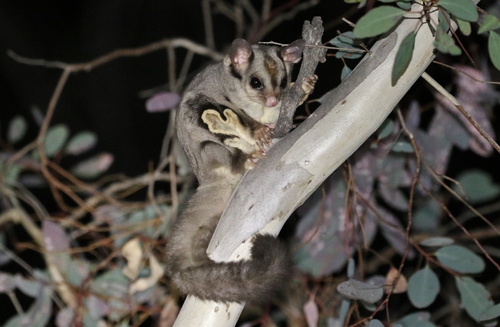
The sugar glider is a small, omnivorous, arboreal, and nocturnal gliding possum. The common name refers to its predilection for sugary foods such as sap and nectar and its ability to glide through the air, much like a flying squirrel. They have very similar habits and appearance to the flying squirrel, despite not being closely relatedβan example of convergent evolution. The scientific name, Petaurus breviceps, translates from Latin as "short-headed rope-dancer", a reference to their canopy acrobatics.
π Taxonomy and evolution
The genus Petaurus is believed to have originated in New Guinea during the mid Miocene epoch, approximately 18 to 24 million years ago. The modern Australian Petaurus, along with New Guinean members of what were formerly considered P. breviceps, diverged from their closest living New Guinean relatives ~9-12 mya. They probably dispersed from New Guinea to Australia between 4.8 and ~8.4 mya, with the oldest Petaurus fossils in Australia being dated to 4.46 million years. This may have been possible due to sea level lowering from about 7 to 10 mya, resulting in land bridges between New Guinea and Australia.
The taxonomy of the species is complex, and is still not fully resolved. It was formerly understood to have a wide range across Australia and New Guinea, being the only glider to have this distribution, and to be divided into seven subspecies, with three occurring in Australia and four in New Guinea. This traditional subspecific division was based on small morphological differences, such as colour and body size.
P. breviceps and P. notatus are estimated to have diverged ~1 million years ago, and may have originated from long term geographic isolation. The early-mid Pleistocene saw an uplifting of the Great Dividing Range, contributing to and coinciding with aridification of the interior of Australia, including on the western side of the range. This, as well as other climactic and geographic factors, may have isolated the ancestors of P. breviceps to refugia on the eastern, coastal side of the Great Dividing Range. This would be an example of allopatric speciation.
π Distribution and habitat
Sugar gliders are distributed in the coastal forests of southeastern Queensland and most of New South Wales. Their distribution extends to altitudes of 2000m in the eastern ranges. In parts of its range, it may overlap with Krefft's glider (P. notatus).
The sugar glider occurs in sympatry with the squirrel glider and yellow-bellied glider; and their coexistence is permitted through niche partitioning where each species has different patterns of resource use.
Like all arboreal, nocturnal marsupials, sugar gliders are active at night, and they shelter during the day in tree hollows lined with leafy twigs.
The average home range of sugar gliders is , and is largely related to the abundance of food sources; density ranges from two to six individuals per hectare (0.8β2.4 per acre).
Native owls (Ninox sp.) Feral cats (Felis catus) also represent a significant threat.
π Appearance and anatomy
The sugar glider has a squirrel-like body with a long, partially (weakly) prehensile tail. The length from the nose to the tip of the tail is about , and males and females weigh respectively. Heart rate range is 200β300 beats per minute, and respiratory rate is 16β40 breaths per minute. The sugar glider is a sexually dimorphic species, with males typically larger than females. Sexual dimorphism has likely evolved due to increased mate competition arising through social group structure; and is more pronounced in regions of higher latitude, where mate competition is greater due to increased food availability.
The fur coat on the sugar glider is thick, soft, and is usually blue-grey; although some have been known to be yellow, tan or (rarely) albino. A black stripe is seen from its nose to midway on its back. Its belly, throat, and chest are cream in colour. Males have four scent glands, located on the forehead, chest, and two paracloacal (associated with, but not part of the cloaca, which is the common opening for the intestinal, urinal and genital tracts) that are used for marking of group members and territory. Sugar gliders have demonstrated trichromacy in behavioral testing with sensitivity in the ultraviolet/blue, green, and red ranges. Ultraviolet sensitivity is corroborated by genetic evidence. The physiological source of their middle wavelength sensitivity is not yet confirmed.
Each foot on the sugar glider has five digits, with an opposable toe on each hind foot. These opposable toes are clawless, and bend such that they can touch all the other digits, like a human thumb, allowing it to firmly grasp branches. The second and third digits of the hind foot are partially syndactylous (fused together), forming a grooming comb.
π Biology and behaviour
π Gliding
The sugar glider is one of a number of volplane (gliding) possums in Australia. It glides with the fore- and hind-limbs extended at right angles to the body, with feet flexed upwards. For every travelled horizontally when gliding, it falls . spent foraging for nutrient poor foods that are irregularly distributed. Young carried in the pouch of females are protected from landing forces by the septum that separates them within the pouch.
π Torpor
Sugar gliders can tolerate ambient air temperatures of up to through behavioural strategies such as licking their coat and exposing the wet area, as well as drinking small quantities of water. With energetic constraints, the sugar glider will enter into daily torpor for 2β23 hours while in rest phase. When food is scarce, as in winter, heat production is lowered in order to reduce energy expenditure. With low energy and heat production, it is important for the sugar glider to peak its body mass by fat content in the autumn (May/June) in order to survive the following cold season. In the wild, sugar gliders enter into daily torpor more often than sugar gliders in captivity.
π Diet and nutrition
]]
Sugar gliders are seasonally adaptive omnivores with a wide variety of foods in their diet, and mainly forage in the lower layers of the forest canopy. Sugar gliders may obtain up to half their daily water intake through drinking rainwater, with the remainder obtained through water held in its food. which is consumed by sugar gliders.}} honeydew or lerp). Sugar gliders have an enlarged caecum to assist in digestion of complex carbohydrates obtained from gum and sap.
To obtain sap or gum from plants, sugar gliders will strip the bark off trees or open bore holes with their teeth to access stored liquid. Pollen can make up a large portion of their diet, therefore sugar gliders are likely to be important pollinators of Banksia species.
π Reproduction
Like most marsupials, female sugar gliders have two ovaries and two uteri; they are polyestrous, meaning they can go into heat several times a year. and a bifurcated penis to correspond with the two uteri of females.
The age of sexual maturity in sugar gliders varies slightly between the males and females. Males reach maturity at 4 to 12 months of age, while females require from 8 to 12 months. In the wild, sugar gliders breed once or twice a year depending on the climate and habitat conditions, while they can breed multiple times a year in captivity as a result of consistent living conditions and proper diet. Joeys have a continuous arch of cartilage in their shoulder girdle which disappears soon after birth; this supports the forelimbs, assisting the climb into the pouch. Young are completely contained in the pouch for 60 days after birth, wherein mammae provide nourishment during the remainder of development.
Breeding is seasonal in southeast Australia, with young only born in winter and spring (June to November).
π Socialisation
Sugar gliders are highly social animals. They live in family groups or colonies consisting of up to seven adults, plus the current season's young. Up to four age classes may exist within each group, although some sugar gliders are solitary, not belonging to a group.
Territory and members of the group are marked with saliva and a scent produced by separate glands on the forehead and chest of male gliders. Intruders who lack the appropriate scent marking are expelled violently. Each colony defends a territory of about where eucalyptus trees provide a staple food source.
Sugar gliders are one of the few species of mammals that exhibit male parental care. The oldest codominant male in a social community shows a high level of parental care, as he is the probable father of any offspring due to his social status.
This paternal care evolved in sugar gliders as young are more likely to survive when parental investment is provided by both parents.
π Conservation
Under the prior taxonomy, the sugar glider was not considered endangered, and its conservation rank was "Least Concern (LC)" on the IUCN Red List. However, despite the loss of natural habitat in Australia over the last 200 years, it is adaptable and capable of living in small patches of remnant bush, particularly if it does not have to cross large expanses of cleared land to reach them. Sugar gliders may persist in areas that have undergone mild-moderate selective logging, as long as three to five hollow bearing trees are retained per hectare. Although not currently threatened by habitat loss, the ability of sugar gliders to forage and avoid predators successfully may be decreased in areas of high light pollution.
Conservation in Australia is enacted at the federal, state and local levels, where sugar gliders are protected as a native species. The central conservation law in Australia is the Environment Protection and Biodiversity Conservation Act 1999 (EPBC Act). The National Parks and Wildlife Act 1974 is an example of conservation law in the state of South Australia, where it is legal to keep (only) one sugar glider without a permit, provided it was acquired legally from a source with a permit. A permit is required to obtain or possess more than one glider, or if one wants to sell or give away any glider in their possession. It is illegal to capture or sell wild sugar gliders without a permit.
π In captivity
In captivity, the sugar glider can suffer from calcium deficiencies if not fed an adequate diet. A lack of calcium in the diet causes the body to leach calcium from the bones, with the hind legs first to show noticeable dysfunction. Calcium to phosphorus ratios should be 2:1 to prevent hypocalcemia, sometimes known as hind leg paralysis (HLP). Their diet should be 50% insects (gut-loaded) or other sources of protein, 25% fruit and 25% vegetables. Some of the more recognised diets are Bourbon's Modified Leadbeaters (BML), High Protein Wombaroo (HPW) and various calcium rich diets with Leadbeaters Mixture (LBM). Iron storage disease (hemochromatosis) is another dietary problem that has been reported in captive gliders and can lead to fatal complications if not diagnosed and treated early.
A large amount of attention and environmental enrichment may be required for the highly social species, especially for those kept as individuals. Inadequate social interaction can lead to depression and behavioural disorders such as loss of appetite, irritability and self-mutilation.
π As a pet
In several countries, the sugar glider (or what was formerly considered to be the sugar glider) is popular as an exotic pet, and is sometimes referred to as a pocket pet. In Australia, there is opposition to keeping native animals as pets from Australia's largest wildlife rehabilitation organisation (WIRES), and concerns from Australian wildlife conservation organisations regarding animal welfare risks including neglect, cruelty and abandonment.
In Australia, sugar gliders can be kept in Victoria, South Australia, and the Northern Territory. However, they are not allowed to be kept as pets in Western Australia, New South Wales, the Australian Capital Territory, Queensland or Tasmania.
DNA analysis indicates that "the USA (sugar) glider population originates from West Papua, Indonesia with no illegal harvesting from other native areas such as Papua New Guinea or Australia". Given that the West Papuan gliders have been tentatively classified as Krefft's gliders (albeit to be changed in the future), this indicates that at least the captive gliders kept in the United States are Krefft's gliders, not sugar gliders.