📌 Evolution
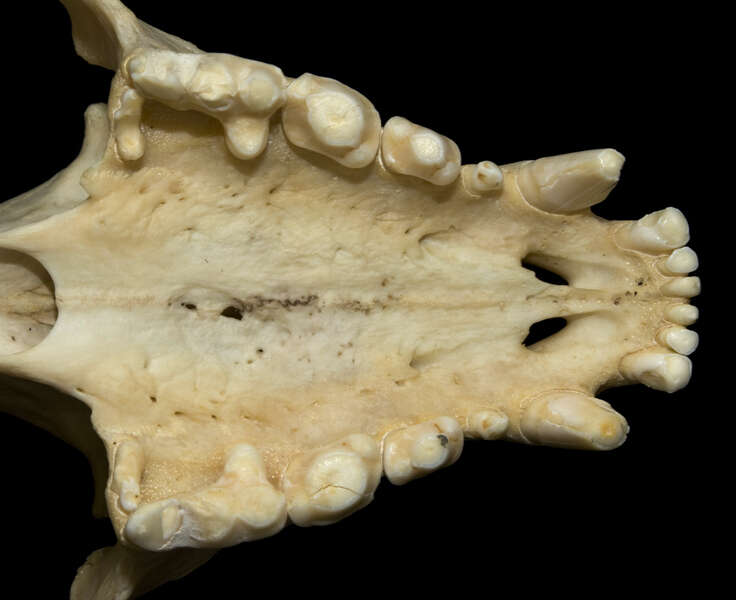
Striped hyena fossils are common in Africa, with records going back as far as the Early Pleistocene. The species may have evolved from Hyaenictitherium namaquensis of Pliocene Africa. As fossil striped hyenas are absent from the Mediterranean region, it is likely that the species is a relatively late invader to Eurasia, having likely spread outside Africa only after the extirpation of spotted hyenas from Asia at the end of the last glacial period. The striped hyena occurred for some time in Europe during the Pleistocene, having been particularly widespread in France and Germany. It also occurred in Montmaurin, Hollabrunn in Austria, the Furninha Cave in Portugal, and the Genista Caves in Gibraltar. The European form was similar in appearance to modern populations, but was larger, being comparable in size to the brown hyena.
📌 Fur
The winter coat is unusually long and uniform for an animal its size, with a luxuriant mane of tough, long hairs along the back from the occiput to the base of the tail. The coat is generally coarse and bristly, though this varies according to season. In winter, the coat is fairly dense, soft, and has well-developed underfur. The guard hairs are long on the flanks, long on the mane and on the tail. In summer, the coat is much shorter and coarser, and lacks underfur, though the mane remains large.
In winter, the coat is usually of a dirty-brownish grey or dirty grey colour. The hairs of the mane are light grey or white at the base, and black or dark brown at the tips. The muzzle is dark, greyish brown, brownish-grey or black, while the top of the head and cheeks are more lightly coloured. The ears are almost black. A large black spot is present on the front of the neck, and is separated from the chin by a light zone. A dark field ascends from the flanks ascending to the rear of the cheeks. The inner and outer surface of the forelegs are covered with small dark spots and transverse stripes. The flanks have four indistinct dark vertical stripes and rows of diffused spots. The outer surface of the thighs has 3–4 distinct vertical or oblique dark bands which merge into transverse stripes in the lower portion of the legs. The tip of the tail is black with white underfur.
📌 Geographic variation
, no subspecies are recognised.
📌 Distribution and habitat
, India]]
The striped hyena's historical range encompassed Africa north of and including the Sahel zone, eastern Africa south into Tanzania, the Arabian Peninsula and the Middle East up to the Mediterranean Sea, Turkey, Iraq, the Caucasus (Azerbaijan, Armenia, Georgia), Iran, Turkmenistan, Uzbekistan, Tajikistan, Afghanistan (excluding the higher areas of Hindukush), and the Indian subcontinent. Today the species' distribution is patchy in most ranges, thus indicating that it occurs in many isolated populations, particularly in most of west Africa, most of the Sahara, parts of the Middle East, the Caucasus, and central Asia. It does however have a continuous distribution over large areas of Ethiopia, Kenya, and Tanzania. Its modern distribution in Pakistan, Iran, and Afghanistan is unknown with some sizable large number in India in open areas of Deccan Plateau.
{| class="wikitable collapsible collapsed"
|-
! Country
! Population
! Status
! Threats/Protection
|-
|Afghanistan
|Unknown
|Data deficient
|Striped hyenas are caught, either for hyena-baiting or for medicinal purposes
|-
|Saudi Arabia
|100-1,000
|Threatened
|
|-
|Turkmenistan
|100–500
|Threatened
|Declining from hunting, though listed in the Red Data Book of Turkmenia
|-
|United Arab Emirates
|Unknown
|Data defictient
|
|-
|Uzbekistan
|25–100
|Threatened
|Striped hyena populations have declined over decades from active hunting and habitat loss, though they are listed in the Red Data Book of Uzbekistan and are protected
|-
|Western Sahara
|Unknown
|Data deficient
|
|-
|Yemen
|Unknown
|Data deficient
|
|}
📌 Behaviour and ecology
=== Social and territorial behaviour ===
, India]]
The striped hyena is a primarily nocturnal animal, which typically only leaves its den at the onset of total darkness, returning before sunrise. Striped hyenas typically live alone or in pairs, though groups of up to seven animals are known in Libya. They are generally not territorial, with home ranges of different groups often overlapping each other. Home ranges in the Serengeti have been recorded to be , while one in the Negev was calculated at . While the composition of juvenile scent pouch bacteria is variable, adult striped hyenas have more uniform bacterial communities in their scent pouches, with specific types and amounts of each taxon present.
In aggressive encounters, the black patch near the thoracic and lumbar vertebrae is erected. When fighting, striped hyenas will bite at the throat and legs, but avoid the mane, which serves as a signaling device. When greeting each other, they lick the mid-back region, sniff each other's noses, extrude their anal pouch, or paw each other's throats. The species is not as vocal as the spotted hyena, its vocalisations being limited to a chattering laugh and howling.
📌 Reproduction and development
The striped hyena is monogamous, with the male establishing the den with the female, helping her raise and feed when cubs are born. The mating season varies according to location; in Transcaucasia, striped hyenas breed in January–February, while those in southeast Turkmenia breed in October–November. In captivity, breeding is non-seasonal. Mating can occur at any time of the day, during which the male grips the skin of the female's neck.
]]
The gestation period lasts 90–91 days. Striped hyena cubs are born with adult markings, closed eyes, and small ears. This is in marked contrast to newborn spotted hyena cubs which are born almost fully developed, though with black, unmarked coats. Their eyes open after 7–8 days, and the cubs leave their dens after one month. Cubs are weaned at the age of 2 months, and are then fed by both parents. By autumn, the cubs are half the size of their parents. In the wild, striped hyenas can live for 12 years, while in captivity they have been known to reach 23.
📌 Burrowing behaviour
The striped hyena may dig its own dens, but it also establishes its lairs in caves, rock fissures, erosion channels, and burrows formerly occupied by porcupines, wolves, warthogs, and aardvarks. Hyena dens can be identified by the presence of bones at their entrances. The striped hyena hides in caves, niches, pits, dense thickets, reeds, and plume grass during the day to shelter from predators, heat, or winter cold. The size and elaboration of striped hyena dens varies according to location. Dens in the Karakum have entrances 0.67–0.72 m wide and are extended over a distance of 4.15–5 m, with no lateral extensions or special chambers. In contrast, hyena dens in Israel are much more elaborate and large, exceeding 27 m in length.
📌 Relationships with other predators
consuming a blackbuck carcass]]
The striped hyena competes with the grey wolf in the Middle East and central Asia. In the latter area, a great portion of the hyena's diet stems from wolf-killed carcasses. In Israel the striped hyena is dominant over the wolf on a one-to-one basis, though wolves in packs can displace single hyenas from carcasses. Both species have been known to share dens on occasion. Rarely, striped hyenas have been known to travel with and live amongst wolf packs, with each species doing the other no harm. Both predators may benefit from this unusual alliance, as the hyenas have better senses of smell and greater strength, and the wolves may be better at tracking large prey.
Red foxes may compete with striped hyenas on large carcasses. Red foxes may give way to hyenas on unopened carcasses, as the latter's stronger jaws can easily tear open flesh which is too tough for foxes. Foxes may harass hyenas, using their smaller size and greater speed to avoid the hyena's attacks. Sometimes, foxes seem to deliberately torment hyenas even when there is no food at stake. Some foxes may mistime their attacks, and are killed.
The species frequently scavenges from the kills of felids such as tigers, leopards, cheetahs, and caracals. A caracal can drive a subadult hyena from a carcass. The hyena usually wins in one-to-one disputes over carcasses with leopards, cheetahs, and tiger cubs, but is dominated by adult tigers. and the sloth bear in Balaram Ambaji Wildlife Sanctuary, in the Indian State of Gujarat.
📌 In culture
=== In folklore, religion, and mythology ===
.]]
Striped hyenas are frequently referenced in Middle Eastern literature and folklore, typically as symbols of treachery and stupidity. In the Near and Middle East, striped hyenas are generally regarded as physical incarnations of jinn. Zakariya al-Qazwini (1204–1283) wrote in Arabic of a tribe of people called "Hyena People." In his book Marvels of Creatures and the Strange Things Existing (), he wrote that should one of this tribe be in a group of 1,000 people, a hyena could pick him out and eat him. The image of striped hyenas in Afghanistan, India, Pakistan and Palestine is more varied. Though feared, striped hyenas were also symbolic of love and fertility, leading to numerous varieties of love medicine derived from hyena body parts. Among the Baloch people, witches or magicians are said to ride striped hyenas at night.
In Gnosticism, the Archon Astaphaios is depicted with a hyænid face.
📌 Predation on livestock and crops
waste in Dahod district, Gujarat, India]]
The striped hyena is sometimes implicated in the killing of livestock, particularly goats, sheep, dogs and poultry. Larger stock is sometimes reportedly taken, though it is possible that these are cases of scavenging being mistaken for actual predation. Although most attacks occur at low densities, a substantial number reputedly occur in Egypt, Ethiopia, India, Iraq, and possibly Morocco.
In Turkmenistan, striped hyenas kill dogs, while they also kill sheep and other small animals in the Caucasus; there were even reports that striped hyenas have killed horses and donkeys in Iraq during the mid-twentieth century. Sheep, dogs, horses, and goats are also preyed upon in North Africa, Israel, Iran, Pakistan, and India.
Striped hyenas also cause damage on occasion to melon fields and to date palms in date plantations in Israel and Egypt, and to plantations of watermelons and plantations of honey melons in Turkmenistan.
📌 Attacks on humans and grave desecration
In ordinary circumstances, striped hyenas are extremely timid around humans, though they may show bold behaviours toward people at night. Several attacks have occurred in India; in 1962, nine children were thought to have been taken by hyenas in the town of Bhagalpur in the Bihar State in a six-week period A census on wild animal attacks during a five-year period in the Indian state of Madhya Pradesh showed that hyenas had only attacked three people, the lowest figure when compared to deaths caused by wolves, gaur, boar, elephants, tigers, leopards, and sloth bears.
Though attacks on live humans are rare, striped hyenas will scavenge on human corpses. In Turkey, stones are placed on graves to stop hyenas digging the bodies out. In World War I, the Turks imposed conscription (safar barlek) on Lebanon; people escaping from the conscription fled north, where many died and were subsequently eaten by hyenas.
📌 Hunting
.]]
Striped hyenas were hunted by Ancient Egyptian peasants for duty and amusement along with other animals that were a threat to crops and livestock. Algerian hunters historically considered the killing of striped hyenas as beneath their dignity, due to the animal's reputation for cowardice. A similar attitude was held by British sportsmen in British India. On some rare occasions, hyenas were ridden down and speared by men on horseback. Although hyenas were generally not fast enough to outrun horses, they had the habit of doubling and turning frequently during chases, thus ensuring long pursuits. Generally though, hyenas were hunted more as pests than sporting quarries. Their scavenging damages skulls, skins and other articles from hunter's camps, which made them unpopular among sportsmen. In the Soviet Union, hyena hunting was not specially organised. Most hyenas were caught incidentally in traps meant for other animals.
📌 Striped hyenas as food
]]
A mural depicted on Mereruka's tomb in Sakkara indicates that Old Kingdom Egyptians forcefed hyenas in order to fatten them up for food, European writers in the 19th and early 20th centuries recorded that striped hyenas were eaten by some Egyptian peasants, Arabian Bedouins, Palestinian laborers, Sinai Bedouins, Tuaregs, Among some Bedouins of Arabia at the beginning of the 20th century, hyena meat was generally considered medicine, rather than food.
📌 Striped hyenas in folk magic
The Ancient Greeks and Romans believed the blood, excrement, rectum, genitalia, eyes, tongue, hair, skin, and fat, as well as the ash of different parts of the striped hyena's body, were effective means to ward off evil and to ensure love and fertility. The Greeks and Romans believed that the genitalia of a hyena "would hold a couple peaceably together" and that a hyena anus worn as an amulet on the upper arm would make its male possessor irresistible to women.
In West and South Asia, hyena body parts apparently play an important role in love magic and in the making of amulets. In Iranian folklore, it is mentioned that a stone found in the hyenas body can serve as a charm of protection for whoever wears it on his upper arm. In the Pakistani province of Sindh, the local Muslims place the tooth of a striped hyena over churns in order not to lose the milk's baraka. In Iran, a dried striped hyena pelt is considered a potent charm which forces all to succumb to the possessors attraction. In Afghanistan and Pakistan striped hyena hair is used either in love magic or as a charm in sickness. Hyena blood has been held in high regard in northern India as potent medicine, and the eating of the tongue helps fight tumors. In the Khyber area, burned striped hyena fat is applied to a man's genitals or sometimes taken orally to ensure virility, while in India the fat serves as a cure for rheumatism. In Afghanistan, some mullahs wear the vulva (kus) of a female striped hyena wrapped in silk under their armpits for a week. If a man peers through the vulva at the woman of his desire, he will invariably get hold of her. This has led to the proverbial expression in Dari of kus-e kaftar bay, as well as in Pashto of kus-e kaftar which literally mean "it happens as smoothly as if you would look through the vulva of a female striped hyena". In the North-West Frontier Province and Baluchistan, the Pakhtun keep the vulva in vermilion powder, itself having aphrodesic connotations. The rectum of a freshly killed striped hyena is likewise used by homosexuals and bisexuals to attract young men. This has led to the expression "to possess the anus of a [striped] hyena" which denotes somebody who is attractive and has many lovers. A striped hyena's penis kept in a small box filled with vermilion powder can be used for the same reasons.
📌 Tameability
striped hyena.]]
The striped hyena is easily tamed and can be fully trained, particularly when they are young. Although the Ancient Egyptians did not consider striped hyenas sacred, they did supposedly tame them for use in hunting. When they are raised with a firm hand, they may eventually become affectionate and as amenable as well-trained dogs, though they emit a strong odour which no amount of bathing will cover. Although they kill dogs in the wild, striped hyenas raised in captivity can form bonds with them.