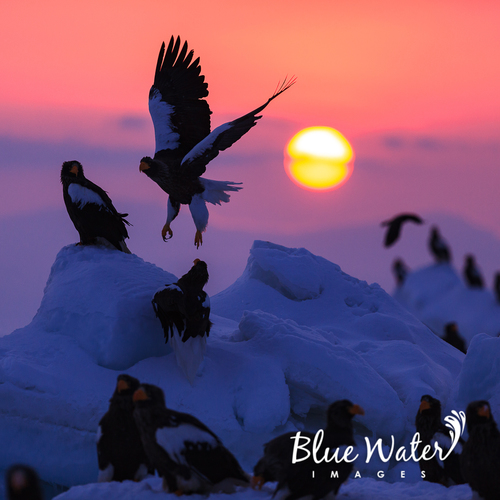
Steller's sea eagle, also known as the Pacific sea eagle or white-shouldered eagle, is a very large diurnal bird of prey in the family Accipitridae. It was described first by Peter Simon Pallas in 1811. No subspecies are recognised. A sturdy eagle, it has dark brown plumage with white wings and tail, a yellow beak, and yellow talons. Typically, it is the heaviest eagle in the world, at about 5 to 10ย kg, but in some standard measurements, may be ranked below the harpy eagle and the Philippine eagle. Steller's sea eagle females are bigger than males, similar to other raptors.
๐ก๏ธ Conservation Status
vulnerable
vu
๐ Taxonomy
This species was described initially as Aquila pelagica by Prussian naturalist Peter Simon Pallas, in 1811. The species name is the Ancient Greek pelagos, "the open sea/ocean". Dutch naturalist Coenraad Jacob Temminck named it Falco leucopterus, "white winged eagle", in 1824, and Heinrich von Kittlitz called it Falco imperator in 1832. George Robert Gray moved the species into the genus Haliaeetus in 1849.
"Steller's sea eagle" has been designated the official name by the International Ornithologists' Union (IOU). It is named after the German naturalist, Georg Wilhelm Steller. It also is known as Steller's fish eagle, Pacific sea eagle, or white-shouldered eagle. In Korean, the eagle is called chamsuri (true eagle). In Mandarin, it is called hวtรณu hวidiฤo (tiger-headed sea eagle).
A 1996 analysis of the cytochrome b gene of mitochondrial DNA showed that Steller's sea eagles diverged from a lineage that gave rise to the bald eagle (Haliaeetus leucocephalus) and white-tailed eagle (H. albicilla) around three to four million years ago. All three of these species have yellow eyes, beaks, and talons, unlike their next-closest relative, Pallas's fish eagle (H. leucoryphus).
H. pelagicus is monotypic, although a dubious subspecies has been named; H. p. niger. The latter name was given to the population that lacked white feathers except for the tail, and may have resided all year in Korea. Last seen in 1968 and long believed to be extinct, a female matching H. p. niger in appearance was hatched in captivity in the Bayerischen Jagdfalkenhof (Germany) in 2001 and subsequently transferred to Tierpark Berlin. Both her parents had typical coloration, indicating that H. p. niger is an extremely rare dark morph rather than a valid subspecies, as had been suggested earlier. One of the offspring of the dark Berlin female, a male hatched in 2014 that now lives in Skandinavisk Dyrepark (Denmark), also is a dark morph.
๐ Standard measurements and physiology
, United States]]
As in most Haliaeetus eagles, the tarsus and tail are relatively short compared to other very large eagles at and in length, respectively, with the Philippine eagle surpassing it by up to and , apparently. In all sea and fish eagles, the toes are relatively short and stout, with the bottom of the foot covered in spicules and the talons being relatively shorter and more strongly curved than in comparably sized eagles of forests and fields, such as the "booted eagle" group (i.e. Aquila) or "harpy eagles". All of these specializations developed in the aid of capturing fish rather than medium-sized mammals and large birds, although, clearly these are not excluded from capture.
The bill is large. The skull is around in total length, the culmen is from , and the bill from the gape to the tip is around . A Steller's sea eagle's bill is probably the largest of any living eagle, just surpassing the Philippine eagle with a sole known culmen measurement (from a mature female) of , and are similar in robustness (if slightly shorter in culmen length) to those of the largest accipitrids, the Old World vultures.
๐ Plumage
, Germany: Before the hatching of this female, which had "normal" parents, the dark morph was considered a separate subspecies. The bold, pied coloration of adults may play some part in social hierarchies with other eagles of their own species during the nonbreeding season, although this has not been extensively studied. A very rare dark morph, once regarded as a separate subspecies, H. p. niger, lacks white in its plumage, except for the tail. The eyes, bill, and feet of adults are yellow.
The downy plumage of chicks is silky white on hatching, though it soon turns a smoky brown-grey. As in other sea eagles, remiges and rectrices of the first-year plumage are longer than those of adults. Juvenile plumage is largely a uniform dark soot-brown with occasional grey-brown streaking about the head and the neck, white feather bases, and light mottling on the rectrices. The tail of the immature eagle is white with black mottling distally. The young Steller's sea eagle has dark brown irises, whitish legs, and blackish-brown beak. Through at least three intermediate plumages, mottling in the tail decreases, body and wing feathering acquires a bronze cast, and the eyes and bill lighten in colour. Definitive plumage is probably reached in the fourth to fifth year of life, based on data from captives. Young of the typical morph and the rare dark morph are alike. The difference only becomes clear once they have gained the adult plumage.
First and intermediate plumages are difficult to distinguish from those of the white-tailed eagle, which co-occurs in the entire breeding range of H. pelagicus, but beyond their bulkier, larger overall form, they can fairly reliably be distinguished at reasonable range by their considerably more massive bill and their darker and more uniform body plumage. This is not to mention the differing shape of the Steller's diamond-shaped tail and wings (paddle-like in Steller's against the square-looking wings of the white-tailed), especially in flight, as well as a generally distinct under-wing pattern.
๐ Voice
Steller's sea eagle is known to make a deep barking cry, ra-ra-ra-raurau. In aggressive interactions, its call is similar to the white-tailed eagles, but deeper.
๐ Distribution and habitat
, Russia, a part of the species' breeding range]]
Steller's sea eagle breeds on the Kamchatka Peninsula, the coastal area around the Sea of Okhotsk, the lower reaches of the Amur River, and on northern Sakhalin and the Shantar Islands, Russia. Many eagles migrate from breeding grounds to Korea, Japan, and China in winter. Most birds winter south of their breeding range, in the southern Kuril Islands, Russia, and Hokkaidล, Japan. Steller's sea eagle is less prone to vagrancy than the white-tailed eagle, as it lacks the long-range dispersal typical of juveniles of that species, but vagrant eagles have been found in North America at locations including the Aleutian Islands, Pribilof Islands, and Kodiak Island, as well as a single individual seen in Texas, Nova Scotia, Massachusetts, Maine, and Newfoundland, and inland in Asia to as far as Beijing in China and Yakutsk in Russia's Sakha Republic, and south to as far as Taiwan.
The large body size (see also Bergmann's rule) and distribution of Steller's sea eagle suggests it is a glacial relict, meaning it evolved in a narrow subarctic zone of the northeasternmost Asian coasts, which shifted its latitude according to ice age cycles, and never occurred anywhere else. Their nests are built on large, rocky outcroppings or at the tops of large trees on the coast and alongside large rivers with mature trees. Habitat with large Erman's birches (Betula ermanii) and floodplain forests of larches, alders, willows, and poplars are preferred. Some eagles, especially those that nest on seacoasts, may not migrate. The timing, duration, and extent of migration depends on ice conditions and food availability.
On Kamchatka, eagles overwinter in forests and river valleys near the coast, but are irregularly distributed over the peninsula. Most wintering birds there appear to be residential adults. Steller's sea eagles that do migrate fly south to winter in rivers and wetlands in Japan, but occasionally move to mountainous inland areas as opposed to the seacoast. Each winter, drifting ice on the Sea of Okhotsk drives thousands of eagles south. Ice reaches Hokkaido in late January.
Eagle numbers peak in the Nemuro Strait in late February. On Hokkaido, eagles concentrate in coastal areas and on lakes near the coast, along with substantial numbers of white-tailed eagles. Eagles depart between late March and late April, with adults typically leaving before immatures. Migrants tend to follow seacoasts and are usually observed flying singly. In groups, migrants are typically observed flying apart. On Kamchatka, most migrants are birds in transitional plumages. They are also occasionally seen flying over the northern ocean or perching on sea ice during the winter.
๐ Vagrancy
A single individual has been moving around North America, having first been seen on August 30, 2020, near Denali National Park in Alaska. Subsequently, a Steller's sea eagle was photographed in Victoria, TX, not long after a winter storm blew into the state. This sighting has been verified by the Texas Bird Records Committee and is presumed to be the same individual as seen in Denali, though the photos are not sufficient to establish this identity. This was the first record of the species in the contiguous United States. The sea eagle was then confirmed in several locations in New Brunswick, Quebec, and Nova Scotia throughout the summer and into November. In December, it was spotted on the Taunton River in Massachusetts and then moved north to the Maine coast (Georgetown, Boothbay, and Pemaquid). More recently, it was seen on the east side on Newfoundland on April 22, 2022. In early 2023, this individual was spotted again in Maine along the shores of Georgetown. Marks on the wing indicate that all these sightings are of the same individual. This bird has been nicknamed "Stella" and garnered significant attention from birders, who boosted the local economy when traveling to see it.
Beginning in the spring of 2024 in Newfoundland, a Steller's sea eagle was reported constructing a nest.
๐ Interspecific competition
Occasionally, a smaller species of eagle may steal a fish away from the Steller's, especially if it is distracted by aggression from conspecifics, and both juvenile and adult Steller's may lose fish to the smaller species even face-to-face, especially a less assertive bird, such as immature Steller's. One video shows a golden eagle engaging an immature Steller's in a conflict and ultimately displacing it after maintaining a superior grip despite its smaller size. In other cases, the Steller's have been photographed coming away with the prey after using its superior size to dominate, usually by bearing down its mass and large bill over the smaller eagles.
In other cases, the three eagle species have been observed to feed in close proximity and seem to be outwardly indifferent to each other's presence. In inland areas, where golden, bald, and white-tailed eagles compete over food sources which are not as abundant as these fish and, more importantly, compete for nesting ranges, aggressive interspecies competition can be more common. Steller's sea eagles co-occur with cinereous vultures, the largest living accipitrid, during the winter in the Korean Peninsula and Northeast China. In one case, a cinereous vulture, the largest living accipitrid, was observed to be pursued in flight and kleptoparasitized by a Steller's sea eagle.
๐ Reproduction
, Poland. Steller's sea eagles take several years to reach maturity, attaining the adult color pattern when four.]]
This eagle builds several bulky aeries made of twigs and sticks at a height up to and diameter up to . They usually place such nests high up on trees or on rocky outcrops at above the ground, sometimes in trees up to . Alternate nests are usually built within of each other. In one case, two active nests were found to have been located within . Steller's sea eagles copulate on the nest after building it. Due primarily to egg predation and nest collapses, only 45โ67% of eggs are successfully reared to adulthood and up to 25% of nestlings may be lost. Once fully grown, though, the eagle has no natural predators.
๐ Conservation status
Steller's sea eagles are classified as vulnerable by the IUCN. They are legally protected, being classified as a national treasure in Japan and mostly occurring in protected areas in Russia, but many threats to their survival persist. These mainly include habitat alteration, industrial pollution, and overfishing, which in turn decrease their prey source. The current population is estimated at 5,000 and decreasing.
In Kamchatka, 320 pairs have been recorded. An additional 89 nesting areas are not monitored. In the mountains of Koryakan and along the Bay of Penshina, over 1,200 pairs breed and at least 1,400 juveniles occur. About 500 pairs live in the Khabarovsk region of the Okhostsk coast, and 100 on the Shantar Islands. Another 600 pairs occur in the lower Amur. About 280 pairs are on Sakhalin Island and a few are on the Kurile Islands. The total population is around 3,200 breeding pairs. Possibly, up to 3,500 birds winter on Kamchatka, and another roughly 2,000 may occur on Hokkaido. Generally, the species' outlook is favorable. Outside the breeding range, food bases in the principal wintering areas are so far secure.