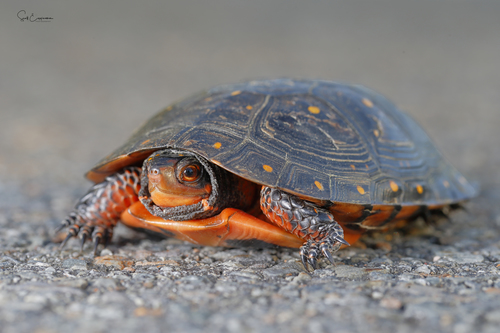
The spotted turtle, the only species of the genus Clemmys, is a small, semi-aquatic turtle. Their broad, smooth, low upper shell, or carapace, reaches 8–12 cm (3.1–4.7 in) upon adulthood, and ranges in its exact colour from black to a bluish black with a number of tiny yellow round spots. The spotting patterning extends from the head, to the neck and out onto the limbs. Sexually mature males have a concave plastron and a long, thick tail. By contrast, sexually mature females possess a flat plastron and have a tail that is noticeably shorter and thinner than that of mature males. Mature males also have a dark iris and face; females typically have a yellow or orange iris and a similarly coloured face that is distinctly lighter than the males'. Juveniles appear female-like in this regard, and at maturity males begin to develop darker features.
🛡️ Conservation Status
endangered
en
📌 Taxonomy
The spotted turtle is the only species in the genus Clemmys, which was first named in 1828 by Ferdinand August Maria Franz von Ritgen. Johann Gottlob Schneider originally described the species as Testudo guttatai in 1792; however, he is now the authority for the current binomial name, Clemmys guttata. The bog turtle and the wood turtle were moved to the genus Glyptemys, while the western pond turtle has been renamed Actinemys, leaving the spotted turtle the only member of its genus.
📌 Distribution
.]]
The spotted turtle ranges from southern Maine, Quebec, and Ontario, south along the eastern US to Florida in the east and central Indiana and Ohio in the west. Disjunct populations exist in the Canadian portion of its range and also in central Illinois, central Georgia, North Carolina, South Carolina, and Indiana. In Indiana and Illinois, the species is found only in the northern portion of the state but it is found on most of the lower peninsula of Michigan. The highly fragmented distribution of spotted turtles in Ohio only covers the northern two-thirds of the state.
The spotted turtle occupies a variety of habitats including swamps, bogs, fens, marshes, woodland streams, and wet pastures. Also, brackish streams that are influenced by tides can also serve as a home to this turtle An optimum habitat would include shallow and slow-moving waters with soft muddy soil, sedge tussocks, water lilies, sphagnum moss, and cattails. Because it is so often found in areas that contain duckweed, the yellow spots on these turtles may serve as a form of camouflage. The spotted turtle avoids artificial reservoirs and deep, open-water areas.
The spotted turtle can be decidedly terrestrial, spending a good amount of time on land and sometimes basking on patches of grass near its body of water. The females during times of nesting will travel onto land and lay eggs on sunny soil. Nesting also may take place in other terrestrial locations, for instance near man-made dikes or the nest of a muskrat.
📌 Reproduction
A study in Pennsylvania analyzed the reproductive biology of the spotted turtle. Sexual maturity is not reached until age 8, upon which researchers found that courtship and nesting periods typically ranged from March until June. The courtships involved females being frantically chased by one to several males for approximately 15 to 30 minutes. During the chase, females' tails and legs were often bit by males. If two males were present, they occasionally stopped the chase to fight with one another and the losing male retreated. When the female was caught, the male mounted her and placed his tail beneath the female while grasping her carapace tightly. Females later constructed their nest in well-drained areas that were exposed to full sunlight. Clutches can range from 1–8 with an average of 3–4. These animals also exhibit temperature-dependent sex determination, meaning that the outside temperature during the incubation period determines the sex of the hatchling with males resulting from the temperature being lower and females when it's higher. After the eggs were laid, they were arranged in the nest by alternate movements of the hind feet. The hind feet were also used to scrape soil and grass back into the nest cavity. Incubation periods were estimated to range between 70 and 83 days.
📌 Population features
Although the spotted turtle has been observed in Quebec, no permanent population is known to exist there. However, 104 populations have been discovered in Ontario. Most of these concentrated around Georgian Bay, on the north shore of Lake Erie, and southeastern Ontario. Of the original 104 sites noted, 36 are known to no longer have spotted turtles.
📌 Ecology and behavior
The spotted turtle is one species whose sex is determined by temperature during embryonic development. Some researchers have claimed that global warming may deleteriously impact population sex ratios.
During the freezing temperatures of winter and the extreme heat of summer, spotted turtles become inactive during environmentally unfavorable conditions. However, the species appears to be relatively tolerant of drought conditions. Spotted turtles do become active very early in the spring, and are often active at relatively cold water temperatures during that season. Activity appears to peak during April and May in the northern part of the range. In the warmest part of the summer (when water temperatures exceed 30 °C), they may aestivate terrestrially or aquatically for long periods of time. During summer dormancy, the turtles may burrow into leaf litter in woodlands or marsh edges or open fields; others remain in muskrat burrows or other aquatic refuges. Litzgus and Brooks (2000) have questioned the common presumption that summer dormancy is an attempt by the turtles to avoid high temperatures; data from Ontario and elsewhere suggests that avoidance of predation and conservation of energy resources may be viable alternate explanations. No matter the explanation for dormancy, the "winter" dormant period may commence in late summer or fall, but in almost every instance after a return to aquatic habitats.
Spotted turtles home ranges tend to occupy limited areas of about 0.5 to 3.5 hectares (1.2 to 8.6 acres). Note that due to their size, these small turtles are highly vulnerable to predation, particularly during their frequent terrestrial wanderings. Many specimens will show mutilation injuries and scars from past predation attempts. Raccoons (Procyon lotor) are particularly adept at consuming and killing this species. Spotted turtles have been observed to dive into the water and bury themselves in the bottom mud when surprised while basking. Muskrats kill many spotted turtles during the winter dormant period.
📌 Conservation
in released back into the wild in Virginia on August 1, 2024.]]
In Canada, the spotted turtle is federally endangered, It is listed by the IUCN as endangered, In the Northeast, it has protective status in five of the six New England states and is listed as a species of special concern in New York.
Habitat destruction, alteration, and conversion, collection for the pet trade, and other human impacts such as vehicle mortality (cars and mowers) are leading to declines in populations. Additionally, since reproductive rates of these turtles are low, spotted turtles are extremely susceptible to population impacts.
Due to their aquatic habitat, these turtles are particularly sensitive to pollutants and toxic substances. They will disappear rapidly from areas with declining water quality.
📌 Actions to benefit the species
New Hampshire has identified some ways to conserve the habitat of spotted turtles.
These include:
# Designing roads and transportation infrastructure to reduce vehicular mortality
# Public education about relevant rules and regulations on spotted turtles and other reptiles and amphibians (e.g. sale and possession)
# Minimize disturbance to turtles from recreational activities
# Additional research and monitoring of the species
# Promote habitat restoration and enhancement
# Promote alternatives to habitat conversion and dewatering