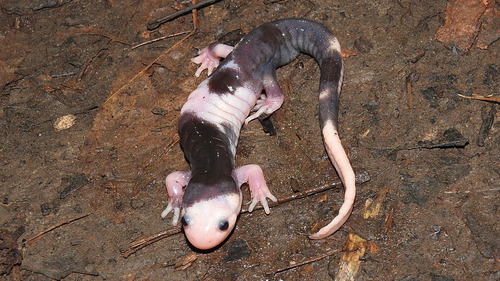
The spotted salamander, also known commonly as the yellow-spotted salamander, is a species of mole salamander in the family Ambystomatidae. The species is native to the eastern United States and Canada. It is the state amphibian of Ohio and South Carolina. The species ranges from Nova Scotia, to Lake Superior, to southern Georgia and Texas. Its embryos have been found to have symbiotic algae, Chlorococcum amblystomatis, living in and around them, the only known example of vertebrate cells hosting an endosymbiont microbe.
📌 Habitat and dispersal
The spotted salamander usually lives in mature forests with ponds or ephemeral vernal pools for breeding sites. Vernal pools are suitable breeding sites for these amphibians as they dry often enough to exclude fish that eat the salamander eggs and larvae, while retaining water long enough to allow amphibian larvae to complete development and metamorphose into terrestrial adults. A study showed larger pools (as opposed to smaller pools) had more egg masses, higher occupancy, and higher larval survival rates for spotted salamanders. Outside of the breeding season, these salamanders spend their time in forests with well-drained soils that contain many burrows dug by small mammals. They have also been known to be absent from landscapes and forest with canopy cover below 30%.
Salamander populations from nearby pools form genetically-distinct metapopulations. Subpopulations within 4.8 kilometers share a higher proportion of genes, while populations greater than 4.8 kilometers share a smaller proportion of genes. Inter-population dispersal is likely mediated by both species-specific behaviors and natural limitations.
📌 Behavior
The spotted salamander is fossorial. It rarely comes above ground, except after a rain or for foraging and breeding. During the winter, it brumates underground, and is not seen again until breeding season in early March–May. In the spring after rain and when temperatures rise above , salamanders emerge from underground. They cross Henry Street to get to their breeding grounds, vernal pools which form on the other side of the road, an event common among amphibians and known as the Big Night.
A. maculatum has several methods of defense, including hiding in burrows or leaf litter, autotomy of the tail, and a toxic milky liquid it excretes when perturbed. This secretion comes from large poison glands around the back and neck. The spotted salamander, like other salamanders, shows great regenerative abilities: if a predator manages to dismember a part of a leg, tail, or even parts of the brain, head, or organs, the salamander can grow back a new one, although this takes a massive amount of energy. As juveniles, they spend most of their time under the leaf litter near the bottom of the pools where their eggs were laid. The larvae tend to occupy refuges in vegetation, and lower their activity in the presence of predators.
A. maculatum tend to follow the same path in their migration to and from their burrows and breeding pools. They accomplish their journey in conditions that lack visual cues, since it is usually during periods of cloud cover. Some studies show evidence of landmark learning and use of geotaxis in spotted salamanders. Researchers found that spotted salamanders can associate visual landmarks with food. Thus spotted salamanders may learn landmarks in their habitat that are reliable indicators of resource locations or provide orientation clues for migration to and from breeding ponds.
Male salamanders come out earlier than females due to different responses in temperature than females. According to a study there is a correlation between the salamander's spot coloration and body condition. Salamanders' in lower body condition had less color and those with a better body score had brighter colored spots.
📌 Life cycle
During the majority of the year, spotted salamanders live in the shelter of leaves or burrows in deciduous forests. However, when the temperature rises and the moisture level is high, the salamanders make their abrupt migration towards their annual breeding ponds. Recent studies, however, indicate that temperature may be a more important factor than precipitation, as precipitation in winter months increase, yet salamanders do not migrate. In just one night, hundreds to thousands of salamanders may make the trip to their ponds for mating. Males will start a dance-like behavior called a liebsspiel, where afterward they lay down their spermatophore. This dance includes the salamanders circling around one another and putting their head's on one another's tail. Then, the male will swim away wiggling his tail. If the female wants to mate she will follow him to a sperm pack he made earlier. ("Spotted Salamander Ambystoma Maculatum") Males will migrate at higher rates than females early in the migration season. This could be due to different responses to temperature between males and females. This polymorphism is thought to confer advantages in vernal pools with varying dissolved nutrient levels, while also reducing mortality from feeding by wood frog larvae.
Adults only stay in the water for a few days, then the eggs hatch in one to two months. When the eggs hatch depends on the water temperatures. Eggs of A. maculatum can have a symbiotic relationship with the green alga Chlorococcum amblystomatis. A dense gelatinous matrix surrounds the eggs and prevents the eggs from drying out, but it inhibits oxygen diffusion (required for embryo development). C. amblystomatis provides increased oxygen and supplemental nutrition from fixed carbon products via photosynthesis and removes the embryo's nitrogenous waste (ammonia) in the egg capsule, aiding in the salamander's embryonic development and growth. The developing salamander thus metabolizes the oxygen, producing carbon dioxide (which then the alga consumes). Photosynthetic algae are present within the egg capsule of the developing salamander embryo, enhancing growth. However, the widely used herbicide, atrazine, has been found to significantly lower hatching success rate by eliminating the symbiotic algae associated with the egg masses.
As larvae, they are usually light brown or greenish-yellow. They have small dark spots and are born with external gills. In two to four months, the larvae lose their gills, and become juvenile salamanders that leave the water. Spotted salamanders have been known to live up to 32 years, and normally return to the same vernal pool every year. These pools are seasonal and will usually dry up during the late spring and stay dry until winter.
Spotted salamanders are often preyed on by raccoons, skunks, turtles, snakes and sometimes salmonoid fish. For this reason they perform an important function by connecting the food chain. sought out through the pet trade.
File:Ambystoma maculatum polymorphic egg masses.jpg|Polymorphic spotted salamander egg masses: white morph (left) and clear morph (right)
File:Spotted Salamander (Ambystoma maculatum) Larva.jpg|Spotted salamander (Ambystoma maculatum) larva
File:Adult Spotted Salamander.jpg|An adult spotted salamander seen crawling on the forest floor in central Ontario.