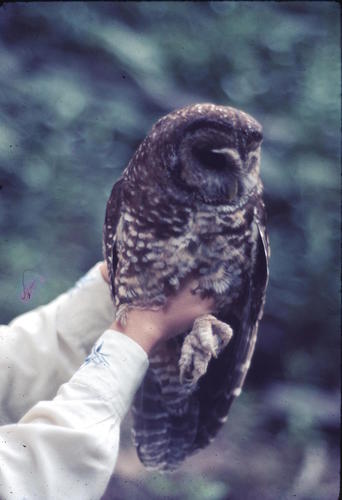
The spotted owl is a species of true owl. It is a resident species of old-growth forests in western North America, where it nests in tree hollows, old bird of prey nests, or rock crevices. Nests can be between 12 and 60 metres high and usually contain two eggs. It is a nocturnal owl which feeds on small mammals and birds. Three subspecies are recognized, ranging in distribution from British Columbia to Mexico. The spotted owl is under pressure from habitat destruction throughout its range, and is currently classified as a near-threatened species.
π‘οΈ Conservation Status
near threatened
nt
π Subspecies
*S. o. caurina β Northern spotted owl
*S. o. lucida β Mexican spotted owl
*S. o. occidentalis β California spotted owl
The Gila Wilderness is home to the largest population of the Mexican subspecies.
π Distribution
The northern spotted owl has a nearly contiguous range from southwestern British Columbia south through western Washington and Oregon to Marin County, California. The California spotted owl's range overlaps this range in the southern Cascade Range, and extends south through the western Sierra Nevada to Tulare County, with discrete populations in mountainous areas of coastal and southern California from Monterey County to northern Baja California. The Mexican spotted owl occurs in disjunct populations in mountain ranges and canyons of the Southwestern US (including Utah, Colorado, Arizona, New Mexico, and extreme western Texas), as well as in western Mexico (Sonora, Chihuahua, Nuevo LeΓ³n, and eastern Coahuila) through the Sierra Madre Occidental and the Sierra Madre Oriental.
π Ecology
===Home range and density===
Spotted owl home ranges are generally large but of variable size, with extents of , depending on subspecies, habitat, and prey availability. Home ranges are smaller in the breeding season than in the nonbreeding season, and females have larger home ranges than males.
Density of spotted owl pairs within suitable habitat also depends on specific habitat quality and location, varying between 0.022 owls/km2 in pinyon-juniper woodlands of the Sacramento Mountains and 1.049 owls/km2.
π Nesting
Spotted owls do not build their own nests, instead making use of cavities found in trees, deadwood, and snags, as well as the sites of abandoned raptor or squirrel nests. Some nest sites are used repeatedly. Spotted owls most often choose the same type of cover selected for nesting sites for daytime roosting.
π Breeding
The spotted owl's breeding season occurs from early spring to late summer or fall, with prelaying behaviors such as preening and roosting together starting in February or March.
Spotted owl pairs are monogamous and rarely re-nest after failed breeding attempts. The species does not normally breed every year, with average breeding probability being 62%. Young owls may start breeding after one year but two years or older is more common. Normal clutch size is two eggs but may reach four on rare occasions. The female sits on the eggs and cares for the young, while the male provides food for them. Egg incubation times of about a month have been reported from western Oregon; time from fledging to independence of chicks is between three and four months. Once independent, juveniles disperse in late summer to fall, in the northern range often settling into a wintering range before seeking out breeding territories in the spring. Dispersal range is often less than .
π Lifespan and mortality
Spotted owls are long-lived and maximum ages of 16 or 17 years have been documented in the northern subspecies. The average annual survival rate is usually in excess of 80% for adults, although it is considerably lower for juveniles, which have an average annual survival rate of 21β29%. In New Mexico, the survival rate for fledgling Mexican spotted owls can be as low as 11%. The most common causes of mortality are predation, starvation, and possibly disease.
Spotted owls are nocturnal, sit-and-wait predators. They often hunt from a perch and swoop or pounce on prey, or may take arboreal prey from tree boles and limbs. They do occasionally hunt during the day. Although diet varies with location, the majority consists of a few mammalian species. Species taken most often are northern flying squirrels (which may comprise more than 30% of total prey) and woodrats (the most common prey overall), including dusky-footed (Neotoma fuscipes), bushy-tailed, (N. cinerea), and Mexican woodrats (N. mexicana). In some portions of its range, much of the spotted owl's diet is composed of several other mammals such as deer mice (Peromyscus maniculatus), pocket gophers (Thomomys spp.), voles (Microtus, Clethrionomys, and Phenocomys spp.), snowshoe hares (Lepus americanus), rabbits, and several species of squirrels. Bats and non-mammalian prey species are taken to a lesser extent, including birds (smaller owls, jays, woodpeckers, and passerines, including various songbirds), amphibians, reptiles, and insects.
π Conservation
The IUCN Red List status for the spotted owl is near threatened with a decreasing population trend. All studies assessing the species' population trend have found populations to be in decline. Habitat loss due to timber harvesting is generally recognized as the main threat. Forest and spotted owl management documents often state that severe wildfire is a cause of recent declines in populations of spotted owls, and that mixed-severity fires (5β70% of burned area in high-severity patches, with >75% mortality of dominant vegetation) pose a primary threat to spotted owl population viability, but a systematic review and meta-analysis found fires created more benefits than costs for spotted owls. The northern spotted owl was one of a few cases where the "God committee", a provision of the Endangered Species Act, has been invoked to decide whether or not to open up more federal forest for commercial logging.