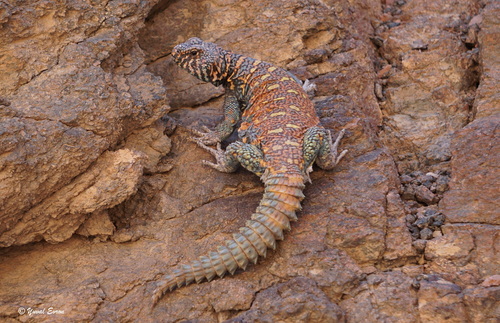
Uromastyx is a genus of lizards in the family Agamidae. The genus is native to Africa and the Middle East. Members of the species are commonly called spiny-tailed lizards, uromastyces, mastigures, or dabb lizards.
📌 Taxonomy
The generic name Uromastyx is derived from the Ancient Greek words (), meaning "tail", and (), meaning "whip" or "scourge", after the thick-spiked tail characteristic of all Uromastyx species.
📌 Species
The following species are in the genus Uromastyx. Three additional species were formerly placed in this genus, but have been moved to their own genus, Saara.
{| class="wikitable"
|-
! Image !! Scientific name !! Common name !! Distribution
|-
| ||Uromastyx acanthinura || North African mastigure, North African spiny-tailed lizard ||Morocco, Algeria, Tunisia, Libya, Egypt, Western Sahara, Chad, Mali, Niger, and Sudan
|-
| ||Uromastyx aegyptia || Egyptian mastigure, Egyptian spiny-tailed lizard|| Egypt and the Middle East.
|-
| ||Uromastyx alfredschmidti || ebony mastigure, Schmidt's mastigure, Schmidt's spiny-tailed lizard||Algeria and Libya.
The spiny tail of the Uromastyx serves as a defense mechanism, which the lizard swings at predators to protect itself. The tail’s spines can inflict damage, making it an effective tool for deterring threats
|-
| ||Uromastyx benti || Bent's mastigure, Yemeni spiny-tailed lizard|| Oman and Yemen.
|-
| ||Uromastyx dispar || Sudan mastigure||Mauritania, Sudan, Chad, Western Sahara, Algeria, and Mali.
|-
| ||Uromastyx geyri || Geyr's dabb lizard, Geyr's spiny-tailed lizard, Sahara mastigure, Saharan spiny-tailed lizard, Saharan yellow uromastyx, yellow Niger uromastyx ||Algeria, Mali, and Niger.
|-
| ||Uromastyx macfadyeni || Macfadyen's mastigure|| Somalia
|-
| ||Uromastyx nigriventris || Moroccan spiny-tailed lizard|| Morocco and Algeria.
|-
| ||Uromastyx occidentalis || || Western Sahara
|-
| ||Uromastyx ocellata || ocellated spinytail, eyed dabb lizard, ocellated uromastyx ||southern Egypt, Sudan, Eritrea, Djibouti, Ethiopia (near the Somali border), and northwestern Somalia
|-
| ||Uromastyx ornata || ornate mastigure|| Egypt, Israel, Saudi Arabia, and Yemen
|-
| ||Uromastyx princeps || princely spiny-tailed lizard, princely mastigure, Somalian mastigure ||Somalia, Ethiopia
|-
| ||Uromastyx shobraki || || Yemen
|-
| ||Uromastyx thomasi || Omani spiny-tailed lizard, Thomas's mastigure|| Oman
|-
| ||Uromastyx yemenensis || South Arabian spiny-tailed lizard||Yemen
|-
|}
Nota bene: A binomial authority in parentheses indicates that the species was originally described in a genus other than Uromastyx.
📌 Distribution
Uromastyx inhabit a range stretching through most of North and Northeast Africa, the Middle East, ranging as far east as Iran. Species found further east are now placed in the genus Saara. Uromastyx occur at elevations from sea level to well over . They are regularly eaten, and sold in produce markets, by local peoples.
📌 Reproduction
A female Uromastyx can lay anywhere from 5 to 40 eggs, depending on age and species. Eggs are laid approximately 30 days following copulation with an incubation time of 70–80 days.
Wild female Uromastyx are smaller and less colorful than males. For example, U. dispar maliensis females are often light tan with black dorsal spots, while males are mostly bright yellow with mottled black markings. Females also tend to have shorter claws. In captivity female U. dispar maliensis tend to mimic males in color. U. dispar maliensis are, therefore, reputably difficult to breed in captivity.
📌 Relationship with humans
📌 Captivity
Uromastyx are removed from the wild in an unregulated manner for the pet and medicinal trade in Morocco, despite their protected status in the country; conditions of the animals while being sold is often extremely poor and overcrowding is common. Historically, captive Uromastyx had a poor survival rate, due to a lack of understanding of their dietary and environmental needs. In recent years, knowledge has significantly increased, and appropriate diet and care has led to survival rates and longevity approaching and perhaps surpassing those in the wild. With good care, they are capable of living for over 25 years, and possibly as old as 60.
📌 Consumption by humans
U. dispar maliensis, known as "ḍabb" () by peninsular Arabs, is historically consumed as food by some of the Bedouin population of the Arabian peninsula, mainly those residing in the interior and eastern regions of Arabia. This lizard used to be considered an "Arabian delicacy". It is recorded that when an Uromastyx was brought to the Islamic prophet Muhammad by Bedouins, Muhammad did not eat the lizard, but Muslims were not prohibited by him from consuming it; thus Muhammad's companion Khalid bin Walid consumed the lizard.
In Judaism, this lizard is traditionally identified as the biblical tzav, one of the eight "creeping" animals forbidden for consumption that impart ritual impurity. The Torah states: "The following shall be impure for you among the creeping animals that swarm upon the earth: The weasel, and the mouse, and the dab lizard (tzav) of every variety; and the gecko, and the land-crocodile, and the lizard, and the skink, and the chameleon" (Leviticus 11:29–30).