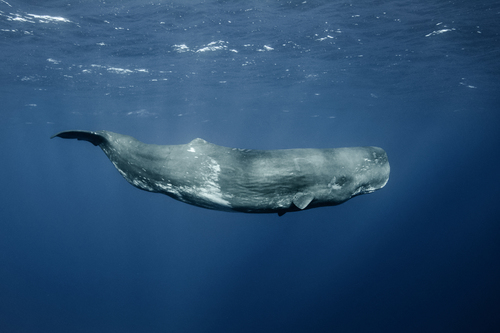
The sperm whale or cachalot is the largest of the toothed whales and the largest toothed predator. It is the only living member of the genus Physeter and one of three extant species in the sperm whale superfamily Physeteroidea, along with the pygmy sperm whale and dwarf sperm whale of the genus Kogia.
🛡️ Conservation Status
vulnerable
vu
📌 Taxonomy and naming
=== Etymology ===
The name "sperm whale" is a clipping of "spermaceti whale". Spermaceti, originally mistakenly identified as the whales' semen, is the semi-liquid, waxy substance found within the whale's head.
(See "Spermaceti organ and melon" below.)
The sperm whale is also known as the "cachalot", which is thought to derive from the archaic French for 'tooth' or 'big teeth', as preserved for example in the word in the Gascon dialect (a word of either Romance
or Basque
origin).
The etymological dictionary of Corominas says the origin is uncertain, but it suggests that it comes from the Vulgar Latin 'sword hilts'. The word cachalot came to English via French from Spanish or Portuguese , perhaps from Galician/Portuguese 'big head'.
The term is retained in the Russian word for the animal, (), as well as in many other languages.
The scientific genus name Physeter comes from the Greek (), meaning 'blowpipe, blowhole (of a whale)', or – as a pars pro toto – 'whale'.
The specific name macrocephalus is Latinized from the Greek ( 'big-headed'), from () + ().
Its synonymous specific name catodon means 'down-tooth', from the Greek elements ('below') and ('tooth'); so named because it has visible teeth only in its lower jaw. (See "Jaws and teeth" below.)
Another synonym australasianus ('Australasian') was applied to sperm whales in the Southern Hemisphere.
📌 Taxonomy
The sperm whale belongs to the order Cetartiodactyla, the order containing all cetaceans and even-toed ungulates. It is a member of the unranked clade Cetacea, with all the whales, dolphins, and porpoises, and further classified into Odontoceti, containing all the toothed whales and dolphins. It is the sole extant species of its genus, Physeter, in the family Physeteridae. Two species of the related extant genus Kogia, the pygmy sperm whale Kogia breviceps and the dwarf sperm whale K. sima, are placed either in this family or in the family Kogiidae. In some taxonomic schemes the families Kogiidae and Physeteridae are combined as the superfamily Physeteroidea (see the separate entry on the sperm whale family). The 1598 specimen was near Berkhey.
The sperm whale is one of the species originally described by Carl Linnaeus in his landmark 1758 10th edition of Systema Naturae. He recognised four species in the genus Physeter. Experts soon realised that just one such species exists, although there has been debate about whether this should be named P. catodon or P. macrocephalus, two of the names used by Linnaeus. Both names are still used, although most recent authors now accept macrocephalus as the valid name, limiting catodon status to a lesser synonym. Until 1974, the species was generally known as P. catodon. In that year, however, Dutch zoologists Antonius M. Husson and Lipke Holthuis proposed that the correct name should be P. macrocephalus, the second name in the genus Physeter published by Linnaeus concurrently with P. catodon.
This proposition was based on the grounds that the names were synonyms published simultaneously, and, therefore, the ICZN Principle of the First Reviser should apply. In this instance, it led to the choice of P. macrocephalus over P. catodon, a view re-stated in Holthuis, 1987. This has been adopted by most subsequent authors, although Schevill (1986 and 1987) argued that macrocephalus was published with an inaccurate description and that therefore only the species catodon was valid, rendering the principle of "First Reviser" inapplicable. The most recent version of ITIS has altered its usage from P. catodon to P. macrocephalus, following L. B. Holthuis and more recent (2008) discussions with relevant experts. Furthermore, The Taxonomy Committee of the Society for Marine Mammalogy, the largest international association of marine mammal scientists in the world, officially uses Physeter macrocephalus when publishing their definitive list of marine mammal species.
📌 Biology
===External appearance===
{| class="wikitable" style="float:right; margin-left:2px; margin:10px"
|+ Average sizes
! !! Length !! Weight
|-
! Male
| ||
|-
! Female
| ||
|-
! Newborn
| ||
|}
The sperm whale is the largest toothed whale and is among the most sexually dimorphic of all cetaceans. Both sexes are about the same size at birth,
Newborn sperm whales are usually between long. Female sperm whales are sexually mature at in length, whilst males are sexually mature at . Female sperm whales are physically mature at about in length and generally do not achieve lengths greater than . Male sperm whales are physically mature at about in length, and larger males can generally achieve .
There are occasional reports of individual sperm whales achieving even greater lengths, with some historical claims reaching or exceeding . One example is the whale that sank the Essex (one of the incidents behind Moby-Dick), which was claimed to be . However, there is disagreement as to the accuracy of some of these claims, which are often considered exaggerations or as being measured along the curves of the body. It has been estimated to weigh . Large lower jawbones are held in the British Natural History Museum and the Oxford University Museum of Natural History, measuring and , respectively. Old males taken at Solander Islands were recorded to be extremely large and unusually rich in blubbers.
, the sperm whale's blowhole is highly skewed to the left side of the head.]]
The sperm whale's unique body is unlikely to be confused with any other species. The sperm whale's distinctive shape comes from its very large, block-shaped head, which can be one-quarter to one-third of the animal's length. The S-shaped blowhole is located very close to the front of the head and shifted to the whale's left. The whale lifts its flukes high out of the water as it begins a feeding dive. Albinos have been reported.
📌 Skeleton
The ribs are bound to the spine by flexible cartilage, which allows the ribcage to collapse rather than snap under high pressure. While sperm whales are well adapted to diving, repeated dives to great depths have long-term effects. Bones show the same avascular necrosis that signals decompression sickness in humans. Older skeletons showed the most extensive damage, whereas calves showed no damage. This damage may indicate that sperm whales are susceptible to decompression sickness, and sudden surfacing could be lethal to them.
Like that of all cetaceans, the spine of the sperm whale has reduced zygapophysial joints, of which the remnants are modified and are positioned higher on the vertebral dorsal spinous process, hugging it laterally, to prevent extensive lateral bending and facilitate more dorso-ventral bending. These evolutionary modifications make the spine more flexible but weaker than the spines of terrestrial vertebrates.
Like many cetaceans, the sperm whale has a vestigial pelvis that is not connected to the spine.
Like that of other toothed whales, the skull of the sperm whale is asymmetrical so as to aid echolocation. Sound waves that strike the whale from different directions will not be channeled in the same way. Within the basin of the cranium, the openings of the bony narial tubes (from which the nasal passages spring) are skewed towards the left side of the skull.
📌 Jaws and teeth {{anchor|Teeth}}
The sperm whale's lower jaw is very narrow and underslung. The sperm whale has 18 to 26 teeth on each side of its lower jaw which fit into sockets in the upper jaw. The teeth are functional, but do not appear to be necessary for capturing or eating squid, as well-fed animals have been found without teeth or even with deformed jaws. One hypothesis is that the teeth are used in aggression between males. Mature males often show scars which seem to be caused by the teeth. Rudimentary teeth are also present in the upper jaw, but these rarely emerge into the mouth. Analyzing the teeth is the preferred method for determining a whale's age. Like tree rings, the teeth build distinct layers of cementum and dentine as they grow.
📌 Brain
The sperm whale brain is the largest known of any modern or extinct animal, weighing on average about (with the smallest known weighing and the largest known weighing ), Although larger brains generally correlate with higher intelligence, it is not the only factor. Elephants and dolphins also have larger brains than humans. The sperm whale has a lower encephalization quotient than many other whale and dolphin species, lower than that of non-human anthropoid apes, and much lower than that of humans.
The sperm whale's cerebrum is the largest in all mammalia, both in absolute and relative terms. The olfactory system is reduced, suggesting that the sperm whale has a poor sense of taste and smell. By contrast, the auditory system is enlarged. The pyramidal tract is poorly developed, reflecting the reduction of its limbs.
📌 Biological systems
The sperm whale respiratory system has adapted to cope with drastic pressure changes when diving. The flexible ribcage allows lung collapse, reducing nitrogen intake, and metabolism can decrease to conserve oxygen. Between dives, the sperm whale surfaces to breathe for about eight minutes before diving again. On average, females and juveniles blow every 12.5 seconds before dives, while large males blow every 17.5 seconds before dives. A sperm whale killed south of Durban, South Africa, after a 1-hour, 50-minute dive was found with two dogfish (Scymnodon sp.), usually found at the sea floor, in its belly.
The sperm whale has the longest intestinal system in the world, exceeding 300 m in larger specimens. The sperm whale has a four-chambered stomach that is similar to ruminants. The first secretes no gastric juices and has very thick muscular walls to crush the food (since whales cannot chew) and resist the claw and sucker attacks of swallowed squid. The second chamber is larger and is where digestion takes place. Undigested squid beaks accumulate in the second chamber – as many as 18,000 have been found in some dissected specimens. Most squid beaks are vomited by the whale, but some occasionally make it to the hindgut. Such beaks precipitate the formation of ambergris. The circulatory system has a number of specific adaptations for the aquatic environment. The diameter of the aortic arch increases as it leaves the heart. This bulbous expansion acts as a windkessel, ensuring a steady blood flow as the heart rate slows during diving. The arteries that leave the aortic arch are positioned symmetrically. There is no costocervical artery. There is no direct connection between the internal carotid artery and the vessels of the brain. Their circulatory system has adapted to dive at great depths, as much as for up to 120 minutes. More typical dives are around and 35 minutes in duration. The blood has a high density of red blood cells, which contain oxygen-carrying haemoglobin. The oxygenated blood can be directed towards only the brain and other essential organs when oxygen levels deplete. The spermaceti organ may also play a role by adjusting buoyancy (see below). The arterial retia mirabilia are more extensive and larger than those of any other cetacean.
📌 Senses
====Spermaceti organ and melon====
Atop the whale's skull is positioned a large complex of organs filled with a liquid mixture of fats and waxes called spermaceti. The purpose of this complex is to generate powerful and focused clicking sounds, the existence of which was proven by Valentine Worthington and William Schevill when a recording was produced on a research vessel in May 1959. The sperm whale uses these sounds for echolocation and communication.
The spermaceti organ is like a large barrel of spermaceti. Its surrounding wall, known as the case, is extremely tough and fibrous. The case can hold within it up to 1,900 litres of spermaceti. It is proportionately larger in males. This oil is a mixture of triglycerides and wax esters. It has been suggested that it is homologous to the dorsal bursa organ found in dolphins. The proportion of wax esters in the spermaceti organ increases with the age of the whale: 38–51% in calves, 58–87% in adult females, and 71–94% in adult males. The spermaceti at the core of the organ has a higher wax content than the outer areas. The speed of sound in spermaceti is 2,684 m/s (at 40 kHz, 36 °C), making it nearly twice as fast as in the oil in a dolphin's melon.
Below the spermaceti organ lies the "junk" which consists of compartments of spermaceti separated by cartilage. It is analogous to the melon found in other toothed whales. The structure of the junk redistributes physical stress across the skull and may have evolved to protect the head during ramming. The increase in specific density generates a down force of about and allows the whale to dive with less effort. During the hunt, oxygen consumption, together with blood vessel dilation, produces heat and melts the spermaceti, increasing its buoyancy and enabling easy surfacing. However, more recent work has found many problems with this theory including the lack of anatomical structures for the actual heat exchange. Another issue is that if the spermaceti does indeed cool and solidify, it would affect the whale's echolocation ability just when it needs it to hunt in the depths.
Herman Melville's fictional story Moby-Dick suggests that the "case" containing the spermaceti serves as a battering ram for use in fights between males. A few famous instances include the well-documented sinking of the ships Essex and Ann Alexander by attackers estimated to weigh only one-fifth as much as the ships.
File:Sperm whale phonic lips (NASA).jpg|The phonic lips.
File:Sperm whale exposed frontal sac.jpg|The frontal sac, exposed. Its surface is covered with fluid-filled knobs.
File:Sperm whale frontal sac surface close-up.jpg|A piece of the posterior wall of the frontal sac. The grooves between the knobs trap a consistent film of air, making it an excellent sound mirror.
📌 Eyes and vision
The sperm whale's eye does not differ greatly from those of other toothed whales except in size. It is the largest among the toothed whales, weighing about 170 g. It is overall ellipsoid in shape, compressed along the visual axis, measuring about 7×7×3 cm. The cornea is elliptical and the lens is spherical. The sclera is very hard and thick, roughly 1 cm anteriorly and 3 cm posteriorly. There are no ciliary muscles. The choroid is very thick and contains a fibrous tapetum lucidum. Like other toothed whales, the sperm whale can retract and protrude its eyes, thanks to a 2-cm-thick retractor muscle attached around the eye at the equator, but are unable to roll the eyes in their sockets.
According to Fristrup and Harbison (2002),
sperm whale's eyes afford good vision and sensitivity to light. They conjectured that sperm whales use vision to hunt squid, either by detecting silhouettes from below or by detecting bioluminescence. If sperm whales detect silhouettes, Fristrup and Harbison suggested that they hunt upside down, allowing them to use the forward parts of the ventral visual fields for binocular vision.
📌 Sleeping
For some time researchers have been aware that pods of sperm whales may sleep for short periods, assuming a vertical position with their heads just below or at the surface, or head down. A 2008 study published in Current Biology recorded evidence that whales may sleep with both sides of the brain. It appears that some whales may fall into a deep sleep for about 7 percent of the time, most often between 6 p.m. and midnight.
📌 Genetics
Sperm whales have 21 pairs of chromosomes (2n=42). The genome of live whales can be examined by recovering shed skin.
==Vocalization complex==
After Valentine Worthington and William E. Schevill confirmed the existence of sperm whale vocalization, further studies found that sperm whales are capable of emitting sounds at a source level of 230 decibels–making the sperm whale the loudest animal in the world.
📌 Mechanism
When echolocating, the sperm whale emits a directionally focused beam of broadband clicks. Clicks are generated by forcing air through a pair of phonic lips (also known as "monkey lips" or "") at the front end of the nose, just below the blowhole. The sound then travels backwards along the length of the nose through the spermaceti organ. Most of the sound energy is then reflected off the frontal sac at the cranium and into the melon, whose lens-like structure focuses it.
This multi-pulse click structure allows researchers to measure the whale's spermaceti organ using only the sound of its clicks. Because the interval between pulses of a sperm whale's click is related to the length of the sound producing organ, an individual whale's click is unique to that individual. However, if the whale matures and the size of the spermaceti organ increases, the tone of the whale's click will also change.
The source of the air forced through the phonic lips is the right nasal passage. While the left nasal passage opens to the blow hole, the right nasal passage has evolved to supply air to the phonic lips. It is thought that the nostrils of the land-based ancestor of the sperm whale migrated through evolution to their current functions, the left nostril becoming the blowhole and the right nostril becoming the phonic lips.
Air that passes through the phonic lips passes into the distal sac, then back down through the left nasal passage. This recycling of air allows the whale to continuously generate clicks for as long as it is submerged.
📌 Vocalization types
The sperm whale's vocalizations are all based on clicking, described in four types: the usual echolocation, creaks, codas, and slow clicks.
The usual echolocation click type is used in searching for prey. A creak is a rapid series of high-frequency clicks that sounds somewhat like a creaky door hinge. It is typically used when homing in on prey.
Slow clicks are heard only in the presence of males (it is not certain whether females occasionally make them). Males make a lot of slow clicks in breeding grounds (74% of the time), both near the surface and at depth, which suggests they are primarily mating signals. Outside breeding grounds, slow clicks are rarely heard, and usually near the surface.
{| class="wikitable"
|+ Characteristics of sperm whale clicks
! Click type
! Apparent source level (dB re 1 μPa m)
! Directionality
! Centroidfrequency (kHz)
! Inter-click interval (s)
! Duration of click (ms)
! Duration of pulse (ms)
! Range audible to sperm whale (km)
! Inferred function
! Audio sample
|-
! Usual
| 230 || High || 15 || 0.5–1.0 || 15–30 || 0.1 || 16 || Searching for prey ||
|-
! Creak
| 205 || High || 15 || 0.005–0.1 || 0.1–5 || 0.1 || 6 || Homing in on prey ||
|-
! Coda
| 180 || Low || 5 || 0.1–0.5 || 35 || 0.5 || ~2 || Social communication ||
|-
! Slow
| 190 || Low || 0.5 || 5–8 || 30 || 5 || 60 || Communication by males ||
|}
📌 Codas
The most distinctive vocalizations are codas, which are short rhythmic sequences of clicks, mostly numbering 3–12 clicks, in stereotyped patterns. They are classified using variations in the number of clicks, rhythm, and tempo. and are made in the context of the whales' social unit. In particular, whales will not group with whales of another clan even though they share the same geographical area. Distinctive codas identify seven clans described among the approximately 150,000 female sperm whales in the Pacific Ocean, and there are another four clans in the Atlantic.
Individual identity in sperm whale vocalizations is an ongoing scientific issue, however. A distinction needs to be made between cues and signals. Human acoustic tools can distinguish individual whales by analyzing micro-characteristics of their vocalizations, and the whales can probably do the same. This does not prove that the whales deliberately use some vocalizations to signal individual identity in the manner of the signature whistles that bottlenose dolphins use as individual labels.
📌 Ecology
===Distribution===
Sperm whales are among the most cosmopolitan species. They prefer ice-free waters over deep.
They are relatively abundant from the poles to the equator and are found in all the oceans. They inhabit the Mediterranean Sea, but not the Black Sea, The first ever sighting off the coast of Pakistan was made in 2017. The first ever record off the west coast of the Korean Peninsula (Yellow Sea) was made in 2005. followed by one near Ganghwa Island in 2009.
Populations are denser close to continental shelves and canyons. off Kinkasan, vicinity to Tokyo Bay and the Bōsō Peninsula to the Izu and the Izu Islands, the Volcano Islands, Yakushima and the Tokara Islands to the Ryukyu Islands, Taiwan, the Northern Mariana Islands, and so forth. Historical catch records suggest there could have been smaller aggression grounds in the Sea of Japan as well. Along the Korean Peninsula, the first confirmed observation within the Sea of Japan, eight animals off Guryongpo, was made in 2004 since after the last catches of five whales off Ulsan in 1911, while nine whales were observed in the East China Sea side of the peninsula in 1999.
Grown males are known to enter surprisingly shallow bays to rest (whales will be in a state of rest during these occasions). Unique, coastal groups have been reported from various areas around the globe, such as near Scotland's coastal waters, and the Shiretoko Peninsula, off Kaikōura, in Davao Gulf. Such coastal groups were more abundant in pre-whaling days.
Genetic analysis indicates that the world population of sperm whales originated in the Pacific Ocean from a population of about 10,000 animals around 100,000 years ago, when expanding ice caps blocked off their access to other seas. In particular, colonization of the Atlantic was revealed to have occurred multiple times during this expansion of their range.
📌 Life cycle
Sperm whales can live 70 years or more. Bulls do not provide paternal care to their offspring but rather play a fatherly role to younger bulls to show dominance.
Females become fertile at around 9 years of age. The oldest pregnant female ever recorded was 41 years old. Gestation requires 14 to 16 months, producing a single calf. compared to 4% in cow milk. This gives it a consistency similar to cottage cheese, which prevents it from dissolving in the water before the calf can drink it. It has an energy content of roughly 3,840 kcal/kg, Calves may be allowed to suckle from females other than their mothers.
Males become sexually mature at 18 years. Upon reaching sexual maturity, males move to higher latitudes, where the water is colder and feeding is more productive. Females remain at lower latitudes. Males reach their full size at about age 50.
📌 Social behaviour
===Relations within the species===
formation" to defend a vulnerable pod member.|alt=Diagram showing silhouettes of 10 inward-facing whales surrounding a single, presumably injured, group member]]
Like elephants, females and their young live in matriarchal groups called pods, while bulls live apart. Bulls sometimes form loose bachelor groups with other males of similar age and size. As they grow older, they typically live solitary lives, only returning to the pod to socialize or to breed.
📌 Relations with other species
The most common natural predator of sperm whales is the orca (killer whale), but pilot whales and false killer whales sometimes harass them. Orcas prey on target groups of females with young, usually making an effort to extract and kill a calf. The females will protect their calves or an injured adult by encircling them. They may face inwards with their tails out (the 'marguerite formation', named after the flower). The heavy and powerful tail of an adult whale is potentially capable of delivering lethal blows. Alternatively, they may face outwards (the 'heads-out formation'). Other than sperm whales, southern right whales had been observed to perform similar formations. However, formations in non-dangerous situations have been recorded as well. Such a tactic is described in Moby-Dick: "Say you strike a Forty-barrel-bull—poor devil! all his comrades quit him. But strike a member of the harem school, and her companions swim around her with every token of concern, sometimes lingering so near her and so long, as themselves to fall a prey."If the killer whale pod is large, its members may sometimes be able to kill adult female sperm whales and can at least injure an entire pod of sperm whales. Bulls have no predators, and are believed to be too large, powerful and aggressive to be threatened by killer whales. Solitary bulls are known to interfere and come to the aid of vulnerable groups nearby. However, the bull sperm whale, when accompanying pods of female sperm whales and their calves as such, may be reportedly unable to effectively dissuade killer whales from their attacks on the group, although the killer whales may end the attack sooner when a bull is present.}}
At potential feeding sites, the killer whales may prevail over sperm whales even when outnumbered by the sperm whales. Some authors consider the killer whales "usually" behaviorally dominant over sperm whales but express that the two species are "fairly evenly matched", with the killer whales' greater aggression, more considerable biting force for their size and predatory prowess more than compensating for their smaller size.}} A 2013 study found male sperm whales changed their behavior in response to the orca sound playback by performing deep dives and reduced vocal activity. While several cases of orcas hunting bull sperm whales have been documented, none of these events were successful.
Sperm whales are not known for forging bonds with other species, but it was observed that a bottlenose dolphin with a spinal deformity had been accepted into a pod of sperm whales. They are known to swim alongside other cetaceans such as humpback, fin, minke, pilot, and killer whales on occasion.
📌 Parasites
Sperm whales can suffer from parasites.
Out of 35 sperm whales caught during the 1976–1977 Antarctic whaling season, all of them were infected by Anisakis physeteris (in their stomachs) and Phyllobothrium delphini (in their blubber).
Both whales with a placenta were infected with Placentonema gigantissima, potentially the largest nematode worm ever described.
📌 Evolutionary history
|1=
|label2=Physeteridae
|2=
}}
}}
|2=
|2=Beaked whales
}}
}}
}}
|2=Baleen whales
}}
}}
| caption = Evolutionary family tree of sperm whales,including simplified summary of extinct groups (†)
}}
📌 Fossil record
Although the fossil record is poor, several extinct genera have been assigned to the clade Physeteroidea, which includes the last common ancestor of the modern sperm whale, pygmy sperm whales, dwarf sperm whales, and extinct physeteroids. These fossils include Ferecetotherium, Idiorophus, Diaphorocetus, Aulophyseter, Orycterocetus, Scaldicetus, Placoziphius, Zygophyseter and Acrophyseter. Ferecetotherium, found in Azerbaijan and dated to the late Oligocene (about ), is the most primitive fossil that has been found, which possesses sperm whale-specific features, such as an asymmetric rostrum ("beak" or "snout"). Orycterocetus fossils have also been found in the North Atlantic Ocean and the Mediterranean Sea, in addition to the west coast of the United States. Placoziphius, found in Europe, and Acrophyseter, from Peru, are dated to the late Miocene.
Two poorly known fossil species belonging to the modern genus Physeter have been recognized so far: P. antiquus (Neogene of France) and P. vetus (Neogene of eastern North America). Physeter vetus is very likely an invalid species, as the few teeth that were used to identify this species appear to be identical to those of another toothed whale, Orycterocetus quadratidens.
📌 Phylogeny
The traditional view has been that Mysticeti (baleen whales) and Odontoceti (toothed whales) arose from more primitive whales early in the Oligocene period, and that the super-family Physeteroidea, which contains the sperm whale, dwarf sperm whale, and pygmy sperm whale, diverged from other toothed whales soon after that, over . From 1993 to 1996, molecular phylogenetics analyses by Milinkovitch and colleagues, based on comparing the genes of various modern whales, suggested that the sperm whales are more closely related to the baleen whales than they are to other toothed whales, which would have meant that Odontoceti were not monophyletic; in other words, it did not consist of a single ancestral toothed whale species and all its descendants.
These analyses also confirm that there was a rapid evolutionary radiation (diversification) of the Physeteroidea in the Miocene period. The Kogiidae (dwarf and pygmy sperm whales) diverged from the Physeteridae (true sperm whales) at least .
📌 Usage by humans
===Sperm whaling===
Spermaceti, obtained primarily from the spermaceti organ, and sperm oil, obtained primarily from the blubber in the body, were much sought after by 18th, 19th, and 20th century whalers. These substances found a variety of commercial applications, such as candles, soap, cosmetics, machine oil, other specialised lubricants, lamp oil, pencils, crayons, leather waterproofing, rust-proofing materials and many pharmaceutical compounds. Although the story may not be true, sperm whales were indeed soon exploited by American whalers. Judge Paul Dudley, in his Essay upon the Natural History of Whales (1725), states that a certain Atkins, 10 or 12 years in the trade, was among the first to catch sperm whales sometime around 1720 off the New England coast.
There were only a few recorded instances during the first few decades (1709–1730s) of offshore sperm whaling. Instead, sloops concentrated on the Nantucket Shoals, where they would have taken right whales or went to the Davis Strait region to catch bowhead whales. By the early 1740s, with the advent of spermaceti candles (before 1743), American vessels began to focus on sperm whales. The diary of Benjamin Bangs (1721–1769) shows that, along with the bumpkin sloop he sailed, he found three other sloops flensing sperm whales off the coast of North Carolina in late May 1743. On returning to Nantucket in the summer 1744 on a subsequent voyage, he noted that "45 spermacetes are brought in here this day," another indication that American sperm whaling was in full swing. In the same decade, the British began sperm whaling, employing American ships and personnel. By the following decade, the French had entered the trade, also employing American expertise. Sperm whaling in the 18th century began with small sloops carrying only one or two whaleboats. The fleet's scope and size increased over time, and larger ships entered the fishery. In the late 18th century and early 19th century, sperm whaling ships sailed to the equatorial Pacific, the Indian Ocean, Japan, the coast of Arabia, Australia and New Zealand. Hunting could be dangerous to the crew, since sperm whales (especially bulls) will readily fight to defend themselves against attack, unlike most baleen whales. When dealing with a threat, sperm whales will use their huge head effectively as a battering ram. This instance is popularly believed to have inspired Herman Melville's famous book Moby-Dick.
was the art of engraving on the teeth of sperm whales. It was a way for whalers to pass the time between hunts.]]
The sperm whale's ivory-like teeth were often sought by 18th- and 19th-century whalers, who used them to produce inked carvings known as scrimshaw. 30 teeth of the sperm whale can be used for ivory. Each of these teeth, up to and across, are hollow for the first half of their length. Like walrus ivory, sperm whale ivory has two distinct layers. However, sperm whale ivory contains a much thicker inner layer. Though a widely practised art in the 19th century, scrimshaw using genuine sperm whale ivory declined substantially after the retirement of the whaling fleets in the 1880s.
Modern whaling was more efficient than open-boat whaling, employing steam-powered ships and exploding harpoons. Initially, modern whaling activity focused on large baleen whales, but as these populations were taken, sperm whaling increased. Spermaceti, the fine waxy oil produced by sperm whales, was in high demand. In both the 1941–1942 and 1942–1943 seasons, Norwegian expeditions took over 3,000 sperm whales off the coast of Peru alone. After World War II, whaling continued unabated to obtain oil for cosmetics and high-performance machinery, such as automobile transmissions.
The hunting led to the near-extinction of large whales, including sperm whales, until bans on whale oil use were instituted in 1972. The International Whaling Commission gave the species full protection in 1985, but hunting by Japan in the northern Pacific Ocean continued until 1988.
It is estimated that the historic worldwide population numbered 1,100,000 before commercial sperm whaling began in the early 18th century. while in the 20th century, at least 770,000 were taken, the majority between 1946 and 1980.
Sperm whales increase levels of primary production and carbon export by depositing iron-rich faeces into surface waters of the Southern Ocean. The iron-rich faeces cause phytoplankton to grow and take up more carbon from the atmosphere. When the phytoplankton dies, it sinks to the deep ocean and takes the atmospheric carbon with it. By reducing the abundance of sperm whales in the Southern Ocean, whaling has resulted in an extra 2 million tonnes of carbon remaining in the atmosphere each year.
Remaining sperm whale populations are large enough that the species' conservation status is rated as vulnerable rather than endangered. However, the recovery from centuries of commercial whaling is a slow process, particularly in the South Pacific, where the toll on breeding-age males was severe.
📌 Conservation status
The total number of sperm whales in the world is unknown, but is thought to be in the hundreds of thousands.
Sperm whales are listed on Appendix I and Appendix II of the Convention on the Conservation of Migratory Species of Wild Animals (CMS). It is listed on Appendix I as this species has been categorized as being in danger of extinction throughout all or a significant proportion of their range and CMS Parties strive towards strictly protecting these animals, conserving or restoring the places where they live, mitigating obstacles to migration and controlling other factors that might endanger them. It is listed on Appendix II as it has an unfavourable conservation status or would benefit significantly from international co-operation organised by tailored agreements. It is also covered by the Agreement on the Conservation of Cetaceans in the Black Sea, Mediterranean Sea and Contiguous Atlantic Area (ACCOBAMS) and the Memorandum of Understanding for the Conservation of Cetaceans and Their Habitats in the Pacific Islands Region (Pacific Cetaceans MOU).
The species is protected under Appendix I of the Convention on International Trade in Endangered Species of Wild Fauna and Flora (CITES). This makes commercial international trade (including in parts and derivatives) prohibited, with all other international trade strictly regulated through a system of permits and certificates.
📌 Cultural importance
Rope-mounted teeth are important cultural objects throughout the Pacific. In New Zealand, the Māori know them as "rei puta"; such whale tooth pendants were rare objects because sperm whales were not actively hunted in traditional Māori society. Whale ivory and bone were taken from beached whales. In Fiji the teeth are known as tabua, traditionally given as gifts for atonement or esteem (called sevusevu), and were important in negotiations between rival chiefs. Friedrich Ratzel in The History of Mankind reported in 1896 that, in Fiji, whales' or cachalots' teeth were the most-demanded article of ornament or value. They occurred often in necklaces. Today the tabua remains an important item in Fijian life. The teeth were originally rare in Fiji and Tonga, which exported teeth, but with the Europeans' arrival, teeth flooded the market and this "currency" collapsed. The oversupply led in turn to the development of the European art of scrimshaw.
Herman Melville's novel Moby-Dick is based on a true story about a sperm whale that attacked and sank the whaleship Essex. The fearsome reputation perpetuated by Melville was based on bull whales' ability to fiercely defend themselves from attacks by early whalers, smashing whaling boats and, occasionally, attacking and destroying whaling ships.
In Jules Verne's 1870 novel Twenty Thousand Leagues Under the Seas, the Nautilus fights a group of "cachalots" (sperm whales) to protect a pod of southern right whales from their attacks. Verne portrays them as being savage hunters ("nothing but mouth and teeth").
The sperm whale was designated as the Connecticut state animal by the General Assembly in 1975. It was selected because of its specific contribution to the state's history and because of its present-day plight as an endangered species.
📌 Watching sperm whales
Sperm whales are not the easiest of whales to watch, due to their long dive times and ability to travel long distances underwater. However, due to the distinctive look and large size of the whale, watching is increasingly popular. Sperm whale watchers often use hydrophones to listen to the clicks of the whales and locate them before they surface. Popular locations for sperm whale watching include the town of Kaikōura on New Zealand's South Island, Andenes and Tromsø in Arctic Norway; as well as the Azores, where the continental shelf is so narrow that whales can be observed from the shore, and Dominica where a long-term scientific research program, The Dominica Sperm Whale Project, has been in operation since 2005.
📌 Plastic waste
The introduction of plastic waste to the ocean environment by humans is relatively new. From the 1970s, sperm whales have occasionally been found with pieces of plastic in their stomachs.