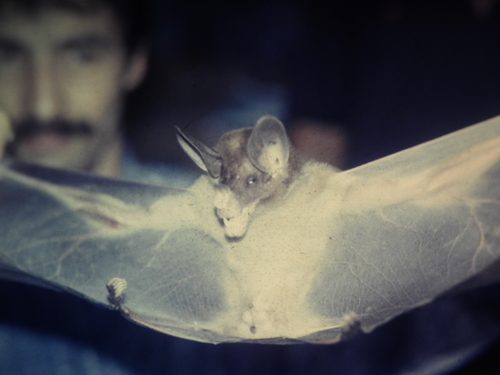
The spectral bat, also called the great false vampire bat, great spectral bat, American false vampire bat or Linnaeus's false vampire bat, is a large, carnivorous leaf-nosed bat found in Mexico, Central America, and South America. It is the only member of the genus Vampyrum; its closest living relative is the big-eared woolly bat. It is the largest bat species in the New World, as well as the largest carnivorous bat: its wingspan is 0.7–1.0 m (2.3–3.3 ft). It has a robust skull and teeth, with which it delivers a powerful bite to kill its prey. Birds are frequent prey items, though it may also consume rodents, insects, and other bats.
🛡️ Conservation Status
near threatened
nt
📌 Taxonomy and evolution
The spectral bat was described in 1758 by Swedish zoologist Carl Linnaeus. The holotype was collected in South America by Daniel Rolander. Linnaeus assigned it to the genus Vespertilio, which he classified as a kind of primate. The genus and species names were not used in their current combination until biologist George Gilbert Goodwin did so in 1942.
{{cladogram|align=left|style=width:315px;font-size:85%;line-height:85%|caption=Position of Vampyrum in Phyllostomidae based on molecular data. Tribe relationships based on Hoffmann et al. 2008. The spectral and big-eared woolly bats likely evolved from an insectivorous ancestor.
The spectral bat is included within the subfamily Phyllostominae, which includes species of diverse feeding strategies, including carnivory, insectivory and mixed insectivory/frugivory. The spectral and big-eared woolly bats are the two extant members of the tribe Vampyrini. Vampyrini additionally includes the extinct genus Notonycteris. Based on dental characteristics, Czaplewski and Morgan additionally included the fringe-lipped bat (genus Trachops) and sometimes the round-eared bats (genus Lophostoma) in Vampyrini.
Along with its sister genus Chrotopterus, the ghost bat from Australia, and a few others, the spectral bat is one of the few macropredatory bats, feeding on relatively large vertebrates (this group includes the various fishing bats). A number of morphological features arose independently in these species, which independently evolved from insectivorous ancestors.
📌 Distribution and habitat
The spectral bat is found in Belize, Bolivia, Brazil, Colombia, Costa Rica, Ecuador, French Guiana, Guatemala, Guyana, Honduras, Mexico, Nicaragua, Peru, Suriname, Trinidad and Tobago, and Venezuela. It has been documented at elevations from above sea level, though in Mexico it is only found in lowland areas of below . It is associated with tropical rainforests. It is occasionally encountered in pastures and orchards.
📌 Behavior and ecology
===Diet===
, one of the spectral bat's primary food sources]]
The spectral bat is exclusively carnivorous, consuming birds, rodents, and other species of bat. Additionally, it consumes some insects such as beetles. It was once thought to supplement its diet with fruit, but a captive pair refused to eat any fruit over a 5-year period.
Doves and cuckoos are frequently consumed—they represented over half the prey items documented in the Costa Rican study. Some prey species such as cuckoos, trogons, and motmots are known to have a strong odor, leading Vehrencamp et al. to hypothesize that spectral bats may rely on scent to locate prey. It also prefers prey that roost in groups, which may aid in detection. The groove-billed ani, which both has a strong smell and roosts in groups, is a particularly common prey item, representing approximately 24-26 of the 86 prey items identified in the study. Other species identified included the orange-fronted parakeet, orange-chinned parakeet, rufous-naped wren, streak-backed oriole, and scissor-tailed flycatcher. The largest prey species identified was the white-tipped dove, which at , weighs almost as much as spectral bats. Because its prey items can be so large, it may only need to consume one bird every two or three nights to meet its caloric requirements.
📌 Foraging
spectral bat "consuming" a mouse]]
The spectral bat uses echolocation to navigate, creating short pulses of ultrasound at relatively low frequencies; its echolocation characteristics are suited for maneuvering around obstacles while flying low to the ground. It kills its prey by delivering a forceful bite to the skull. Relative to its size, its bite force is stronger than any Carnivoran. It has been recorded as being attracted to the distress calls of smaller bats while hunting.
In a study of the wing morphology of 51 Neotropical bat species, the spectral bat had the lowest wing loading (body mass to wing area ratio) at 20.05. Low wing loading is advantageous for carnivorous bats because it allows them to pick up prey items from the ground and fly with them. Its wing structure allows it to take flight in confined spaces and to carry heavy prey items, despite the bat's size. Males will carry prey back to their roosts to provision females and their pup.
📌 Reproduction and life cycle
The spectral bat is one of an estimated 18 species of bat which are monogamous. Additionally, it is one of two known species of bat where the males provide parental care, the other being the yellow-winged bat. Males have relatively small testes—as a monogamous species, there is not generally sperm competition, so males can save energy by producing less sperm.
It is a seasonal breeder, with females giving birth at the end of the dry season or the beginning of the rainy season. The mother is reportedly very attentive and gentle with her offspring. The male is often in attendance as well and will frequently sleep with both the female and their young completely wrapped up in his wings.
Spectral bats roost independently or in small colonies of up to five individuals in hollow trees.
📌 Conservation
As of 2018, the spectral bat is classified as near threatened by the IUCN. Its population size is difficult to assess, as it is rarely encountered. However, its population trend is assessed as decreasing.
As of 1999, the spectral bat is listed as endangered in Bolivia. It has been listed as an endangered species in Mexico since 2001.