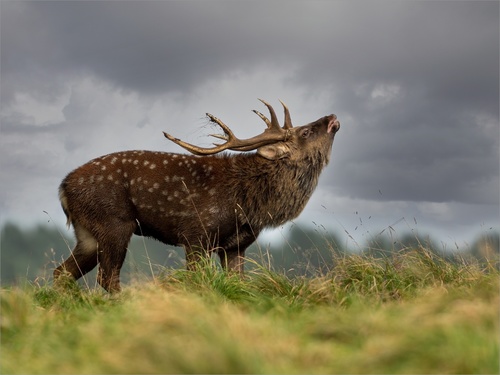
The sika deer, also known as the northern spotted deer or the Japanese deer, is a species of deer native to much of East Asia and introduced to other parts of the world. Previously found from northern Vietnam in the south to the Russian Far East in the north, it was overhunted to the brink of extinction in the 19th century. Protection laws were enacted in the mid-20th century, leading to a rapid recovery of their population from the 1950s to the 1980s.
📌 Etymology
The name "sika deer" comes from , the Japanese word for "deer", and in Japan, the species is known as the . In Chinese, it is known as , "plum blossom deer", referring to the white fur spots on the deer's back resembling plum blossoms.
📌 Taxonomy
The sika deer is a member of the genus Cervus, a group of deer also known as the "true" deer, within the larger deer family, Cervidae. Formerly, sika were grouped together in this genus with nine other diverse species; these animals have since been found to be genetically different, and reclassified elsewhere under different genera. Currently, deer species within the genus Cervus are the sika, the red deer (C. elaphus) of Eurasia and North Africa (introduced in Argentina, Australia, New Zealand), and the wapiti, or elk (C. canadensis), of North America, Siberia, and north-central Asia.
DNA evidence indicates that the species formerly placed under Cervus are not as closely related as once thought, resulting in the creation of several new genera. The ancestor of all Cervus species probably originated in Central Asia and possibly resembled the sika deer. Members of this genus can crossbreed and produce hybrids in areas where they coexist. This includes sika and wapiti; in the Scottish Highlands, the interbreeding of native Scottish red deer with introduced sika has been deemed a serious threat to the gene pool of the Scottish deer. By comparison, though, an invasive sika deer in the United States cannot reproduce with a North American white-tailed, mule, or black-tailed deer, all of which are placed in a separate genus, Odocoileus.
📌 Subspecies
Serious genetic pollution has occurred in many populations, especially in China, so the status of many subspecies remains unclear.
*C. n. pseudaxis, northern Vietnam
*C. n. pulchellus, Tsushima Island
*C. n. sichuanicus, western China
*†C. n. sintikuensis, Taiwan
*C. n. soloensis, Southern Philippines (anciently introduced to Jolo island; of unknown subspecies origin, probably extinct)
*C. n. taiouanus, Taiwan
*C. n. yakushimae, Yakushima, Japan
*C. n. yesoensis, Hokkaido, Japan
📌 Behavior
]]
Sika deer can be active throughout the day, though in areas with heavy human disturbance, they tend to be nocturnal. Seasonal migration is known to occur in mountainous areas, such as Japan, with winter ranges being up to lower in elevation than summer ranges.
Lifestyles vary between individuals, with some occurring alone, while others are found in single-sex groups. Large herds gather in autumn and winter. Males spend most years alone, occasionally forming herds together. Females with fawns only form herds during birthing season. The sika deer is a highly vocal species, with over 10 individual sounds, ranging from soft whistles to loud screams.
Sika males are territorial and keep harems of females during their rut, which peaks from early September through November, but may last well into the winter. Territory size varies with habitat type and size of the buck; strong, prime bucks may hold up to . Territories are marked by a series of shallow pits or "scrapes", which is digging holes (up to 1.6 m in wide and 0.3 m in deep) with forefeet or antlers,
📌 Population
]]
Sika deer inhabit temperate and subtropical woodlands, often in areas suitable for farming and other human exploitation. Their range encompasses some of the most densely populated areas in the world, where forests were cleared hundreds of years ago. Their population status varies significantly in different countries. Although the species as a whole is thriving, it is endangered and extinct in many areas.
Japan has by far the largest native sika population in the world. The population was estimated to be between 170,000 and 330,000 individuals in 1993, mainly due to recent conservation efforts and the extinction of its main predator, the Japanese wolf (Canis lupus hodophilax), over a century ago. Without its main predator, the population of sika exploded and it is now overpopulated in many areas, posing a threat to both forests and farmlands. Efforts are now being made to control its population instead of conserving it. None of its subspecies is endangered except the Kerama deer (C. n. keramae) on the tiny Kerama Islands.
China used to have the largest population of sika, but thousands of years of hunting and habitat loss have reduced the population to less than 1,000.
File:Sikadeer.jpg|Outside of a store on the island of Miyajima
File:Miyajima Deer Sep08.jpg|Tame deer wandering the streets of the town of Miyajima, Japan
📌 Introduced populations
Sika deer have been introduced into a number of other countries, including Estonia, Latvia, Lithuania, Austria, Belgium, Denmark, France, Germany, Ireland, Netherlands, Norway, Switzerland, Russia, Romania, New Zealand, Australia, the Philippines (Jolo Island), Poland, Sweden, Finland, Canada, the United Kingdom, and the United States (in Delaware, Maryland, Oklahoma, Nebraska, Texas,
In the UK and Ireland, several distinct feral populations now exist, in addition to about 1000 individuals in deer parks. Some of these are in isolated areas, for example on the island of Lundy, but others are contiguous with populations of the native red deer. In the United Kingdom, Sika deer are most common in Scotland, with scattered smaller populations in England - particularly Cumbria, Lancashire, Dorset and in the New Forest - and Northern Ireland. The introduced populations of the United Kingdom are exclusively of the nominate subspecies C. n. nippon.
In research which rated the negative impact of introduced mammals in Europe, the sika deer was found to be among the most damaging to the environment and economy, along with the brown rat and muskrat.
In the 1900s, King Edward VII presented a pair of sika deer to John, the second Baron Montagu of Beaulieu. This pair escaped into Sowley Wood and were the basis of the sika to be found in the New Forest today. They were so prolific, culling had to be introduced in the 1930s to control their numbers.
📌 Hunting
ukiyo-e depicting the Minamoto no Tsunemoto hunting a sika with a yumi]]
Across its original range and in many areas to which it has been introduced, the sika is regarded as a particularly prized and elusive sportsman's quarry. In Britain, Ireland, and mainland Europe, sika display very different survival strategies and escape tactics from the indigenous deer. They have a marked tendency to use concealment in circumstances when red deer, for example, would flee, and have been seen to squat and lie belly-flat when danger threatens.
In the British Isles, sika are widely regarded as a serious threat to new and established woodlands, and public and private forestry bodies adopt policies of rigorous year-round culling.
The main predators of sika deer include tigers, wolves, leopards, and brown bears. Lynx and golden eagles target fawns.
📌 Deer farming
===Velvet antler===
Velvet antler (dried precalcified antlers) is a popular ingredient in traditional Chinese medicine, and sika deer were domesticated by deer farms in China long ago for the antler trade, along with several other species. In Taiwan, both Formosan sika deer and Formosan sambar deer (Cervus unicolor swinhoei) have been farmed for velvet antlers. Japan is the only country in East Asia where sika deer were not farmed for velvet antlers.
Other deer raised for the antler trade were Thorold's deer (Cervus albirostris), central Asian red deer (Cervus hanglu), and American elk (Cervus canadensis).
📌 Cultural significance
In Shinto, the Shika Deer is considered a kind of messenger between mortals and the kami.