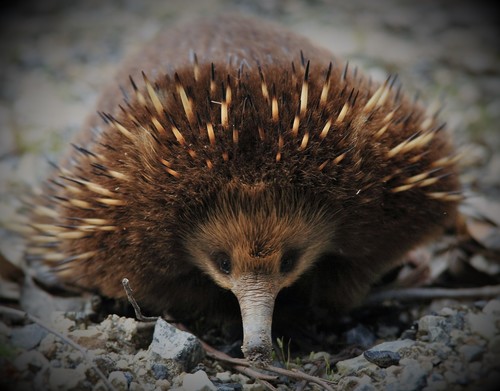
The short-beaked echidna, also known as the common echidna, or short-nosed echidna, is one of four living species of echidna, and the only member of the genus Tachyglossus, from Ancient Greek ταχύς, meaning "fast", and γλῶσσα, meaning "tongue". It is covered in fur and spines and has a distinctive snout and a specialised tongue, which it uses to catch its insect prey at a great speed. Like the other extant monotremes, the short-beaked echidna lays eggs; the monotremes are the only living group of mammals to do so.
📌 Taxonomy and naming
The short-beaked echidna was first described by George Shaw in 1792. He named the species Myrmecophaga aculeata, thinking that it might be related to the giant anteater. Since Shaw first described the species, its name has undergone four revisions: from M. aculeata to Ornithorhynchus hystrix, Echidna hystrix, Echidna aculeata and finally, Tachyglossus aculeatus. The name Tachyglossus comes from Ancient Greek (), meaning "fast", and (), meaning "tongue", and aculeatus means 'spiny' or 'equipped with spines' in Latin.
The short-beaked echidna is the only member of its genus, sharing the family Tachyglossidae with the extant species of the genus Zaglossus that occur in New Guinea. Zaglossus species, which include the western long-beaked, Sir David's long-beaked and eastern long-beaked echidnas, are all significantly larger than T. aculeatus, and their diets consist mostly of worms and grubs rather than ants and termites. Species of the Tachyglossidae are egg-laying mammals; together with the related family Ornithorhynchidae, they are the only extant monotremes in the world.
The five subspecies of the short-beaked echidna are each found in different geographical locations. The subspecies also differ from one another in their hairiness, spine length and width, and the size of the grooming claws on their hind feet.
* T. a. acanthion is found in the arid parts of Australia, including the Northern Territory.
* T. a. multiaculeatus is found on Kangaroo Island. This "post-Pleistocene dwarfing" affects many Australian mammals. Part of the last radiation of monotreme mammals, echidnas are believed to have evolutionally diverged from the platypus around 66 million years ago, between the Cretaceous and Tertiary periods.
, Tasmania]]
The short-beaked echidna was commonly called the spiny anteater in older books, though this term has fallen out of fashion since the echidna is only very distantly related to the true anteaters. It has a variety of names in the indigenous languages of the regions where it is found. The Noongar people from southwestern Western Australia call it the . In Central Australia southwest of Alice Springs, the Pitjantjatjara term is or , from the word for spike of porcupine grass (Triodia irritans). The word can also mean 'slowpoke'. In the Wiradjuri language of Central NSW, it is called .
In the central Cape York Peninsula, it is called in Pakanh, where is a qualifier meaning 'meat' or 'animal', in Uw Oykangand and in Uw Olkola, where is a qualifier meaning 'meat' or 'animal'. In the highland regions of southwestern New Guinea, it is known as the in the Daribi and Chimbu languages.
📌 Ecology and behaviour
building a defensive burrow]]
No systematic study of the ecology of the short-beaked echidna has been published, but studies of several aspects of their ecological behaviour have been conducted. They live alone, and, apart from the burrow created for rearing young, they have no fixed shelter or nest site. They do not have a home territory they defend against other echidnas, but range over a wide area.
Short-beaked echidnas are typically active in the daytime, though they are ill-equipped to deal with heat because they have no sweat glands and do not pant. Therefore, in warm weather, they change their patterns of activity, becoming crepuscular or nocturnal. It can also reduce its metabolism and heart rate and body temperature.
In addition to brief and light bouts of torpor throughout the year, the echidna enters periods during the Australian winter when it hibernates, both in cold regions and in regions with more temperate climates. During hibernation, the body temperature drops to as low as . The heart rate falls to four to seven beats per minute—down from 50 to 68 at rest Echidnas begin to prepare for hibernation between February and April, when they reduce their consumption and enter brief periods of torpor. Males begin hibernating first, while females that have reproduced start later. burrowing animals also tend to have low metabolism generally.
Echidnas hibernate even though it is seemingly unnecessary for survival; they begin their hibernation period while the weather is still warm, and food is generally always plentiful. One explanation is that echidnas maximize their foraging productivity by exercising caution with their energy reserves. Another hypothesis is that they are descended from ectothermic ancestors, but have taken to periodic endothermy for reproductive reasons, so that the young can develop more quickly.
, Canberra.]]
Short-beaked echidnas can live anywhere with a good supply of food, and regularly feast on ants and termites. They are believed to locate food by smell, using sensors in the tips of their snouts, by shuffling around seemingly arbitrarily, and using their snout in a probing manner. Vision is not believed to be significant in hunting, as blind animals have been observed to survive in the wild. They avoid ants and termites that secrete repulsive liquids, and have a preference for the eggs, pupae and winged phases of the insects. Echidnas hunt most vigorously towards the end of the southern winter and early in spring, when their fat reserves have been depleted after hibernation and nursing. At this time, ants have high body fat, and the echidna targets their mounds. However, termites are preferred, if available, as their bodies contain a smaller proportion of indigestible exoskeleton. Termites from the Rhinotermitidae family are avoided due to their chemical defences. Scarab beetle larvae are also a large part of the diet when and where available. In the New England study, 37% of the food intake consisted of beetle larvae, although the echidna had to squash the prey in its snout as it ingested it, due to size. This is based on the estimation that a single echidna will move up to of soil a year, that it is the most widespread of any terrestrial Australian species, is relatively common, and that other bioturbators have been heavily impacted by human settlement.
📌 Reproduction
The solitary short-beaked echidna looks for a mate between May and September; In the months before the mating season, the size of the male's testes increases by a factor of three or more before spermatogenesis occurs. Both males and females give off a strong, musky odour during the mating season, by turning their cloacas inside out and wiping them on the ground, secreting a glossy liquid believed to be an aphrodisiac. During this time, they forage for food together, and the train often changes composition, as some males leave and others join the pursuit. In cooler parts of their range, such as Tasmania, females may mate within a few hours of arousal from hibernation.
Before mating, the male smells the female, paying particular attention to the cloaca. This process can take a few hours, and the female can reject the suitor by rolling herself into a ball. If more than one male is in the vicinity, fighting over the female may occur. This process takes between a half and three hours.
Fertilisation occurs in the oviduct. Gestation takes between 21 and 28 days after copulation, is laid from her cloaca directly into a small, backward-facing pouch that has developed on her abdomen. The egg is ovoid, leathery, soft, and cream-coloured. Between laying and hatching, some females continue to forage for food, while others dig burrows and rest there until hatching.
Hatchlings are about long and weigh between . After hatching, young echidnas are known as "puggles". Although newborns are still semitranslucent and still surrounded by the remains of the egg yolk, and the eyes are still barely developed, they already have well-defined front limbs and digits that allow them to climb on their mothers' bodies. Studies of captives have shown they can ingest milk once every two or three days and then increase their mass by 20% in one milk-drinking session lasting between one and two hours.
The composition of the milk secreted by the mother changes over time. At the moment of birth, the solution is dilute and contains 1.25% fat, 7.85% protein, and 2.85% carbohydrates and minerals. Mature milk has much more concentrated nutrients, with 31.0, 12.4 and 2.8% of the aforementioned nutrients, respectively.
The principal carbohydrate components of the milk are fucosyllactose and saialyllactose; it has a high iron content, which gives it a pink colour. The high iron content and low levels of free lactose differ from eutherian mammals. Lactose production is believed to proceed along the same lines as in the platypus. The longest-lived specimen reached 49 years of age in a zoo in Philadelphia. In contrast to other mammals, echidna rates of reproduction and metabolism are lower, and they live longer, as though in slow motion,
Homosexual behaviours between males have been observed in captivity; this has sometimes led to cloacal injuries being observed following the interactions.
📌 Conservation status
The short-beaked echidna is common throughout most of temperate Australia and lowland New Guinea, and is not listed as endangered. In Australia, it remains widespread across a wide range of habitats, including urban outskirts, coastal forests and dry inland areas, and is especially widespread in Tasmania and on Kangaroo Island. In Australia, the number of short-beaked echidnas has been less affected by land clearance than have some other species, since they do not require a specialised habitat beyond a good supply of ants and termites. although almost all victims are young. Goannas are known for their digging abilities and strong sense of smell, and are believed to have been the main predators of the echidna before the introduction of eutherian mammals.
Infection with the introduced parasitic tapeworm Spirometra erinaceieuropaei is considered fatal for the echidna. This waterborne infection is contracted through sharing drinking areas with infected dogs, foxes, cats, and dingos, which do not die from the parasite. The infection is seen as being more dangerous in drier areas, where more animals are sharing fewer bodies of water, increasing the chance of transmission. The Wildlife Preservation Society of Queensland runs an Australia-wide survey, called Echidna Watch, to monitor the species. Echidnas are also known to be affected by other tapeworms, protozoans and herpes-like viral infections, but little is known of how the infections affect the health of the animals or the populations.
Although it is considered easy to keep echidnas healthy in captivity, breeding is difficult, partly due to the relatively infrequent cycle. In 2009, Perth Zoo managed to breed some captive short-beaked echidnas, and in 2015 the first zoo-born echidnas were successfully bred there. Until 2006, only five zoos have managed to breed short-beaked echidnas, but no captive-bred young have survived to maturity. Of these five institutions, only one in Australia—Sydney's Taronga Zoo—managed to breed echidnas, in 1977. The other four cases occurred in the Northern Hemisphere, two in the United States and the others in western Europe. In these cases, breeding occurred six months out of phase compared to Australia, after the animals had adapted to Northern Hemisphere seasons. The failure of captive breeding programs has conservation implications for the endangered species of echidna from the genus Zaglossus, and to a lesser extent for the short-beaked echidna.