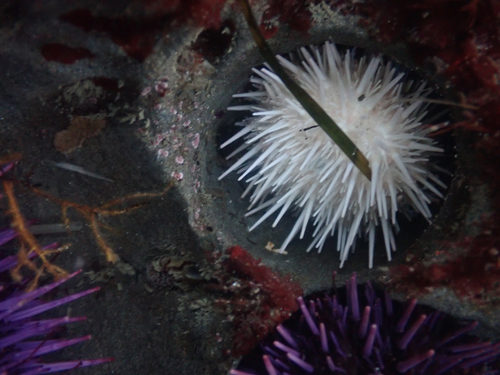
Sea urchins or urchins are marine creatures called echinoderms in the class Echinoidea. Approximately 950 species live on the seabed, inhabiting all oceans and depth zones from the intertidal zone which actually is not a fixed number but varies greatly, usually defined by the range between the highest and lowest tide, to deep seas of 5,000Β m (16,000Β ft). They typically have a globular body covered by spiny protective tests, typically from 3 to 10Β cm across. Sea urchins move slowly, crawling with their tube feet, and sometimes pushing themselves with their spines. They feed primarily on algae but also eat slow-moving or sessile animals such as crinoids and sponges. Their predators include sharks, sea otters, starfish, wolf eels, triggerfish, and humans. When unchecked by predators, urchins can create urchin barrens, damaged environments devoid of large algae and the animals associated with them.
π Diversity
Sea urchins are members of the phylum Echinodermata, which also includes starfish, sea cucumbers, sand dollars, brittle stars, and crinoids. Like other echinoderms, they have five-fold symmetry (called pentamerism) and move by means of hundreds of tiny, transparent, adhesive "tube feet". The symmetry is not obvious in the living animal, but is easily visible in the dried test.
Together with sea cucumbers (Holothuroidea), they make up the subphylum Echinozoa, which is characterized by a globoid shape without arms or projecting rays. Sea cucumbers and the irregular echinoids have secondarily evolved diverse shapes. Although many sea cucumbers have branched tentacles surrounding their oral openings, these have originated from modified tube feet and are not homologous to the arms of the crinoids, sea stars, and brittle stars.
File:Paracentrotus lividus profil.JPG|Paracentrotus lividus, a regular sea urchin (Euechinoidea, infraclass Carinacea)
File:Live Sand Dollar trying to bury itself in beach sand.jpg|A sand dollar, an irregular sea urchin (Irregularia)
File:Phyllacanthus.jpg|Phyllacanthus imperialis, a cidaroid sea urchin (Cidaroidea)
π Systems
=== Musculoskeletal ===
of a purple sea urchin]]
The internal organs are enclosed in a hard shell or test composed of fused plates of calcium carbonate covered by a thin dermis and epidermis. The test is referred to as an endoskeleton rather than exoskeleton even though it encloses almost all of the urchin. This is because it is covered with a thin layer of muscle and skin; sea urchins also do not need to molt the way invertebrates with true exoskeletons do, instead the plates forming the test grow as the animal does.
The test is rigid, and divides into five ambulacral grooves separated by five wider interambulacral areas. Each of these ten longitudinal columns consists of two sets of plates (thus comprising 20 columns in total). The ambulacral plates have pairs of tiny holes through which the tube feet extend.
All of the plates are covered in rounded tubercles to which the spines are attached. The spines are used for defence and for locomotion and come in a variety of forms. The inner surface of the test is lined by peritoneum.
Most species have two series of spines, primary (long) and secondary (short), distributed over the surface of the body, with the shortest at the poles and the longest at the equator. The spines are usually hollow and cylindrical. Contraction of the muscular sheath that covers the test causes the spines to lean in one direction or another, while an inner sheath of collagen fibres can reversibly change from soft to rigid which can lock the spine in one position. Located among the spines are several types of pedicellaria, moveable stalked structures with jaws. The tube feet protrude through pairs of pores in the test, and are operated by a water vascular system; this works through hydraulic pressure, allowing the sea urchin to pump water into and out of the tube feet. During locomotion, the tube feet are assisted by the spines which can be used for pushing the body along or to lift the test off the substrate. Movement is generally related to feeding, with the red sea urchin (Mesocentrotus franciscanus) managing about a day when there is ample food, and up to a day where there is not. An inverted sea urchin can right itself by progressively attaching and detaching its tube feet and manipulating its spines to roll its body upright.
File:Sea Urchin test 5629 03 22.jpg|Test of an Echinus esculentus, a regular sea urchin
File:BlackSeaUrchinTest.jpg|Test of black sea urchin, showing tubercles and ambulacral plates (on right)
File:Inner surface of black sea urchin test.jpg|Inner surface of test, showing pentagonal interambulacral plates on right, and holes for tube feet on left.
File:Echinodiscus2.jpg|Test of an Echinodiscus tenuissimus, an irregular sea urchin ("sand dollar")
File:Phyllacanthus imperialis test.JPG|Test of a Phyllacanthus imperialis, a cidaroid sea urchin. These are characterised by their big tubercles, bearing large radiola.
File:Sea urchin shell - pattern (6658690371).jpg|Close-up of the test showing an ambulacral groove with its two rows of pore-pairs, between two interambulacra areas (green). The tubercles are non-perforated.
File:Sea Urchin Shell detail.jpg|Close-up of a cidaroid sea urchin apical disc: the 5 holes are the gonopores, and the central one is the anus ("periproct"). The biggest genital plate is the madreporite.
π Feeding and digestion
The mouth lies in the centre of the oral surface in regular urchins, or towards one end in irregular urchins. It is surrounded by lips of softer tissue, with numerous small, embedded bony pieces. This area, called the peristome, also includes five pairs of modified tube feet and, in many species, five pairs of gills.
On the upper surface of the test at the aboral pole is a membrane, the periproct, which surrounds the anus. The periproct contains a variable number of hard plates, five of which, the genital plates, contain the gonopores, and one is modified to contain the madreporite, which is used to balance the water vascular system.
Heart urchins are unusual in not having a lantern. Instead, the mouth is surrounded by cilia that pull strings of mucus containing food particles towards a series of grooves around the mouth.
; m = madreporite; s = aquifer canal; r = radial canal; p = podial ampulla; k = test wall; i = intestine; b = mouth]]
The lantern, where present, surrounds both the mouth cavity and the pharynx. At the top of the lantern, the pharynx opens into the esophagus, which runs back down the outside of the lantern, to join the small intestine and a single caecum. The small intestine runs in a full circle around the inside of the test, before joining the large intestine, which completes another circuit in the opposite direction. From the large intestine, a rectum ascends towards the anus. Despite the names, the small and large intestines of sea urchins are in no way homologous to the similarly named structures in vertebrates.
Digestion occurs in the intestine, with the caecum producing further digestive enzymes. An additional tube, called the siphon, runs beside much of the intestine, opening into it at both ends. It may be involved in resorption of water from food.
π Circulation and respiration
]]
The water vascular system leads downwards from the madreporite through the slender stone canal to the ring canal, which encircles the oesophagus. Radial canals lead from here through each ambulacral area to terminate in a small tentacle that passes through the ambulacral plate near the aboral pole. Lateral canals lead from these radial canals, ending in ampullae. From here, two tubes pass through a pair of pores on the plate to terminate in the tube feet.
Sea urchins possess a hemal system with a complex network of vessels in the mesenteries around the gut, but little is known of the functioning of this system. However, the main circulatory fluid fills the general body cavity, or coelom. This coelomic fluid contains phagocytic coelomocytes, which move through the vascular and hemal systems and are involved in internal transport and gas exchange. The coelomocytes are an essential part of blood clotting, but also collect waste products and actively remove them from the body through the gills and tube feet.
Most sea urchins possess five pairs of external gills attached to the peristomial membrane around their mouths. These thin-walled projections of the body cavity are the main organs of respiration in those urchins that possess them. Fluid can be pumped through the gills' interiors by muscles associated with the lantern, but this does not provide a continuous flow, and occurs only when the animal is low in oxygen. Tube feet can also act as respiratory organs, and are the primary sites of gas exchange in heart urchins and sand dollars, both of which lack gills. The inside of each tube foot is divided by a septum which reduces diffusion between the incoming and outgoing streams of fluid.
π Nervous system and senses
The nervous system of sea urchins has a relatively simple layout. With no true centralized brain, In general, sea urchins are negatively attracted to light, and seek to hide themselves in crevices or under objects. Most species, apart from pencil urchins, have statocysts in globular organs called spheridia. These are stalked structures and are located within the ambulacral areas; their function is to help in gravitational orientation.
π Life history
=== Reproduction ===
) releasing milt, November 1, 2011, Lalo Cove, Sea of Cortez]]
Sea urchins are dioecious, having separate male and female sexes, although no distinguishing features are visible externally. In addition to their role in reproduction, the gonads are also nutrient storing organs, and are made up of two main type of cells: germ cells, and somatic cells called nutritive phagocytes. Regular sea urchins have five gonads, lying underneath the interambulacral regions of the test, while the irregular forms mostly have four, with the hindmost gonad being absent; heart urchins have three or two. Each gonad has a single duct rising from the upper pole to open at a gonopore lying in one of the genital plates surrounding the anus. Some burrowing sand dollars have an elongated papilla that enables the liberation of gametes above the surface of the sediment. The gonads are lined with muscles underneath the peritoneum, and these allow the animal to squeeze its gametes through the duct and into the surrounding sea water, where fertilization takes place.
π Development
During early development, the sea urchin embryo undergoes 10 cycles of cell division, resulting in a single epithelial layer enveloping the blastocoel. The embryo then begins gastrulation, a multipart process which dramatically rearranges its structure by invagination to produce the three germ layers, involving an epithelial-mesenchymal transition; primary mesenchyme cells move into the blastocoel and become mesoderm. It has been suggested that epithelial polarity together with planar cell polarity might be sufficient to drive gastrulation in sea urchins.
An unusual feature of sea urchin development is the replacement of the larva's bilateral symmetry by the adult's broadly fivefold symmetry. During cleavage, mesoderm and small micromeres are specified. At the end of gastrulation, cells of these two types form coelomic pouches. In the larval stages, the adult rudiment grows from the left coelomic pouch; after metamorphosis, that rudiment grows to become the adult. The animal-vegetal axis is established before the egg is fertilized. The oral-aboral axis is specified early in cleavage, and the left-right axis appears at the late gastrula stage.
π Life cycle and development
.]]
In most cases, the female's eggs float freely in the sea, but some species hold onto them with their spines, affording them a greater degree of protection. The unfertilized egg meets with the free-floating sperm released by males, and develops into a free-swimming blastula embryo in as few as 12 hours. Initially a simple ball of cells, the blastula soon transforms into a cone-shaped echinopluteus larva. In most species, this larva has 12 elongated arms lined with bands of cilia that capture food particles and transport them to the mouth. In a few species, the blastula contains supplies of nutrient yolk and lacks arms, since it has no need to feed.
π Longevity
Red sea urchins were originally thought to live 7 to 10 years but recent studies have shown that they can live for more than 100 years. Canadian red urchins have been found to be around 200 years old.
π Ecology
Sea urchins are established in most benthic habitats from the intertidal downwards, at an extremely wide range of depths. Many genera are found in only the abyssal zone, including many cidaroids, most of the genera in the Echinothuriidae family, and the "cactus urchins" Dermechinus. Some species, such as Cidaris abyssicola, can live at depths of several kilometres, and one of the deepest-living families is the Pourtalesiidae, strange bottle-shaped irregular sea urchins that live in only the hadal zone and have been collected as deep as beneath the surface in the Sunda Trench. Compared to other classes of echinoderms, sea urchins inhabit more shallow depths compared to brittle stars, starfish, and crinoids that remain abundant below and sea cucumbers which have been recorded from . Even in these kelp barrens, greatest densities are found in shallow water. Populations are generally found in deeper water if wave action is present.
Sea urchins can be found in all climates, from warm seas to polar oceans. Despite their presence in nearly all the marine ecosystems, most species are found on temperate and tropical coasts, between the surface and some tens of meters deep, close to photosynthetic food sources.
File:Sea urchins in california tide pools.jpg|Purple sea urchins at low tide in California. They dig a cavity in the rock to hide from predators during the day.
File:Expl1825 - Flickr - NOAA Photo Library.jpg|Dermechinus horridus, an abyssal species, at thousands of meters deep
File:Underwater mcmurdo sound.jpg|Antarctic sea urchin (Sterechinus neumayeri) inhabits frozen seas.
File:Colobocentrotus atratus Shingle urchin.jpg|The shape of the shingle urchin allows it to stay on wave-beaten cliffs.
π Trophic ecology
Sea urchins feed mainly on algae, so they are primarily herbivores, but can feed on sea cucumbers and a wide range of invertebrates, such as mussels, polychaetes, sponges, brittle stars, and crinoids, making them omnivores, consumers at a range of trophic levels.
Adult sea urchins are usually well protected against most predators by their strong and sharp spines, which can be venomous in some species. The small urchin clingfish lives among the spines of urchins such as Diadema; juveniles feed on the pedicellariae and sphaeridia, adult males choose the tube feet and adult females move away to feed on shrimp eggs and molluscs.
Sea urchins are one of the favourite foods of lobsters, crabs, triggerfish, California sheephead, sea otter, and wolf eels (which specialise in sea urchins). All these animals carry particular adaptations (teeth, pincers, claws) and a strength that allow them to overcome the excellent protective features of sea urchins.
π Anti-predator defences
is a dangerous, potentially lethally venomous species.]]
The spines, long and sharp in some species, protect the urchin from predators. Some tropical sea urchins, like Diadematidae, Echinothuriidae and Toxopneustidae, have venomous spines. Other creatures also make use of these defences; crabs, shrimps and other organisms shelter among the spines, and often adopt the colouring of their host. Some crabs in the Dorippidae family carry sea urchins, starfish, sharp shells or other protective objects in their claws.
Pedicellariae are a good means of defense against ectoparasites, but not a panacea as some of them actually feed on it. The hemal system defends against endoparasites.
π Urchin barrens
Left unchecked by predators, urchins devastate their environments, creating what biologists call an urchin barren, devoid of macroalgae and associated fauna. Sea urchins graze on the lower stems of kelp, causing the kelp to drift away and die. Loss of the habitat and nutrients provided by kelp forests leads to profound cascade effects on the marine ecosystem. The return of predators such as sea otters may reverse this process, promoting kelp regrowth and dramatically improving coastal ecosystem health.
The shift to urchin barrens may be better characterized as a "compositional redistribution", where change is observed in the species present in certain locales of a region, but the species extirpated in these locales remain present in other parts of the region. Compared to urchin barrens, kelp forests deliver more ecosystem services, such as biodiversity, species richness, abalone abundance, and sea urchin roe quality.
Urchin barrens replace kelp forests, thus they occur in places where kelp are native, such as off the coast of the contiguous United States, Canada, the Aleutians, Chile, Europe's Atlantic coastline, Greece, Australia, Japan, and the Russian Far East.]]
Contrary to what the name suggests, urchin barrens host invertebrates species other than sea urchins, such as sea stars, brittle stars, and mussels, along with coralline algae encrusting the substrate, which replace fleshy and filamentous algae. Regardless, these barrens are characterized by the dominance of sea urchins and coralline algae.
Sea urchin mass mortality events may cause the rapid return of a kelp forest, as was observed in the Southern California Bight, where the ecosystem returned to a "kelp-dominated state" within 6 months of a disease outbreak. Targeted culling of sea urchins, where divers kill purple sea urchins with small hammers, may aid this process.
π Disease
Mass mortality of sea urchins was first reported in the 1970s, but diseases in sea urchins had been little studied before the advent of aquaculture. In 1981, bacterial "spotting disease" caused almost complete mortality in juvenile Pseudocentrotus depressus and Hemicentrotus pulcherrimus, both cultivated in Japan; the disease recurred in succeeding years. It was divided into a cool-water "spring" disease and a hot-water "summer" form. Another condition, bald sea urchin disease, causes loss of spines and skin lesions and is believed to be bacterial in origin.
π Evolution
=== Fossil history ===
were used for walking on the soft seabed.]]
The earliest echinoid fossils date to the Middle Ordovician period (circa 465 Mya). There is a rich fossil record, their hard tests made of calcite plates surviving in rocks from every period since then.
Spines are present in some well-preserved specimens, but usually only the test remains. Isolated spines are common as fossils. Some Jurassic and Cretaceous Cidaroida had very heavy, club-shaped spines.
Most fossil echinoids from the Paleozoic era are incomplete, consisting of isolated spines and small clusters of scattered plates from crushed individuals, mostly in Devonian and Carboniferous rocks. The shallow-water limestones from the Ordovician and Silurian periods of Estonia are famous for echinoids. Paleozoic echinoids probably inhabited relatively quiet waters. Because of their thin tests, they would certainly not have survived in the wave-battered coastal waters inhabited by many modern echinoids.
Some echinoids, such as Micraster in the chalk of the Cretaceous period, serve as zone or index fossils. Because they are abundant and evolved rapidly, they enable geologists to date the surrounding rocks.
In the Paleogene and Neogene periods (circa 66 to 2.6 Mya), sand dollars (Clypeasteroida) arose. Their distinctive, flattened tests and tiny spines were adapted to life on or under loose sand in shallow water, and they are abundant as fossils in southern European limestones and sandstones.
π Phylogeny
==== External ====
Echinoids are deuterostome animals, like the chordates. A 2014 analysis of 219 genes from all classes of echinoderms gives the following phylogenetic tree. Approximate dates of branching of major clades are shown in millions of years ago (mya).
|label2=Asterozoa
|2=
}}
|label2=Crinoidea |sublabel2=Crinoids
|2=
}}
}}
|label2 =Protostomia |sublabel2=610 mya
|2=
}}
}}
}}
π Internal
The phylogeny of the sea urchins is as follows:
|label2=Echinoida
|2=
}}
}}
}}
}}
}}
}}
}}
}}
}}
}}
}}
}}
}}
}}
The phylogenetic study from 2022 presents a different topology of the Euechinoidea phylogenetic tree. Irregularia are sister group of Echinacea (including Salenioida) forming a common clade Carinacea, basal groups Aspidodiadematoida, Diadematoida, Echinothurioida, Micropygoida, and Pedinoida are comprised in a common basal clade Aulodonta.
π Relation to humans
=== Injuries ===
Sea urchin injuries are puncture wounds inflicted by the animal's brittle, fragile spines.
These are a common source of injury to ocean swimmers, especially along coastal surfaces where coral with stationary sea urchins are present. Their stings vary in severity depending on the species. Their spines can be venomous or cause infection. Granuloma and staining of the skin from the natural dye inside the sea urchin can also occur. Breathing problems may indicate a serious reaction to toxins in the sea urchin. They inflict a painful wound when they penetrate human skin, but are not themselves dangerous if fully removed promptly; if left in the skin, further problems may occur.
π Science
Sea urchins are traditional model organisms in developmental biology. This use originated in the 1800s, when their embryonic development became easily viewed by microscopy. The transparency of the urchin's eggs enabled them to be used to observe that sperm cells actually fertilize ova. They continue to be used for embryonic studies, as prenatal development continues to seek testing for fatal diseases. Sea urchins are being used in longevity studies for comparison between the young and old of the species, particularly for their ability to regenerate tissue as needed. Scientists at the University of St Andrews have discovered a genetic sequence, the '2A' region, in sea urchins previously thought to have belonged only to viruses like foot-and-mouth disease virus. More recently, Eric H. Davidson and Roy John Britten argued for the use of urchins as a model organism due to their easy availability, high fecundity, and long lifespan. Beyond embryology, urchins provide an opportunity to research cis-regulatory elements. Oceanography has taken an interest in monitoring the health of urchins and their populations as a way to assess overall ocean acidification, temperatures, and ecological impacts.
The organism's evolutionary placement and unique embryology with five-fold symmetry were the major arguments in the proposal to seek the sequencing of its genome. Importantly, urchins act as the closest living relative to chordates and thus are of interest for the light they can shed on the evolution of vertebrates. The genome of Strongylocentrotus purpuratus was completed in 2006 and established homology between sea urchin and vertebrate immune system-related genes. Sea urchins code for at least 222 Toll-like receptor genes and over 200 genes related to the Nod-like-receptor family found in vertebrates. This increases its usefulness as a valuable model organism for studying the evolution of innate immunity. The sequencing also revealed that while some genes were thought to be limited to vertebrates, there were also innovations that have previously never been seen outside the chordate classification, such as immune transcription factors PU.1 and SPIB.
π As food
The gonads of both male and female sea urchins, sometimes euphemized as sea urchin "roe" or "corals", are culinary delicacies in many parts of the world, especially Japan. In Japan, sea urchin is known as , and its gonads (the only meaty, edible parts of the animal) can retail for as much as Β₯40,000 ($360) per kilogram; they are served raw as sashimi or in sushi, with soy sauce and wasabi. Japan imports large quantities from the United States, South Korea, and other producers. Japan consumes 50,000 tons annually, amounting to over 80% of global production. Japanese demand for sea urchins has raised concerns about overfishing.
Sea urchins are commonly eaten stuffed with rice in the traditional oko-oko dish among the Sama-Bajau people of the Philippines. They were once foraged by coastal Malay communities of Singapore who call them . In New Zealand, Evechinus chloroticus, known as in MΔori, is a delicacy, traditionally eaten raw. Though New Zealand fishermen would like to export them to Japan, their quality is too variable.
In Mediterranean cuisines, Paracentrotus lividus is often eaten raw, or with lemon, and known as on Italian menus where it is sometimes used in pasta sauces. It can also flavour omelettes, scrambled eggs, fish soup, mayonnaise, bΓ©chamel sauce for tartlets, the for a soufflΓ©, or Hollandaise sauce to make a fish sauce. In the region of Marseille, sea urchin are commonly eaten in dedicated food festival called oursinade.
On the Pacific Coast of North America, Strongylocentrotus franciscanus was praised by Euell Gibbons; Strongylocentrotus purpuratus is also eaten. The coast of Southern California is known as a source of high quality , with divers picking sea urchin from kelp beds in depths as deep as 24 m/80 ft. As of 2013, the state was limiting the practice to 300 sea urchin diver licenses. In the West Indies, slate pencil urchins are eaten.
In Chilean cuisine, it is served raw with lemon, onions, and olive oil.
Unidon Murakami.jpg|Japanese , or rice bowl with sea urchin roe
Sushi uni.jpg|Japanese with sea urchin roe
Sushi Saito IMG 1773 (23720371141).jpg|Sea urchin roe () sashimi
Fried rice with sea urchin 1.jpg|Fried rice with sea urchin (, ) served in China
π Aquaria
, thought to have been used as an amulet]]
Some species of sea urchins, such as the slate pencil urchin (Eucidaris tribuloides), are commonly sold in aquarium stores. Some species are effective at controlling filamentous algae, and they make good additions to an invertebrate tank.
π Folklore
A folk tradition in Denmark and southern England imagined sea urchin fossils to be thunderbolts, able to ward off harm by lightning or by witchcraft, as an apotropaic symbol. Another version supposed they were petrified eggs of snakes, able to protect against heart and liver disease, poisons, and injury in battle, and accordingly they were carried as amulets. These were, according to the legend, created by magic from foam made by the snakes at midsummer.