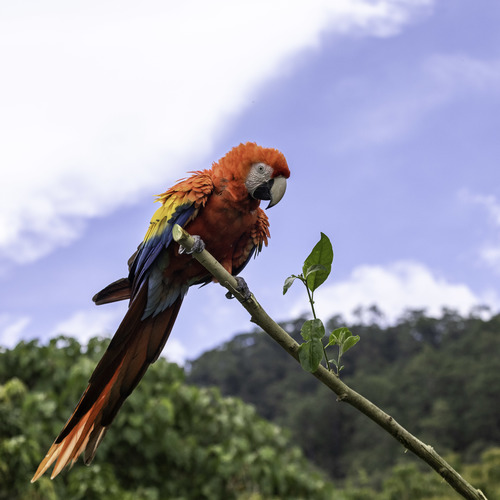
The scarlet macaw also called the red-and-yellow macaw, red-and-blue macaw or red-breasted macaw, is a large yellow, red and blue Neotropical parrot native to humid evergreen forests of the Americas. Its range extends from southeastern Mexico to Peru, Ecuador, Colombia, Bolivia, Venezuela, Honduras, and Brazil in lowlands of 500 m (1,600 ft) up to 1,000 m (3,300 ft), the Caribbean island of Trinidad, as well as the Pacific island of Coiba. Formerly, the northern extent of its range included southern Tamaulipas. In some areas, it has suffered local extinction because of habitat destruction, or capture for the parrot trade, but in other areas, it remains fairly common. It is the national bird of Honduras. Like its relative the blue-and-yellow macaw, the scarlet macaw is a popular bird in aviculture as a result of its striking plumage. It is the third most common macaw species in captivity after the blue-and-yellow and red-and-green macaw respectively. In recent years it has become much rarer in captivity and much more expensive due to stricter laws, its price being higher than even red-and-green macaws.
🛡️ Conservation Status
Appendix I
appendix i
📌 Taxonomy
The scarlet macaw was formally described by the Swedish naturalist Carl Linnaeus in 1758 in the tenth edition of his Systema Naturae under the binomial name Psittacus macao. The scarlet macaw is now placed in the genus Ara (Lacépède, 1799), one of 6 genera of Central and South American macaws.
The two subspecies can be recognized by size and color detail in the feathers on the wings:
* Ara macao macao (Linnaeus, 1758): South American scarlet macaw, the nominate subspecies. In the wings the medium and secondary coverts have green tips.
* A. m. cyanopterus Wiedenfeld, 1995: North Central American scarlet macaw. The Central American scarlet macaw is larger and has blue on its wings instead of green.
📌 Genetics
In May 2013, it was announced that a team of scientists, led by Dr. Christopher M. Seabury and Dr. Ian Tizard of Texas A&M University had sequenced the complete genome of the scarlet macaw. Based on this genome, species-specific microsatellite genetic markers were developed to aid genetic studies throughout the range of the species. These genetic markers were later validated on the trace amount of DNA acquired from feathers, and applied to study red-and-green macaws in a tropical landscape where DNA can degrade very quickly. These markers were proven to be useful to study their population genetics
📌 Behavior
A typical sighting is of a single bird or a pair flying above the forest canopy, though in some areas flocks can be seen. Field observations in Costa Rica found that scarlet macaws spend nearly all their time high in the forest canopy, usually more than 10 m above the ground, and are rarely seen near or on the ground, likely to reduce predation risk and because most of their food sources occur in the canopy. They often gather at clay licks. Scarlet macaws communicate primarily through raucous honks; however, vocal communication is highly variable, and captive macaws are known to be adept mimics of human speech.
fruits]]
📌 Feeding
Wild scarlet macaws feed on fruits, nuts, seeds, flowers and nectar.
As with smaller parrot species, there are reports of their consumption of insects, larvae, and snails; however, this seems to be rare for macaws and is not a major component of their diet. Seeds of Cnidoscolus and Schizolobium are thought to be the main sources of protein for nestling scarlet macaws.
In Costa Rica's Central Pacific they have learned to feed on introduced Teak trees (Tectona grandis) and Almond Beach Trees. Local non-profit organizations have planted hundreds of those trees along the coastline from the Tárcoles River basin to Esterillos Beach which had helped increase the population drastically. The combined efforts and the correct ecotourism also have an important role in the conservation of such majestic birds. Tour companies along the Tarcoles River and its mangroves have bet on the importance of birdwatching as an asset for the growth on its population.
📌 Mating
]]
While comparatively docile at most times of the year, scarlet macaws may be formidably aggressive during periods of breeding. Scarlet macaws are monogamous birds, with individuals remaining with one partner throughout their lives. The hen lays two or three white eggs in a large tree cavity. The female incubates the eggs for about five weeks, and the chicks fledge from the nest about 90 days after hatching and leave their parents about a year later. Juveniles reach sexual maturity at five years of age.
📌 Distribution and habitat
The scarlet macaw inhabits primarily humid, lowland subtropical rain forests, open woodlands, river edges, and savannas. In some regions, they are known to periodically visit natural mineral deposits (or 'licks'), typically in areas rich in clay and sediment, which the macaws will eat for digestive purposes and to glean vital nutrients, including sodium and calcium. The species' South American range is extensive, spanning much of the Amazon basin and rainforest of the northern half of the continent, extending as far south as Peru (east of the Andes) and Bolivia. The species also occurs as an introduced species in Puerto Rico.
A small introduced population exists in Kirkby Stephen, Cumbria, having been introduced to the area around 2010. This population, which includes a number of related blue-and-yellow macaws, was introduced to the village around 2010; they are trained to fly freely around the area, returning to a conservation centre for food and shelter in the evenings.
📌 Conservation status
The habitat of scarlet macaws is also considered to have the greatest latitudinal range for any bird in the genus Ara, as the estimated maximum territorial range covers 6,700,000 km2. Nevertheless, the scarlet macaw's habitat is fragmented, and the bird is mostly confined to tiny populations scattered throughout its original range in Middle America. However, as they still occur in large numbers over most of their original range in South America, the species is classified by IUCN as least concern. Its wild population is currently estimated to be between 50,000 and 499,999 individuals.
The northern subspecies, A. m. cyanopterus, is listed as endangered by the USFWS. The USFWS estimates that only 2,000–3,000 birds of the northern subspecies remain in the wild.
📌 Aviculture
The scarlet macaw is an early example of a parrot breeding in captivity. Captive breeding occurred in Northern Mexico at Paquime (also called Casas Grandes) and very likely Southwest New Mexico Mimbres Valley in the 11th century. Breeding pens, perches, bones, and eggshell fragments have been uncovered. The straightforward nature of scarlet macaw breeding and the value of their plumes in trade created a market for trade wherein the animals were used in religious rites north to the Colorado Plateau region.
Today the scarlet macaw is found worldwide in captivity, but is best represented in captivity in the Americas. Captive techniques developed from the pet trade have positively affected wild populations: in areas with low macaws populations, the "extra" babies that typically die in the nest may be reared by human hands and released into the wild to bolster the population, as has been done by the Tambopata Macaw Project. Their captive diet, egg incubation, assisted hatching, hand rearing, co-parenting, parent-rearing, fledgling, maturation, and breeding are well understood within the avicultural community (AFA Watchbird magazine).
📌 Predation
Young may be taken in the nest by arboreal predators such as snakes, monkeys and other small carnivores. Adults and fledglings may also be taken by large cats, such as jaguars, and by eagles and hawks.