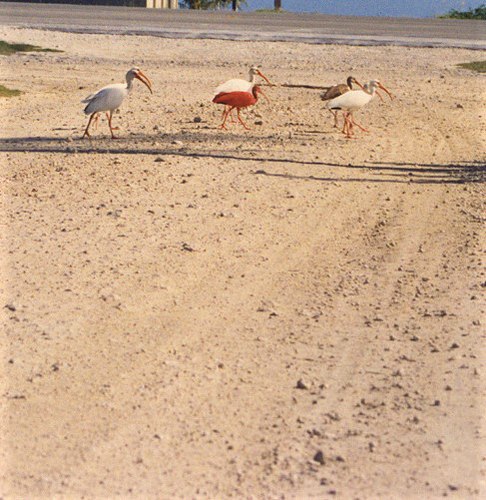
The scarlet ibis, sometimes called red ibis, is a species of ibis in the bird family Threskiornithidae. It inhabits tropical South America and part of the Caribbean. In form, it resembles most of the other twenty-seven extant species of ibis, but its remarkably brilliant scarlet coloration makes it unmistakable. It is one of the two national birds of Trinidad and Tobago, and its Tupi–Guarani name, guará, is part of the name of several municipalities along the coast of Brazil.
📌 Taxonomy
The species was first classified by Carl Linnaeus in 1758. Initially given the binomial nomenclature of Scolopax rubra
Biologically the scarlet ibis is very closely related to the American white ibis (Eudocimus albus) and is sometimes considered conspecific with it, leaving modern science divided over their taxonomy. The two birds each have exactly the same bones, claws, beaks, feather arrangements and other features – their one marked difference lies in their pigmentation. Traditional taxonomy has regarded the two as distinct.
Some biologists now wish to pair them with Eudocimus albus as two subspecies of the same American ibis.
📌 Distribution and habitat
The range of the scarlet ibis is very large, and colonies are found throughout vast areas of South America and the Caribbean islands. Native flocks exist in Brazil; Colombia; French Guiana; Guyana; Suriname; and Venezuela, as well as the islands of the Netherlands Antilles, and Trinidad and Tobago. In recent years, bird colonies can be seen as far south as in the coastal areas of Joinville and the island of São Francisco do Sul.
The largest populations are found in the Llanos region of western Venezuela and eastern Colombia. The fertile and remote tropical grassland plains of the Llanos provide a safe haven from human activity.
Scarlet ibis vagrants have been identified in Belize, Ecuador, and Panama; Aruba, Cuba, Dominica, Grenada, and Jamaica; sightings have even been made in the United States. However, virtually all modern occurrences of the species in North America have been introduced or escaped birds. In one notable example from 1962, scarlet ibis eggs were placed in white ibis nests in Florida's Greynolds Park, and the resulting population hybridised easily, producing "pink ibises" that are still occasionally seen.
📌 Behavior
===Breeding===
. Video clip]]
Mating pairs build nests in a simple style, typically "loose platforms of sticks" They roost in leaf canopies, mostly preferring the convenient shelter of young waterside mangrove trees. Scarlet ibises like wet, muddy areas such as swamps, but for safety they build their nests in trees well above the water. If they can, they nest on islands, where their eggs and chicks are less likely to be in danger from predators.
To attract a female, the male will perform a variety of mating rituals such as "preening, shaking, bill popping, head rubbing, and high flights. As with most birds, mating does not involve any coupling or insertion: instead, a transfer of seminal fluids occurs during external contact between the cloacal openings. After a gestation period of five to six days, After a successful courtship, pairs remain faithful and cohabitant, sharing parental responsibilities for the young.
In southeastern Brazil, the ibises gather in colonies in mid-September and build nests at the beginning of November. Egg laying within the colony was synchronous, with female birds laying eggs in three waves in early November, late December and late January.
📌 Feeding
Their distinctive long, thin bills are used to probe for food in soft mud or under plants.
, Coro-Coro ]]
They do, however, eat much shrimp and other similar fare like ragworms (Nereis), mollusks (such as Melampus), small crabs (Aratus, Uca and Ucides) and other crustaceans, such as crayfish. The large quantity of shrimp and other red shellfish produces a surfeit of astaxanthin, a carotenoid which is the key component of the birds' red pigmentation. Frogs, small snakes, small fish (Cichlidae), fruits and seeds are also occasional prey items for scarlet ibises.
📌 Social behavior
The scarlet ibis is a sociable and gregarious bird, and very communally-minded regarding the search for food and the protection of the young. They live in flocks of thirty or more. Members stay close, and mating pairs arrange their nests in proximity to other pairs in the same tree.
For protection, flocks often congregate in large colonies of several thousand individuals. They also regularly participate in mixed flocks, gaining additional safety through numbers: storks, spoonbills, egrets, herons and ducks are all common companions during feedings and flights.
📌 Status
The species has protected status throughout the world,
📌 Relationship with humans
The scarlet ibis and the rufous-vented chachalaca, popularly known as the cocrico, are the national birds of Trinidad and Tobago respectively. Both birds are featured on the coat of arms of Trinidad and Tobago. The cocrico is found on Tobago, Venezuela and Colombia.
An important local habitat for the scarlet ibis is the wildlife sanctuary of Caroni Swamp of Trinidad, a wetland reserve first designated in 1953 specifically to provide a habitat for the scarlet ibis.
Using the bird as a literary symbol, American author James Hurst composed a popular short story, "The Scarlet Ibis" (1960). The name also belongs to a book of verse by American poet Susan Hahn.
Eudocimus ruber 01 - Young bird.jpg|Juvenile
Scarlet Ibis SMTC.jpg|The wing tips are black.
Scarlet_ibis_(Eudocimus_ruber).jpg|Caroni Swamp, Trinidad
Scarlet_ibis_(Eudocimus_ruber)_roosting.jpg|Roosting, Caroni Swamp, Trinidad
File:Scarlet Ibis 2010.ogv|Video of a Scarlet ibis