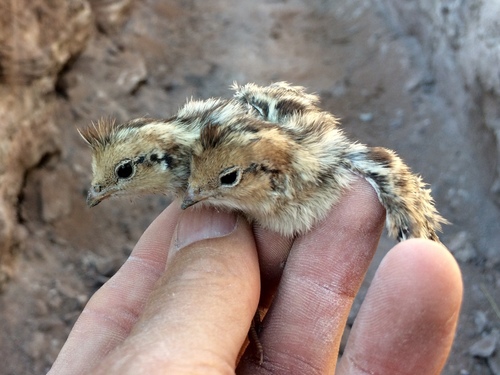
The scaled quail, also commonly called blue quail or cottontop, is a species of the New World quail family. It is a bluish gray bird found in the arid regions of the Southwestern United States to Central Mexico. This species is an early offshoot of the genus Callipepla, diverging in the Pliocene.
π Distribution and taxonomy
Scaled quail occur from south-central Arizona, northern New Mexico, east-central Colorado,
Scaled quail has formed several subspecies, 3 of which range into the USA:
*Callipepla squamata squamata Vigors, 1830 (Altiplano scaled quail). The nominate subspecies; it is only found on the Central Plateau (altiplano) of Mexico. The chestnut brown belly distinguishes it from all other subspecies; it is also darker than the other two found in the USA.
π Plant communities
According to Ligon, the distribution of scaled quail is largely coextensive with mesquite (Prosopis spp.), condalia (Condalia spp.), and
cholla (Cylindropuntia spp.).
In Oklahoma, scaled quail occur in sand sagebrush (Artemisia filifolia)-grassland, pinyon-juniper (Pinus spp.-Juniperus spp.), and shortgrass High Plains.
π Timing of major life events
In Arizona, pairing and maximum dispersal is complete by mid-June. Nesting probably does not begin until early July.
Scaled quail are fairly sedentary. The winter home ranges of scaled quail coveys varied from . The home ranges of separate coveys overlap only slightly or not at all. In Arizona, 75 to 90% of a population apparently moved off of a breeding area by mid-November, moving to nearby mountain foothills. The mountain habitat was consistent with that found on the breeding area. In March the population on the breeding area increased again, with most birds in groups of four to eight.
The average winter covey size for scaled quail is around 30 birds, although coveys of up to 150 birds have been reported.
π Preferred habitat
Scaled quail inhabit dry, open valleys, plains, foothills, rocky slopes, draws, gullies, and canyons that have a mixture of bare ground, low herbaceous growth, and scattered brushy cover. Scaled quail have been reported as inhabiting an area from the nearest water in Arizona. In New Mexico, it was not unusual to find Scaled Quail from water. observed winter coveys from water in Big Bend National Park in southwestern Texas.
In Arizona, scaled quail summer habitat is seldom within of water. Scaled quail were observed drinking at stock tanks from April to June (which was a dry period during the course of the study) every 2 to 3 days. In Oklahoma, scaled quail often migrate to farms and ranches in winter and are thus closer to a source of water in winter than in summer. DeGraaf and others reported that in winter, scaled quail are usually found within of a source of water.
π Cover requirements
Feeding cover: scaled quail use grass clumps and shrubs for cover while feeding. In one study they were frequently seen crossing of bare ground. When disturbed, scaled quail hid in snakeweed (Gutierrezia spp.) or in grass clumps. In northwestern Texas, loafing coverts were characterized by: (1) overhead woody cover, (2) lateral screening cover, (3) a central area with bare soil, and (4) one or more paths through the lateral cover. Covert heights ranged from high and in diameter. Cholla formed all or part of the overhead cover of 85% of coverts, even though they were dominant at only 12% of the study locations. In areas where scaled quail occur without cholla, woody species such as wolfberry (Lycium spp.) and mesquite are important for overhead cover. In Oklahoma pinyon-juniper habitats, scaled quail use the shade of tree cholla (Cylindropuntia imbricata) and human-made structures. In Arizona, scaled quail occupied wolfberry and mesquite tall for loafing cover. This overhead cover provides midday shade, but is open at the base to allow easy escape from predators. In Oklahoma, winter home ranges always contained skunkbush sumac, tree cholla, or human-made structures providing overhead cover.
Night-roosting cover: scaled quail roosts were observed in yucca (Yucca angustifolia), tree cholla, and true mountain-mahogany (Cercocarpus montanus)-yucca-fragrant sumac (Rhus aromatica) vegetation types. The height of vegetation used for night roosts was less than .
Nesting cover: In March or April winter coveys spread out into areas with less cover. This use of areas with less cover coincides with a seasonal decrease in the number of raptors in the same area. Scaled quail nests are constructed under tufts of grasses, and are sheltered by sagebrush (Artemisia spp.), creosotebush (Larrea tridentata), mesquite, catclaw acacia (Acacia greggii), cactus, or yucca; under dead Russian-thistle (Salsola kali), mixed forbs, or soapweed yucca; or sheltered in old machinery or other human-made debris. In Oklahoma, 66% of nests were in one of four situations: (1) dead Russian-thistle, (2) machinery and junk, (3) mixed forbs, and (4) soapweed yucca. In New Mexico, ordination of breeding birds and vegetative microhabitats indicated that scaled quail were associated with increased levels of patchiness and increased cover of mesquite and cactus.
π Food habits
Scaled quail are opportunistic eaters.
In northwestern Texas, selection of foods by scaled quail was dependent on foraging techniques, availability, and seed size. Small seeds were selected when they were still on the plant and could be easily stripped, but were not eaten once they had fallen, presumably because they were too small and/or too hard to find. Broom snakeweed (Gutierrezia sarothrae) was a staple in winter diets; it was not highly selected but was consumed in proportion to its availability (and lack of availability of choice items).
In southwestern Texas, chestnut-bellied scaled quail consumed woody plant seeds and green vegetation. The seeds of brush species comprised 68% of the contents of 32 scaled quail crops. Green food, chiefly wild carrot (Daucus carota) and clover (Trifolium spp.) made up 7.17%. Elbowbush was the single most important source, followed by Roemer acacia (Acacia roemeriana), desert-yaupon (Schaefferia cuneifolia), and spiny hackberry (Celtis pallida).
In southeastern New Mexico, staples (comprising at least 5% of scaled quail diet in both summer and winter) were mesquite and croton (Croton spp.) seeds, green vegetation, and snout beetles. Nonpreferred foods eaten in winter and available but not consumed in summer included broom snakeweed (the main winter food), crown-beard (Verbesina encelioides), cycloloma (Cycloloma atriplicifolium), and lace bugs. Mesquite seeds and broom snakeweed seeds together made up 75% of the winter diet. Grasshoppers were a summer staple. Insect galls, cicadas, scarab beetles, spurge (Euphorbia spp.), plains bristlegrass (Setaria macrostachya) seeds, and white ratany (Krameria grayi) were consumed in a less pronounced seasonal pattern. Another study reported substantial amounts of prairie sunflower seeds (Helianthus petiolaris) and pigweed (Amaranthus spp.) seeds in the diet of scaled quail.
Scaled quail feed in alfalfa (Medicago spp.) fields.
π Predators
In Arizona, potential scaled quail predators include mammals, birds, and reptiles. Most scaled quail kills are made by avian predators including northern harrier (Circus cyaneus), red-tailed hawk (Buteo jamaicensis), American kestrel (Falco sparverius), prairie falcon (Falco mexicanus), and great horned owl (Bubo virginianus).
Scaled quail are popular gamebirds.