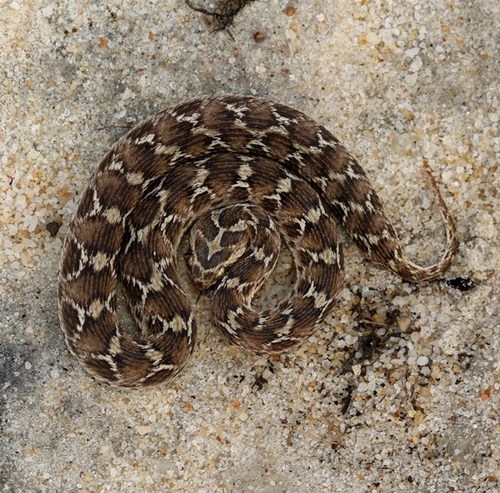
Echis is a genus of vipers found in the dry regions of Africa, the Middle East, India, Sri Lanka and Pakistan. They have a characteristic threat display, rubbing sections of their body together to produce a "sizzling" warning sound. The name Echis is the Latin transliteration of the Greek word for "viper" (ἔχις). Like all vipers, they are venomous. Their common name is "saw-scaled vipers" and they include some of the species responsible for causing the most snakebite cases and deaths in the world. Twelve species are currently recognized.
📌 Geographic range
Species of this genus are found in Pakistan, India (in rocky regions of Maharashtra, Rajasthan, Uttar Pradesh, and Punjab) and Sri Lanka, parts of the Middle East, and Africa north of the equator.
📌 Behaviour
All members of this genus have a distinctive threat display, which involves forming a series of parallel, C-shaped coils and rubbing their scales together to produce a sizzling sound, rather like water on a hot plate. As they become more agitated, this stridulating behavior becomes faster and louder. This display is thought to have evolved as a means of limiting water loss, such as might occur when hissing. However, some authors describe this display as being accompanied by loud hissing.
These snakes can be fierce and are quick to strike. They will strike from the position described above. When doing so, they may overbalance and end up moving towards their aggressor (an unusual behavior for snakes).
Saw-scaled vipers are highly defensive compared to many of their cousins and they are very easy to provoke, so they might strike quickly.
📌 Reproduction
Most Echis species, such as those found in Africa, are oviparous, while others, such as those in India, are viviparous.
📌 Venom
The snake venom of Echis species consists mostly of four types of toxins: neurotoxins, cardiotoxins, hemotoxins, and cytotoxins. The genus is recognized as medically significant in many tropical rural areas. They are widespread and live in areas lacking modern medical facilities. Most victims are bitten after dark when these snakes are active.
Venom toxicity varies among the different species, geographic locations, individual specimens, sexes, over the seasons, different milkings, and, of course, the method of injection (subcutaneous, intramuscular, or intravenous). Consequently, the values for Echis venoms differ significantly. In mice, the intravenous LD50 ranges from 2.3 mg/kg (U.S. Navy, 1991) to 24.1 mg/kg (Christensen, 1955) to 0.44–0.48 mg/kg (Cloudsley-Thompson, 1988). In humans, the lethal dose is estimated to be up to 5 mg in some subspecies (Daniels, J. C. 2002). Venom from females was more than twice as toxic on average as venom from males. 6–48 mg (16 mg average) from Iranian specimens and 13–35 mg of dried venom from animals from various other localities. Yield varies seasonally, as well as between the sexes: the most venom is produced during the summer months and males produce more than females.
📌 Species
{| cellspacing=0 cellpadding=2 border=1 style="border-collapse: collapse;"
!bgcolor="#f0f0f0"|Image
!bgcolor="#f0f0f0"|Species
!bgcolor="#f0f0f0"|Taxon author
!bgcolor="#f0f0f0"|Subsp.*
!bgcolor="#f0f0f0"|Common name
!bgcolor="#f0f0f0"|Geographic range
|-
|
|E. borkini
|Cherlin, 1990
|align="center"|0
|
|style="width:35%"|Southwestern Arabian Peninsula (western Yemen, southern Saudi Arabia)
|-
|
|E. carinatusT
|(Schneider, 1801)
|align="center"|4
|Saw-scaled viper
|style="width:35%"|Southeastern Arabian Peninsula (Oman, Masirah and eastern UAE), southwestern Iran, Iraq, Afghanistan, Uzbekistan, Turkmenistan, Tajikistan, Pakistan (including Urak near Quetta and Astola Island off the Makran Coast), India, Sri Lanka
|-
|
|E. coloratus
|Günther, 1878
|align="center"|0
|Painted saw-scaled viper
|Southeastern Egypt east of the Nile and as far south as the 24th parallel, Sinai, Israel, Jordan, and the Arabian Peninsula in Saudi Arabia, Yemen and Oman
|-
|
|E. hughesi
|Cherlin, 1990
|align="center"|0
|Hughes' saw-scaled viper
|Somalia: northern Migiurtinia, near Meledin
|-
|
|E. jogeri
|Cherlin, 1990
|align="center"|0
|Joger's saw-scaled viper
|Western and central Mali, Senegal
|-
|
|E. khosatzkii
|Cherlin, 1990
|align="center"|0
|Khosatzki's saw-scaled viper
|Eastern Yemen and Oman
|-
|
|E. leucogaster
|Roman, 1972
|align="center"|0
|White-bellied carpet viper
|West and northwest Africa: extreme southern Morocco, Western Sahara, Algeria (Ahaggar), the southern region of Mauritania, Senegal, northern Guinea, central Mali, Burkina Faso, western Niger and northern Nigeria
|-
|
|E. megalocephalus
|Cherlin, 1990
|align="center"|0
|Cherlin's saw-scaled viper
|Red Sea island between Yemen and Eritrea (Dahlak Archipelago)
|-
|
|E. ocellatus
|Stemmler, 1970
|align="center"|0
|African saw-scaled viper
|Northwest Africa: Mauritania, Senegal, Mali, Guinea, Ivory Coast, Burkina Faso, Ghana, Togo, Benin, southern Niger, Nigeria
|-
|
|E. omanensis
|Babocsay, 2004
|align="center"|0
|Oman saw-scaled viper
|United Arab Emirates, Eastern Oman
|-
|
|E. pyramidum
|(Geoffroy Saint-Hilaire, 1827)
|align="center"|2
|Egyptian saw-scaled viper
| Northeastern Africa: northern Egypt and central Sudan, Eritrea, Ethiopia, Somalia and northern Kenya; disjunct populations in the northern regions of Libya, Tunisia and Algeria
|-
|
|E. romani
|Trape, 2018
|align="center"|0
|Roman's carpet viper
| Southwestern Chad, southern Niger, Nigeria, northern Cameroon, northwestern Central African Republic
|-
|}
*) Not including the nominate subspecies
T) Type species
📌 Taxonomy
The taxonomy of the group was long confused, with a plethora of species of uncertain status. Several recent studies have clarified the diversity within the genus. This included the descriptions of E. omanensis and E. romani.
A mitochondrial DNA phylogeny for the genus demonstrated the distinctiveness of E. borkini, E. jogeri and E. khosatzkii, but showed E. multisquamatus to be a synonym of E. carinatus.