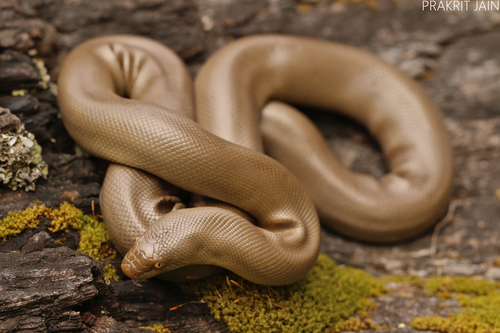
The rubber boa is a species of snake in the family Boidae and is native to western North America. It is sometimes known as the coastal rubber boa or the northern rubber boa and is not to be confused with the southern rubber boa.
π Taxonomy
Henri Marie Ducrotay de Blainville described the rubber boa in 1835. The generic name Charina is from the Ancient Greek "graceful" or "delightful", and the specific name bottae honors Dr. Paolo E. Botta, an Italian ship's surgeon, explorer, and naturalist.
The family Boidae consists of the nonvenomous snakes commonly called boas and consists of 43 species. The genus Charina consists of two species, both of which are found in North America. There is debate on whether the southern rubber boa, a population found in the San Bernardino and San Jacinto Mountains east of Los Angeles in California, should be a separate species or a subspecies (as Charina bottae umbratica). A study published in 2001 concluded there is enough evidence to indicate that the proposed independent species, Charina umbratica, is a separate species based on its geologically separate genetic nature and morphological differences.
π Distribution
Rubber boas are the most northerly of all boa species. The distribution of rubber boas covers a large portion of the western United States, stretching from the Pacific Coast east to western Utah and Montana, as far south as central California, and as far north as southern British Columbia in Canada. There have also been rare sightings in Colorado and Alberta in addition to the states/provinces that they are known to thrive in: California, Oregon, Washington, Nevada, Utah, Wyoming, Montana, Idaho, and extending to its northernmost range in British Columbia, around Pemberton, Williams Lake,
π Behavior
Characteristics of rubber boas' behavior also set them apart from other snakes. Rubber boas are considered one of the most docile of the boa species and are often used to help people overcome their fear of snakes. Rubber boas are known to never strike at or bite a human under any circumstances but will release a potent musk from their vent if they feel threatened. They are primarily nocturnal and likely crepuscular (active during dawn and dusk) which partially contributes to how rarely they are encountered. Because of the temperate regions they inhabit, rubber boas hibernate during the winter months in underground dens.
π Hunting
Rubber boas feed primarily on young mammals such as shrews, voles (such as long-tailed voles), mice (such as deer mice), etc. When they encounter nestling mammals, they try to consume the entire litter and fend off the mother with their tail. This is why they often have extensive scarring on their tails. Rubber boas have also been known to prey on salamanders, possibly frogs, snake eggs, lizard eggs, lizards, young birds, small birds, young bats, and there have even been instances of them eating other snakes.
π Predation
Rubber boas can be preyed upon by almost any reasonably sized predator in their habitat. When threatened, rubber boas curl into a ball around their head, and expose their tail to mimic their head. While this is thought to be a primary defense technique against predators, it is not effective against many predators (raptors, coyotes, raccoons, cats, etc.). The best defense of rubber boas is their secretive nature.
π Reproduction
Rubber boas are viviparous (give birth to live young) and can have up to 9 young per year, although litters of 1β5 are much more common. Rubber boas are less prolific than many snakes found in the US and Canada with females only reproducing on average once every four years. Mating occurs shortly after reemergence from brumation in the spring, and young are born anywhere from August to November later that year.