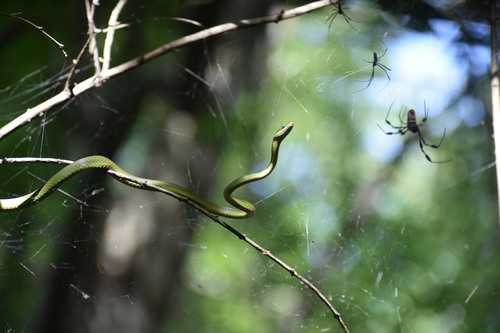
Opheodrys aestivus, commonly known as the rough green snake, is a species of nonvenomous North American snake in the subfamily Colubrinae of the family Colubridae. The species is sometimes called grass snake or green grass snake, but these names are more commonly applied to the smooth green snake. The European colubrid called grass snake is not closely related. The rough green snake is docile, often allowing close approach by humans, and rarely bites. Even when bites occur, they have no venom and are harmless.
📌 Etymology
The specific name, aestivus, is Latin for "summer" in reference to the species' green dorsal color. The generic name, Opheodrys, is derived from Greek ophios, meaning "serpent", and drys, "tree".
📌 Geographic range
The rough green snake ranges throughout the Southeastern United States, from Florida, north to Southern New Jersey, Indiana, and west to Central Texas. At the edge of the species' population, in states such as New Jersey, Indiana, and Kansas, it is often isolated and dependent on locally humid microclimates. The snake is commonly found in the Piedmont and Atlantic coastal plain, but is not found in the higher elevations of the Appalachian Mountains. It is also found in northeastern Mexico, including the state of Tamaulipas and eastern Nuevo León.
📌 Habitat and behavior
The preferred natural habitat of Opheodrys aestivus is moist meadows and woodlands, typically near water. It is highly arboreal, and prefers a narrow arboreal microhabitat of dense brush in edge situations. This microhabitat is found in a variety of habitats, such as lakeshores, streambanks, and upland ravines. The rough green snake also commonly uses disturbed edge habitats alongside roads for thermoregulation and refuge. If kept in captivity it is recommended that it be in a taller enclosure with plenty of cover and climbing opportunities. It is frequently found climbing in low vegetation, and is also a good swimmer. However, it is often found on the ground as well. Unlike many snakes, it is largely diurnal. At night it is found coiled in the branches of trees. Preference is given to perches based upon distance from the shoreline, height of branches, and thickness of the individual branch.
📌 As prey
Predators of the rough green snake include birds and other snakes, such as the eastern racer (Coluber constrictor) and the eastern king snake (Lampropeltis getula). It can also be infested by parasites including species of the genus Cryptosporidium. The rough green snake does not exhibit any predator-resistance capabilities besides fleeing, however it relies heavily on its camouflage. It often undergoes a lot of stress due to human presence.
📌 Reproduction
The male rough green snake reaches sexual maturity at an age of two years, and a snout-to-vent length (SVL) of around . The female reaches sexual maturity around one or two years of age, or when it attains a length of . The rough green snake breeds in spring, and sometimes again in fall. Courtship behaviors expressed by the male include head-jerking, tail-waving, and chin-rubbing. The male aligns its copulatory organs (hemipenes) with the female in an average of 2 minutes and 45 seconds, and copulation averages 16 minutes and 4 seconds. The female lays 2–14 eggs, occasionally in a communal nest shared by more than one female. Up to 75 eggs have been found in one such nest. The nest site varies: under boards, under bark in rotting stumps, in deep mulch, or under a rock. Hatchlings from spring breeding typically emerge in August or September, and each has a total length (tail included) of about . At maturity, the male begins storing abundant amounts of sperm in its vas deferens. It is able to mate in the spring of the next year (third year of life).
📌 Conservation status
The rough green snake is widespread and is not of conservation concern. However, urban development, especially the reduction of vegetation near waterways, may reduce its numbers. Many are killed on roads, and it may be susceptible to poisoning by pesticides used on its insect prey. When dead, it turns blue. It is also one of the most exploited pet snakes in North America. Opheodrys aestivus is collected by the hundreds each year.
📌 Subspecies
*Opheodrys aestivus aestivus – northern rough green snake
*Opheodrys aestivus carinatus – Florida rough green snake