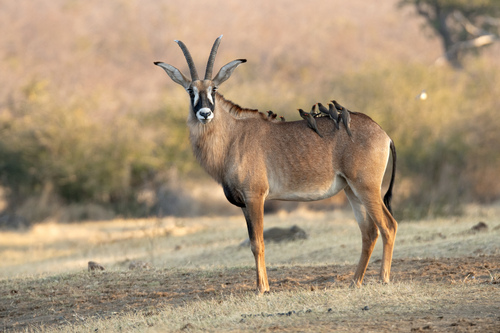
The roan antelope is a large, savanna-dwelling antelope found in Western, Southern, and parts of Central and Eastern Africa. Named for its roan colour, it has a lighter-toned underbelly and a (mostly) white face and snout, but with a black "mask" around the eyes and on the bridge of the snout, being somewhat lighter in females. Additionally, a pair of formidable, recurved horns are present on the heads of both males and females, albeit larger on the males, growing up to 100 cm long. Males and females have short, erect, mohawk-like manes running down their back and very light, shaggy neckbeards, both of which are more pronounced in males. Both mane and neckbeard are tinted with darker tips, which run the length of the animal's back and belly, ending in a dark-coloured tail. The ears are long, erect, and donkey-like.
📌 Taxonomy and evolution
The roan antelope shares the genus Hippotragus with the extinct bluebuck (H. leucophaeus) and the sable antelope (H. niger), and is a member of the family Bovidae. It was first described by French naturalist Étienne Geoffroy Saint-Hilaire in 1803. The specific epithet equinus derives from the Latin ("horse-like"), referring to the horse-like appearance of this antelope.
In 1996, an analysis of mitochondrial DNA extracted from a mounted specimen of the bluebuck found that it was outside the clade containing the roan and sable antelopes. The study therefore concluded that the bluebuck is a distinct species, and not merely a subspecies of the roan antelope. The cladogram below shows the position of the roan antelope among its relatives, following the 1996 analysis:
|2= }} }} }}
In 1974, palaeoanthropologist Richard Klein studied the fossils of Hippotragus species in South Africa. Most of these were found to represent the bluebuck and the roan antelope. The roan antelope seems to have appeared in the Nelson Bay Cave region following climatic changes in the Holocene.
📌 Subspecies
Six subspecies are recognised:
*H. e. bakeri (Heuglin, 1863): Occurs in Sudan (East Africa).
*H. e. cottoni Dollman and Burlace, 1928: Occurs in Angola, Botswana, the southern Democratic Republic of the Congo, central and northern Malawi, and Zambia (Southern Africa).
*H. e. equinus É. Geoffroy Saint-Hilaire, 1803: Occurs in Mozambique, South Africa and Zimbabwe (Southern Africa).
*H. e. koba (Gray, 1872): Range extends from Senegal to Benin (West Africa).
*H. e. langheldi Matschie, 1898: Occurs in Burundi, the northern Democratic Republic of the Congo, Ethiopia, Kenya, Rwanda, South Sudan, Tanzania and Uganda (East Africa).
*H. e. scharicus (Schwarz, 1913): Occurs in Cameroon, the Central African Republic, Chad and eastern Nigeria (Central Africa).
The 6 subspecies were described in 1971 on the basis of morphology instead of genetics. As a result, the validity of the subspecies have been questioned by scientists. Since then, there have been attempts to determine their validity through genetic analysis, but these have been insufficient at resolving the uncertainty.
File:Roan antelope (Hippotragus equinus) male walking.jpg|H. e. equinus, South Africa
File:Roan Antelope, Kafue National Park, Zambia, Nov 2011.jpg|H. e. cottoni, Zambia
File:Roan antelope (Hippotragus equinus koba) showing ears.jpg|H. e. koba showing both sides of ears, Senegal
📌 Ecology
Roan antelopes can be found in woodland, grassland, and savannah; mainly in the tropical and subtropical grasslands, savannas, and shrublands biome, which range in tree density from forest with a grassy understory (such as the central Zambezian Miombo woodlands) to grasslands dotted with few trees, where they eat mid-length grasses.
They live in small groups and form harem groups of 5 to 15 animals with one dominant male. Males commonly fight among themselves for dominance of their herd, brandishing their horns while both animals are on their knees.
Roan antelopes are known to hybridise with sable antelopes in overlaps of the two distributions. Hybridisation occurred due to the wartime poaching depleting both populations.