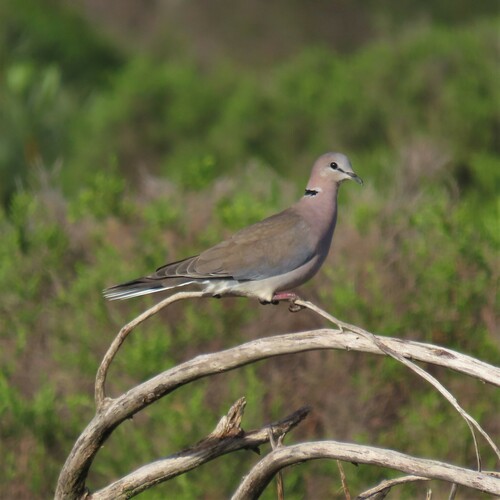
The ring-necked dove, also known as the Cape turtle dove, half-collared dove, or the Cape Lager is a widespread and often abundant dove species in East and southern Africa. It is a mostly sedentary bird, found in a variety of open habitats. Within range, its penetrating and rhythmic, three-syllabled crooning is a familiar sound at any time of the year. Its name is derived from the semi-collar of black feathers on the lower nape, a feature shared with a number of Streptopelia species. Like all doves, they depend on surface water. They congregate in large flocks at waterholes in dry regions to drink and bathe.
📌 Habits
These doves are usually found alone or in pairs, although they do form larger flocks around roosts or sources of food and water,
📌 Food
They feed mainly on seeds (of grasses, cereal grains, lupins, milkweeds, alien acacias and pines), but also on broken fruit and berries (of oaks, gums, currants and Lantana), and insects on occasion (earthworms, termites, weevils and other). Other recorded food items include small sedge bulbs, fleshy succulent leaves, aloe nectar and sugary aphid secretions.
📌 Breeding
collection]]
They are monogamous, territorial nesters. Males display by flapping up a steep gradient before spiraling down with wings and tail spread out. From a perch or on the ground, the male will engage in a bowing display synchronized with a rolling crooning, "uk-carrroooo, ...", while the throat is inflated. A pair will give a double coo with a long second syllable when selecting a nest site. The female takes two to three days to construct the flimsy platform nest. It is made of twigs and leaf petioles that are carefully selected by the male (as in other dove species) and delivered to her at the nest site. The nest is placed 2 to 10 meters above the ground on a horizontal branch fork. Quite often, an old nest of another species may be used. Two to four pure white eggs are laid and both sexes participate in the incubation, which takes about two weeks. Chicks are fed regurgitated food by both parents and fledge after about 16 days. Several broods (up to five) may be raised in a single season.
📌 Subspecies
There are six subspecies. They differ mainly in plumage shade, with those of dry regions being paler and greyer. Western Ethiopian and South Sudanese birds are sometimes separated from S. c. tropica as S. c. electa (Madarász, 1913).
* S. c. capicola – southwestern (winter rainfall) South Africa
* S. c. abunda Clancey, 1960 – central South Africa
* S. c. damarensis (Hartlaub & Finsch, 1870) – arid interior of southern Africa
* S. c. onguati Macdonald, 1957 – western Namibia and Angola
* S. c. tropica (Reichenow, 1902) – tropical and subtropical woodlands from South Africa to South Sudan
* S. c. somalica (Erlanger, 1905) – northern Tanzania to Somalia and Ethiopia
📌 Similar species
A number of Streptopelia species are very similar in appearance, all having semi-collars and subdued plumage tones. The ring-necked dove is distinguished from its locally sympatric sister species, the African collared dove, by call, the paler bases of the tail feathers, and the grey rather than pink crown feathers.
On appearance alone, it may also be confused with the Eurasian collared dove, vinaceous dove, red-eyed dove, red collared dove, African mourning dove or the Barbary dove, the last of these a popular cage bird with isolated feral populations. The red-eyed dove is generally similar, with an identical display flight. It, however, has dark wine red eyes and is larger and darker altogether, with a grey belly and grey tail tips. The African mourning dove has more grey about the head and pale yellow eyes.