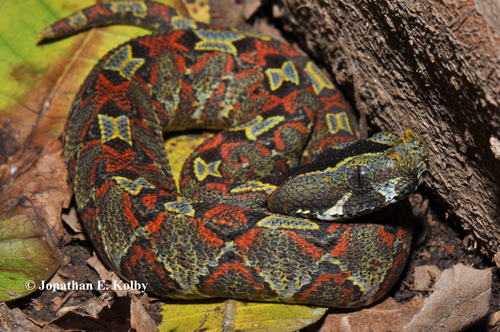
Bitis nasicornis is a viper species belonging to the genus Bitis, part of a subfamily known as "puff-adders", found in the forests of West and Central Africa. This large viper is known for its striking coloration and prominent nasal "horns". No subspecies are currently recognized. Its common names include butterfly viper, rhinoceros viper, river jack and many more. Like all other vipers, it is venomous.
🛡️ Conservation Status
vulnerable
vu
📌 Common names
Its common and historical names include butterfly viper, rhinoceros viper, river jack, and rhinoceros puff adder. Americo-Liberians apparently call adult "puff-adders", such as the B. nasicornis, but also the B. gabonica (gaboon viper), cassava snakes.
Historically this species was referred to as the rhinoceros viper (for example , ) but this introduced confusion after the reclassification of the closely related species Bitis rhinoceros. The common name butterfly viper is therefore more distinct and preferred to avoid confusion.
The name "horned puff adder" (in relation to the viper subfamily "puff adders", today synonymous with the genus Bitis) is also a historical name for Bitis caudalis (horned adder) and can cause confusion. Interestingly the dutch name for Bitis nasicornis is "rhinoceros puff adder" (), while Bitis caudalis (horned adder) is named "horned puff adder" ().
📌 Distribution and habitat
, Uganda]]
B. nasicornis is found from southern Guinea, Sierra Leone and Liberia to Ghana in West Africa, and in Central Africa in the Central African Republic, southern Sudan, Cameroon, Gabon, Congo, DR Congo, Angola, Rwanda, Uganda and western Kenya. The type locality is listed only as "interior parts of Africa."
It mainly occurs in forested areas, rarely venturing into woodlands. Its range is therefore more restricted than B. gabonica.
📌 Behavior
Primarily nocturnal, they hide during the day in leaf litter, in holes, around fallen trees or tangled roots of forest trees. Their vivid coloration actually gives them excellent camouflage in the dappled light conditions of the forest floor, making them almost invisible. Although mainly terrestrial, they are also known to climb into trees and thickets, where they have been found up to above the ground. This climbing behavior is aided by a partially prehensile tail. They are sometimes found in shallow pools and have been described as powerful swimmers.
They are slow moving, but capable of striking quickly, forwards or sideways, without coiling first or giving a warning. Holding them by the tail is not safe; as it is somewhat prehensile, they can use it to fling themselves upwards and strike.
They have been described as generally placid creatures, less so than B. gabonica, but not as bad-tempered as B. arietans. When approached, they often reveal their presence by hissing, said to be the loudest hiss of any African snake—almost a shriek. These adders also make a sort of hissing noise through their nose as part of their respiratory function.
File:Viperidae - Bitis nasicornis.JPG|Two B. nasicornis hidden under tree root
File:Rhinocerous viper - Bitis nasicornis (cropped).jpg|Fully adult B. nasicornis resting flattened at Cincinnati Zoo, US
File:Rhinoceros Viper (Bitis nasicornis) and Gaboon Viper (Bitis gabonica) captive specimens (21362330860).jpg|B. nasicornis held captive with a Gaboon viper (Bitis gabonica)
📌 Feeding
Preferring to hunt by ambush, it probably spends much of its life motionless, waiting for prey to wander by. Froesch (1967) described a captive specimen that would hardly ever leave its hide box, even when hungry, and once waited for three days for a live mouse to enter its hide box before striking. Feeding mainly on small mammals, but in wetland habitats, it is also known to take toads, frogs and even fish. One long-term captive specimen, regularly fed killed mice and frogs, always held on to its prey for several minutes after a strike before swallowing. It generally feeds on smaller prey than the closely related Gaboon viper (Bitis gabonica).
📌 Reproduction
B. nasicornis]]
Like most vipers, Bitis nasicornis are viviparous (producing their young alive). In West Africa, the species gives birth to between six and 38 young in March–April at the beginning of the rainy season. Each neonate is to a in total length when born. In eastern Africa, the breeding season is indefinite.
📌 Venom
Small doses of the snake's primarily hemotoxic venom can be deadly. This is unlike the Gaboon viper, which uses a considerably larger amount of venom. Bitis nasicornis has both neurotoxic, as well as hemotoxic venom, as do most other venomous snakes. The hemotoxic venom in rhinoceros vipers is much more dominant. This venom attacks the circulatory system of the snake's victim, destroying tissue and blood vessels. Internal bleeding also occurs.
When not in use, the rhino viper's fangs are folded up into the roof of the snake's mouth. The snake has the ability to control the movement of its fangs. When a rhino viper opens its mouth, it does not necessarily mean that the fangs will flip down into place. The fangs penetrate deep into the victim and the venom flows through the hollow fangs into the wound.
Because of its restricted geographic range, few bites have been reported. No statistics are available. At least one antivenom protects specifically against bites from this species: India Antiserum Africa Polyvalent.