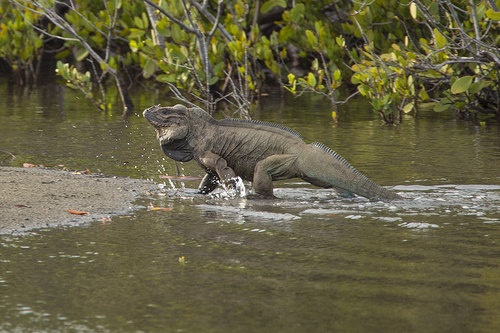
The rhinoceros iguana is an endangered species of iguana that is endemic to the Caribbean island of Hispaniola and its surrounding islands. A large lizard, they vary in length from 60 to 136 centimetres, and skin colours range from a steely grey to a dark green and even brown. Their name derives from the bony-plated pseudo-horn or outgrowth which resembles the horn of a rhinoceros on the iguana's snout. It is known to coexist with the Ricord's iguana ; the two species are the only taxa of rock iguana to do so.
🛡️ Conservation Status
endangered
en
📌 Taxonomy
The rhinoceros iguana is a species of lizard belonging to the genus Cyclura. The rhinoceros iguana's specific name, cornuta, is the feminine form of the Latin adjective cornutus, meaning "horned" and refers to the horned projections on the snouts of males of the species. The species was first identified by Pierre Joseph Bonnaterre in 1789. The Mona ground iguana (Cyclura stejnegeri) from Puerto Rico was originally thought to be a subspecies (and still is by some taxonomists), as Cyclura cornuta stejnegeri.
📌 Anatomy and morphology
]]
The rhinoceros iguana, like other members of the genus Cyclura, is a large-bodied, heavy-headed lizard with strong legs and a vertically flattened tail. Like all reptiles, rhinoceros iguanas are cold-blooded, meaning they need external sources to heat themselves; they move as the sun shifts in order to get an optimal internal temperature.
These iguanas are characterized by the growth of bony prominent tubercles on their snouts which resemble horns. Males possess an adipose pad in the form of a "helmet" on the occipital region of the head, and a large dewlap. This species, like other species of Cyclura, is sexually dimorphic; males are larger than females, and have more prominent dorsal crests and "horns" in addition to large femoral pores on their thighs, which are used to release pheromones.
📌 Distribution and habitat
Ranging in scattered locations throughout Hispaniola (in both Haiti and the Dominican Republic), populations are stable only on Isla Beata and the extreme of the Barahona Peninsula, inside Jaragua National Park.
An individual was photographed on May 4, 2008 on Limbe Island in northern Haiti. It had been caught by a group of fishermen from Bas-Limbe, Bord de Mer village. The rhinoceros iguanas caught on Limbe Island are illegally eaten by the local population. This sighting represents a new area previously not thought to be in the range of C. cornata.
Aside from Hispaniola and its surrounding islands, the rhinoceros iguana was previously found on Navassa Island (with an endemic subspecies: C. c. onchiopsis), but was extirpated there.
📌 Behaviour
Rhinoceros iguanas, like most members of Cyclura, are usually docile and well-tempered. As with many lizard species, "head-bobbing" is a commonly observed form of communication used by the rhinoceros iguana. Males, especially, appear to "nod" their heads toward one another as an assertion of dominance, or announcing their "ownership" of an area. It is oftentimes a warning to not come any closer, as well as to communicate (with females) their desire to mate. At times, this form of body language is directed at humans (by both wild and captive iguanas) as a warning, or as a sort of "greeting" to their human caretaker(s). The females (more or less) only nod their heads to ward off incessant advances from males, and female-to-female head bobbing is infrequent, though not nonexistent.
from lair, Jaragua National Park]]
In general, rhinoceros iguanas (especially captive bred individuals) are among the most docile and human-tolerant of reptiles; some iguanas appear to desire human attention, seeming to enjoy being petted as much as a domestic dog or cat would. Even with this overall docility, levels of human tolerance can vary greatly from iguana to iguana, season to season, and even day by day. Iguanas are highly in-tune with their surroundings, being particularly sensitive to atmospheric and energetic nuances. A normally friendly iguana may have "mood swings", or show a desire to be left alone, for unknown reasons. Though they prefer to flee when attacked or threatened, they will aggressively attack by biting and repeatedly striking with their thick tail if cornered. Their long claws can also cause significant scratches (even drawing blood), though this is not necessarily a defensive act, but can simply result from handling a more friendly iguana. Some owners opt to wear thick, long leather gloves, even with docile individuals.
📌 Mating and reproduction
Male rhinoceros iguanas, unlike other members of the genus Cyclura, reach sexual maturity at four to five years of age. By contrast, in many other animals that exhibit horns such as ungulates or rhinoceros beetles, horns are often only present in males. Rhinoceros iguanas are also reported to show less dimorphism in size than other iguana species.
📌 Predators
The rhinoceros iguana's only confirmed native predator is the Hispaniola racer (Haitiophis anomalus), a large snake which has been recorded to give chase to juvenile iguanas, as well as wait for them outside the exit holes of their burrow. However, most predation of iguanas comes from invasive species like feral dogs (Canis familiaris), feral cats (Felis catus), small Indian mongooses (Urva auropunctata), and feral pigs (Sus domesticus), which all feed on eggs, adults, and juveniles.
📌 Conservation
Zoo]]
Although rhinoceros iguanas are the most common species of Cyclura kept in captivity, as of 1996, approximately 10,000-17,000 iguanas remained in the wild. A successful breeding program existed at the Parque Zoológico Nacional of the Dominican Republic (ZooDom) from 1974 to 1994, with an average of 100 babies hatching annually. Illegal logging, competition from domestic grazers (cows, pigs, goats), predation on young by invasive species, limestone mining, harvesting for the pet trade, hunting for bushmeat, pollution, and wildfires are all manmade threats to the rhinoceros iguana's survival.
📌 Captivity
in Vienna.]]
The rhinoceros iguana is well established in captivity, both in public and private collections. As of 2007, rhinoceros iguanas were present in captivity throughout the United States (total 39 males, 32 females, and 36 undetermined individuals) at 20 zoological institutions, with an additional 533 animals of unassigned subspecies, reported by seven American Zoological and Aquarium Association institutions. 77 zoos in Europe also hold rhinoceros iguanas, all of which are assumed to be of the nominate subspecies (C. cornuta cornuta), including 14 zoos in the United Kingdom and 12 in Germany. The actual number may be much higher, considering most of these zoos hold multiple individuals and there are even more animals kept at South/Central American and Asian zoos, as well as the amount kept as pets in private collections. As a result, the demand for wild-caught animals to supply zoos and the pet trade has been reduced.