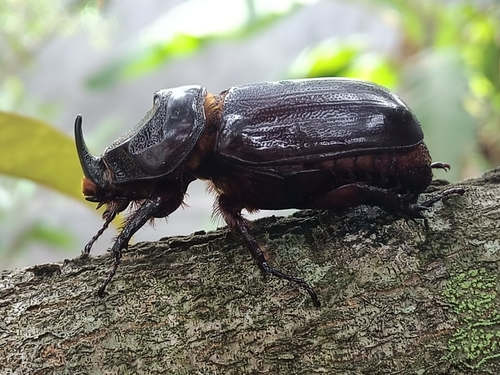
Dynastinae or rhinoceros beetles are a subfamily of the scarab beetle family (Scarabaeidae), named for their rhinoceros-like horns. Other common names – some for particular groups of rhinoceros beetles – include Hercules beetles, unicorn beetles or horn beetles. Over 1,500 species and 225 genera of rhinoceros beetles are known.
📌 Ecology
These beetles' larval stages can be several years long. The larvae feed on rotten wood and the adults feed on nectar, plant sap, and fruit. First, the larvae hatch from eggs and later develop into pupae before they reach adulthood.
📌 Mating
Male Japanese rhinoceros beetles (Allomyrina dichotoma) fight to dominate sap sites. Males use their horns to pry rival males off the area, which also may give them the chance to mate with a female. In this and other species that defend mating sites, larger males with larger horns mate more frequently, as they win more contests. Small males often avoid larger males and exhibit alternative strategies to gain access to females.
📌 As pests
Some species, such as the coconut rhinoceros beetle (Oryctes rhinoceros), can become major pests, e.g., in tree plantations. Usually though, beetle population densities are not as high as in some other pest insects, and they typically prefer food trees which are already sick or dying from some other cause. Some species' larvae, however, will attack healthy trees or even root vegetables, and when they occur in large numbers, can cause economically significant damage. The fungus Metarhizium majus is a proven biocontrol agent for beetle infestation in crops.
📌 Uses
Rhinoceros beetles have become popular pets in parts of Asia, due to being relatively clean, easy to maintain, and safe to handle. Also in Asia, male beetles are used for gambling fights. Since males naturally have the tendency to fight each other for the attention of females, they are the ones used for battle. To get the two male beetles to lock in combat, a female beetle is used, or a small noisemaker duplicating the female's mating call.
There is an illegal trade in rhino beetles which forms part of a broader insect trafficking network catering to exotic pet enthusiasts and trophy collectors willing to pay for rare and culturally popular specimens.
Despite the significant ecological pressures this trade exerts on insect populations such as rhino beetles. insect trafficking remains largely unregulated and overlooked compared to the attention given to charismatic wildlife like elephants or rhinos .
Entomologist Séverin Tchibozo suggests the larvae contain much more protein (40%) than chicken (20%) and beef (approximately 18%), and they could become a protein source for a large human population.
Dr. MinJun Kim, leading a team of engineers in National Science Foundation-funded research, examined the function and aerodynamics of Allomyrina dichotoma with the help of researchers in Drexel University's Mechanical Engineering Department and in collaboration with Konkuk University in South Korea.
📌 Tribes with selected genera and species
📌 Agaocephalini
Auth: Burmeister, 1847. all genera:
# Aegopsis Burmeister, 1847
# Agaocephala Lepeletier & Audinet-Serville, 1828
# Antodon Brême, 1845
# Brachysiderus Waterhouse, 1881
# Colacus Ohaus, 1910
# Democrates (beetle) Burmeister, 1847
# Gnathogolofa Arrow, 1914
# Horridocalia Endrödi, 1974
# Lycomedes (beetle) Breme, 1844
# Mitracephala Thomson, 1859
# Spodistes Burmeister, 1847
📌 [[Cyclocephalini]]
(Cyclocephalini)]]
Auth: Laporte, 1840. Selected genera:
* Ancognatha Erichson, 1847
* Cyclocephala Dejean, 1821 (masked chafers)
* Dyscinetus Harold, 1869 (rice beetles)
📌 [[Dynastini]]
(Dynastini)]]
Auth: MacLeay, 1819. Selected genera:
* Allomyrina Arrow, 1911 (including Trypoxylus)
** Allomyrina dichotoma – Japanese rhinoceros beetle
* Chalcosoma Hope, 1837
**Chalcosoma atlas – Atlas beetle
** Chalcosoma moellenkampi – Moellenkampi beetle
** Chalcosoma caucasus – Caucasus beetle
* Dynastes MacLeay, 1819
**Dynastes hercules – Hercules beetle
**Dynastes neptunus – Neptune beetle
* Eupatorus Burmeister, 1847
**Eupatorus gracilicornis – Five-horned rhinoceros beetle
**Eupatorus siamensis – Siamese beetle
**Eupatorus birmanicus – Rabbit beetle
* Megasoma Kirby, 1825
**Megasoma mars - Mars beetle
**Megasoma elephas - Elephant beetle
**Megasoma actaeon - Actaeon beetle
* Xylotrupes Hope, 1837
**Xylotrupes gideon – Siamese rhinoceros beetle
** Xylotrupes ulysses
📌 [[Hexodontini]]
Auth. Lacordaire, 1856; all genera from Madagascar:
# Hemicyrthus Reiche, 1860
# Hexodon Olivier, 1789
# Hyboschema Péringuey, 1901
📌 [[Oryctini]]
(Oryctini)]]
Auth: Mulsant, 1842. Selected genera:
* Enema Hope, 1837
* Megaceras Hope, 1837
** Megaceras briansaltini
* Oryctes Hellwig, 1798
** Oryctes nasicornis – European rhinoceros beetle
** Oryctes rhinoceros – coconut rhinoceros beetle
* Strategus Kirby, 1828
** Strategus aloeus – ox beetle
* Trichogomphus Burmeister, 1847
* Xyloryctes
📌 [[Oryctoderini]]
Auth. Endrödi, 1966; all genera:
# Chalcasthenes Arrow, 1937
# Chalcocrates Heller, 1903
# Coenoryctoderus Prell, 1933
# Hatamus Sharp, 1877
# Melanhyphus Fairmaire, 1881
# Neohyphus Heller, 1896
# Onychionyx Arrow, 1914
# Oryctoderinus Endrödi, 1978
# Oryctoderus Boisduval, 1835
# Paroryctoderus Dechambre, 1994
📌 [[Pentodontini]]
(Pentodontini)]]
Auth: Mulsant, 1842. Selected genera:
* Diloboderus Sturm, 1826 monotypic Diloboderus abderus
* Ligyrus
* Pentodon Hope, 1837
* Pericoptus Burmeister, 1847
* Tomarus Erichson, 1847
📌 [[Phileurini]]
(Phileurini)]]
Auth: Burmeister, 1847; selected genera:
* Cryptodus MacLeay, 1819
* Phileurus Latreille, 1807