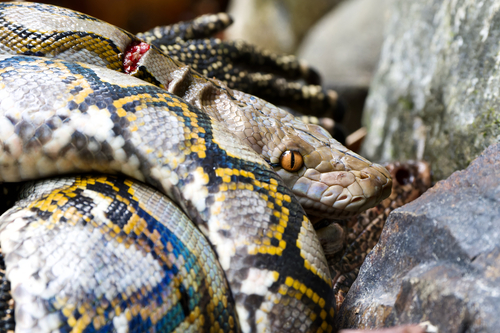
The reticulated python is a python species native to South and Southeast Asia. It is the world's longest snake, and the third heaviest after the green anaconda and Burmese python. It is a non-venomous constrictor and an excellent swimmer that has been reported far out at sea. It has colonized many small islands within its range. Because of its wide distribution, it is listed as least concern on the IUCN Red List. In several countries in its range, it is hunted for its skin, for use in traditional medicine, and for sale as pets. Due to this, it is one of the most economically important reptiles worldwide. Adult humans have been killed by reticulated pythons in the wild, mainly on Sulawesi.
ð Taxonomy
The reticulated python was first described in 1801 by Johann Gottlob Theaenus Schneider, who described two zoological specimens held by the GÃķttingen Museum in 1801 that differed slightly in colour and pattern as separate species, Boa reticulata and Boa rhombeata. The specific name, reticulatus, is Latin and means , or reticulated, and is a reference to the complex color pattern. The generic name Python was proposed by François Marie Daudin in 1803. Arnold G. Kluge performed a cladistics analysis on morphological characters and recovered the reticulated python lineage as sister to the genus Python, hence not requiring a new generic name in 1993.
In a 2004 genetics study using cytochrome b DNA, Robin Lawson and colleagues discovered the reticulated python as sister to Australo-Papuan pythons, rather than Python molurus and relatives. Raymond Hoser erected the genus Broghammerus for the reticulated python in 2004, naming it after the German snake breeder Stefan Broghammer, on the basis of dorsal patterns distinct from those of the genus Python, and a dark mid-dorsal line from the rear to the front of the head, and red or orange (rather than brown) iris colour. In 2008, Lesley H. Rawlings and colleagues reanalysed Kluge's morphological data and combined it with genetic material, finding the reticulated clade to be an offshoot of the Australo-Papuan lineage as well. They adopted and redefined the genus name Broghammerus.
Most taxonomists choose to ignore Broghammerus and other names by Hoser, as its description lacked scientific rigour and was not published in a reputable journal. R. Graham Reynolds and colleagues accordingly proposed the name Malayopython for this species and its sister species, the Timor python, in 2014. Malayopython has been recognized by subsequent authors and the Reptile Database. Hoser has argued that Broghammerus was validly published and Malayopython name is invalid as it is a junior synonym. Nevertheless, the name Malayopython remains in use by reliable sources, and Broghammerus is referred to as an invalid nomen nudum.
ð Subspecies
Three subspecies have been proposed:
* M. r. reticulatus (Schneider, 1801) â Asian reticulated python
* M. r. jampeanus Auliya et al., 2002 â Kayaudi reticulated python or Tanahjampean reticulated python, about half the length, or according to Auliya et al. (2002), not reaching much more than in length.
ð Characteristics
The reticulated python has smooth dorsal scales that are arranged in 69â79 rows at midbody. Deep pits occur on four anterior upper labials, on two or three anterior lower labials, and on five or six posterior lower labials.
The reticulated python is the largest snake native to Asia. More than a thousand wild reticulated pythons in southern Sumatra were studied, and estimated to have a length range of , and a weight range of . Reticulated pythons with lengths more than are rare, though according to the Guinness Book of World Records, it is the only extant snake to regularly exceed that length. One of the largest scientifically measured specimens, from Balikpapan, East Kalimantan, Indonesia, was measured under anesthesia at and weighed after not having eaten for nearly 3 months. Considerable confusion exists in the literature over whether Colossus was male or female (females tend to be larger).
ð Reported sizes
{|class="wikitable sortable collapsible collapsed"
|-
! Date !! Location !! Reported length !! Reported weight !! Reported girth !! Scientifically analyzed length !! Comments
|-
|October, 1859
|Bayan Lepas, Penang Island, Malaysia
|
|Not listed
|
|Not listed
|Discovered eating a pig on the road to Teluk Kumbar and killed
|-
|-
|1931â1948
|Evansville, Indiana, United States
|
|
|Not listed
|Not listed
|Kept at Mesker Zoo between 1931 and 1948. Exceptional weight claim believed to be in error.
|-
|-
|2011
|Kansas City, Missouri, United States
|
|
|
|
|Named "Medusa"; considered by the Guinness Book of World Records to be the longest (verified) living snake ever kept in captivity
The huge size and attractive pattern of this snake has made it a favorite zoo exhibit, with several individuals claimed to be above in length and more than one claimed to be the largest in captivity. However, due to its huge size, immense strength, aggressive disposition, and the mobility of the skin relative to the body, it is very difficult to get exact length measurements of a living reticulated python, and weights are rarely indicative, as captive pythons are often obese. For this reason, scientists do not accept the validity of length measurements unless performed on a dead or anesthetized snake that is later preserved in a museum collection or stored for scientific research.
In 2012, an albino reticulated python, named "Twinkie", housed in Fountain Valley, California, was considered to be the largest albino snake in captivity by the Guinness World Records. It measured in length and weighed about .
Dwarf forms of reticulated pythons also occur, from some islands northwest of Australia, and these are being selectively bred in captivity to be much smaller, resulting in animals often referred to as "super dwarfs". Adult super dwarf reticulated pythons are typically between in length.
ð Distribution and habitat
The reticulated python is found in South and Southeast Asia from the Nicobar Islands, India, Bangladesh, Myanmar, Thailand, Laos, Cambodia, Vietnam, Malaysia, and Singapore, east through Indonesia and the Indo-Australian Archipelago (Sumatra, the Mentawai Islands, the Natuna Islands, Borneo, Sulawesi, Java, Lombok, Sumbawa, Sumba, Flores, Timor, Maluku, Tanimbar Islands) and the Philippines (Basilan, Bohol, Cebu, Leyte, Luzon, Mindanao, Mindoro, Negros, Palawan, Panay, Polillo, Samar, Tawi-Tawi). The original description does not include a type locality. The type locality was restricted to "Java" by Brongersma (1972). but are not recognized in the Integrated Taxonomic Information System. The color and size can vary a great deal among the subspecies described. Geographical location is a good key to establishing the subspecies, as each one has a distinct geographical range.
The reticulated python lives in rainforests, woodlands, and nearby grasslands. It is also associated with rivers and is found in areas with nearby streams and lakes. An excellent swimmer, it has even been reported far out at sea and has consequently colonized many small islands within its range.
ð Behaviour and ecology
eating a reticulated python]]
ð Reproduction
The reticulated python is oviparous. Adult females lay between 15 and 80 eggs per clutch. At an optimum incubation temperature of , the eggs take an average of 88 days to hatch. Hatchlings are at least in length.
ð Danger to humans
The reticulated python is among the few snakes that prey on humans, and is the only species of snake for which video and photographic proof exists of them having consumed humans. In 2015, the species was added to the USA Lacey Act of 1900, prohibiting import into the USA and interstate transport within the USA due to its "injurious" history with humans. Attacks on humans in captivity are not common. Wild pythons, however, are known to sometimes prey on humans, particularly in their natural habitat in Sulawesi, Indonesia. Considering the known maximum prey size, a full-grown reticulated python can open its jaws wide enough to swallow a human, but the width of the shoulders of some adult Homo sapiens can pose a problem for even a snake with sufficient size. Reports of human fatalities and human consumption (the latest examples of consumption of adult human beings well authenticated) include:
* A report of a visit of Antonio van Diemen, Governor-General of the Dutch East India Company, to the Banda Islands in 1638, includes a description of an enslaved woman who, when tending to a garden on the volcanic island of Gunung Api, was strangled by a snake of "24 houtvoeten" (around 7.315 m/ 24 ft) in length, and then swallowed whole. The snake, having become slow after ingesting such a large prey, was subsequently shot by Dutch soldiers and brought to the Governor-General to be looked at, with its victim still inside. Although less reliable than this first-hand document, several early published travel journals describe similar episodes.
* In early 20th-century Indonesia: On Salibabu island, North Sulawesi, a 14-year-old boy was killed and supposedly eaten by a specimen in length. Another incident involved a woman reputedly eaten by a "large reticulated python", but few details are known.
* In the early 1910s or in 1927, a jeweller went hunting with his friends and was apparently eaten by a python after he sought shelter from a rainstorm in or under a tree. Supposedly, he was swallowed feet-first, perhaps the easiest way for a snake to actually swallow a human.
* Among a small group of Aeta peoples in the Philippines, six deaths by pythons were said to have been documented within a period of 40 years, plus one who died later of an infected bite.
* In October 2008, a woman from Virginia Beach, USA, appeared to have been killed by a pet reticulated python. The apparent cause of death was asphyxiation. The snake was later found in the bedroom in an agitated state.
* In January 2009, a 3-year-old boy was wrapped in the coils of a pet reticulated python, turning blue. The boy's mother, who had been petsitting the python on behalf of a friend, rescued him by gashing the python with a knife. The snake was later euthanized because of its wounds.
* In December 2013, a 59-year-old security guard was strangled to death while trying to capture a python near the Bali Hyatt, a luxury hotel on Indonesia's resort island. The incident happened around 3 am as the 4.5-m (15-ft) python was crossing a road near the hotel. The victim had offered to help capture the snake, which had been spotted several times before near the hotel in the Sanur, Bali, area and escaped back into nearby bushes.
*In March 2017, the body of Akbar Salubiro, a 25-year-old farmer in Central Mamuju Regency, West Sulawesi, Indonesia, was found inside the stomach of a reticulated python. He had been declared missing from his palm tree plantation, and the people searching for him found the python the next day with a large bulge in its stomach. They killed the python and found the whole body of the missing farmer inside. This was the first fully confirmed case of a person being eaten by a python. The process of retrieving the body from the python's stomach was documented by pictures and videos taken by witnesses.
* In June 2018, a 54-year-old Indonesian woman in Muna Island, Southeast Sulawesi, Indonesia, was killed and eaten by a python. The woman went missing one night while working in her garden, and the next day, a search party was organized after some of her belongings were found abandoned in the garden. The python was found near the garden with a large bulge in its body. The snake was killed and carried into town, where it was cut open, revealing the woman's body completely intact.
*In June 2020, a 16-year-old Indonesian boy was attacked and killed by a long python in Bombana Regency, Southeast Sulawesi, Indonesia. The incident took place near a waterfall at Mount Kahar in Rumbia sub-district. The victim was separated from his four friends in the woods. When he screamed, his friends came to help and found him encoiled by a large python. Villagers came to help and managed to kill the snake using a parang machete. However, the victim had already suffocated.
*In October 2022, a 52-year-old woman in Terjun Gajah village, Betara Subdistrict, West Tanjung Jabung Regency, Jambi, Indonesia, was killed and swallowed whole by a reticulated python. She went to tap rubber sap on 23 October 2022 and did not return home after sunset. After she was reported missing for a day and a night, a search party discovered a large python with a bulge in its body in a jungle near the rubber plantation. The villagers immediately killed and dissected the python and discovered the intact body of the missing woman inside. Villagers feared more large pythons might be present because farmers previously had reported two goats missing.
*In June 2024, a woman of Kalempang village in South Sulawesi province in Indonesia went missing, and her body was discovered inside a reticulated python. 3 weeks later, in July 2024, another woman was discovered inside a python's stomach in South Sulawesi. In August 2024, an elderly woman was found dead after a predatory attempt by a long python. The snake had killed the victim and tried to swallow her, but could not get over the shoulders, regurgitating the body instead. 2 weeks later another woman in Jambi province was killed by a python, which managed to swallow half of her body before being found and killed by the villagers. In November 2024, a 30-year-old man was killed and swallowed whole by a long specimen, the first recorded case of an adult male being eaten since 2017.
*In July 2025, a man was killed and swallowed whole by a reticulated python in Majapahit Village, Batauga, southeastern Sulawesi.
ð In captivity
.]], Terrarium, South Jakarta, Indonesia]]
Increased popularity of the reticulated python in the pet trade is due largely to increased efforts in captive breeding and selectively bred mutations such as the "albino" and "tiger" strains. Other notable color mutations recorded in this species include "sunfire", "motley", "Aztec", "ocelot", "rainbow", and "goldenchild". The "jaguar" color mutation is likewise controversial in the breeding of captive reticulated pythons, as certain specimens will develop neurological and osseous inner ears, similar to the "Spider" mutation that occurs in the ball python. It remains unclear as to why some individual pythons with the jaguar mutation display neurological issues associated with this genetic trait and others do not.
Smaller animals such as the proposed "super dwarf" subspecies found on small islands are likewise popular due to their smaller size, as they grow to a fraction of the lengths and weights of their mainland kin due to genetics, limited space and prey availability. Dwarf and super dwarf reticulated pythons are likewise defined for captive animals as any reticulated pythons with at least 50 percent lineage hailing from seven select islands in the Selayer island chain near Sulawesi. It can make a good captive, but keepers working with adults from mainland populations should have previous experience with large constrictors to ensure safety to both animal and keeper. Although its interactivity and beauty draws much attention, some feel it is unpredictable. The python can bite and possibly constrict if it feels threatened, or mistakes a hand for food. While not venomous, large pythons can inflict serious injuries by biting, sometimes requiring stitches.