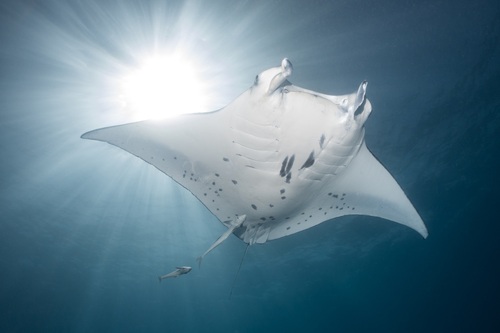
The reef manta ray or hāhālua is a species of ray in the family Mobulidae, one of the largest rays in the world. Among generally recognized species, it is the third-largest species of ray, surpassed by the Giant oceanic manta ray and the Atlantic manta ray.
🛡️ Conservation Status
vulnerable
vu
📌 Physical distinctions between oceanic manta ray and reef manta ray
The first difference could be the size because the giant oceanic manta ray is bigger than the reef manta ray, on average versus on average. However, if the observed rays are young, their size can easily bring confusion. Only the color pattern remains a fast and effective way to distinguish them.
The reef manta ray has a dark dorsal side with usually two lighter areas on top of the head, looking like a nuanced gradient of its dark dominating back coloration and whitish to greyish, the longitudinal separation between these two lighter areas forms a kind of "Y".
While for the oceanic manta ray, the dorsal surface is deep dark and the two white areas are well marked without gradient effect. The line of separation between these two white areas form meanwhile a "T".
Difference can also been made by their ventral coloration, the reef manta ray has a white belly with often spots between the branchial gill slits and other spots spread across trailing edge of pectoral fins and abdominal region. The oceanic manta ray has also a white ventral coloration with spots clustered around lower region of its abdomen. Its cephalic fins, inside of its mouth and its gill slits are often black.
📌 Distribution and habitat
The reef manta ray has a widespread distribution in tropical and subtropical parts of the Indo-Pacific, with few records from the warm East Atlantic and none in the West Atlantic or East Pacific. It is primarily found in coastal regions.
Reef manta rays live in a more or less identical wide area with the possibility of short migration to follow the zooplankton. They therefore have a relatively sedentary behavior with precise areas for cleaning and feeding still within close proximity of coasts, reefs or islands.
📌 Biology
]]
The reef manta ray has a pelagic lifestyle and feeds by filtering sea water in order to catch zooplankton.
Research indicates that mantas may live to at least 50 years old.
In New Caledonia, there are records of reef manta rays diving up to 672m in search of food.
It is believed that this allows Reef manta ray to act in the cold deep waters with certain Rete mirabile in the pectoral fins that can act as countercurrent heat. The brood size is usually one but occasionally two embryos develop simultaneously. The gestation period is thought to be 12–13 months. When fully developed, the pup is in disc width, weighs and resembles an adult. It is expelled from the oviduct, usually near the coast, and it remains in a shallow-water environment for a few years while it grows.
The disc width of the largest pup born at Okinawa Churaumi Aquarium was about . In 2024, a captive melanistic (black) female gave birth. The first pup measured 160 cm in disc width, weighed 42 kg, and—like its mother—was also melanistic. After roughly one year, the first pup had grown to 270 cm and 160 kg.
📌 Status and threats
===Natural predation===
Because of its large size and velocity in case of danger ( escape speed), the reef manta ray has very few natural predators which can be fatal to it. Only big sharks, for example the tiger shark (Galeocerdo cuvier), the great hammerhead shark (Sphyrna mokarran) or the bull shark (Carcharhinus leucas), and also the false killer whale (Pseudorca crassidens) and the killer whale (Orcinus orca) are known to kill and eat mantas. The reef manta ray may escape an attack, leaving it with a part of the wing missing.
The reef manta ray is considered to be vulnerable by the IUCN in its Red List of Threatened Species because their population decreased drastically over the last twenty years due to overfishing. Whatever the type of fishing (artisanal, targeted or bycatch), the impact on a population which has a low fecundity rate, a long gestation period with mainly one pup at a time, and a late sexual maturity can only be seriously detrimental as the species cannot compensate for the losses over several decades. In recent years, fishing for manta rays has been significantly boosted by prices of their gill rakers on the market for traditional Chinese medicine. Pseudo-medicinal virtues assigned to them without proven scientific basis and a clever marketing strategy generate significant demand.
File:Manta alfredi at a ‘cleaning station’ - journal.pone.0046170.g002B.png|M. alfredi at a cleaning station, maintaining a near-stationary position on top a coral patch for several minutes while being cleaned by cleaner fish
File:Manta alfredi cruising - journal.pone.0046170.g002A.png|M. alfredi cruising (swimming with cephalic lobes rolled and mouth closed)
Manta alfredi ram feeding.png|Foraging M. alfredi ram feeding, swimming against the tidal current with its mouth open and sieving zooplankton from the water
File:Female scuba diver swims with a young male Manta ray - Kona district, Hawaii.jpg|Juvenile M. alfredi with a diver (Kona, Hawaii)
File:Reef manta at Manta Alley.JPG|M. alfredi from Komodo, Indonesia
File:Manta ray from Yap.jpg|M. alfredi from Yap, Micronesia
File:Manta Bali.jpg|M. alfredi from Bali, Indonesia