The red kangaroo is the largest of all kangaroos, the largest terrestrial mammal native to Australia, and the largest extant marsupial. It is found across mainland Australia, except for the more fertile areas, such as southern Western Australia, the eastern and southeastern coasts, and the rainforests along the northern coast.
📌 Taxonomy
The initial description of the species by A.G. Desmarest was published in 1822. The type location was given as an unknown location west of the Blue Mountains.
The author assigned the new species to the genus Kangurus. In 1842, Gould reassigned the species to the genus Osphranter,
promoted Osphranter back to the genus level, redefining the red kangaroo, among others, as a species within the genus Osphranter.
📌 Locomotion
The red kangaroo's legs work much like a rubber band, with the Achilles tendon stretching as the animal comes down, then releasing its energy to propel the animal up and forward, enabling the characteristic bouncing locomotion. They can reach speeds of around . The males can cover in one leap while reaching heights of , though the average is .
📌 Ecology and habitat
, Alice Springs]]
The red kangaroo ranges throughout western and central Australia. Its range encompasses scrubland, grassland, and desert habitats. It typically inhabits open habitats with some trees for shade. Red kangaroos are capable of conserving enough water and selecting enough fresh vegetation to survive in an arid environment. The kangaroo's kidneys efficiently concentrate urine, particularly during summer. Red kangaroo primarily eat green vegetation, particularly fresh grasses, forbs and other dicotyledonous flowering plants, and can get enough even when most plants look brown and dry.
One study of kangaroos in Central Australia found that green grass makes up 75–95% of the diet, with Eragrostis setifolia dominating at 54%. This grass continues to be green into the dry season. Kangaroos primarily consumed this species, along with Enneapogon avenaceus in western New South Wales, where it comprised as much as 21–69% of the red kangaroo's diet according to one study. During dry times, kangaroos search for green plants by staying on open grassland and near watercourses.
, Germany]]
At times, red kangaroos congregate in large numbers; in areas with much forage, these groups can number as much as 1,500 individuals. Red kangaroos are mostly crepuscular and nocturnal, resting in the shade during the day. They sometimes move about during the day. Red kangaroos rely on small saltbushes or mulga bushes for shelter in extreme heat rather than rocky outcrops or caves. When forage is poor and rainfall patchy, kangaroos will travel to more favourable feeding grounds. The red kangaroo is too big to be subject to significant non-human predation. They can use their robust legs and clawed feet to defend themselves from attackers with kicks and blows. Additionally, saltwater crocodiles can prey on kangaroos. Kangaroos are adept swimmers, and often flee into waterways if threatened by a terrestrial predator. If pursued into the water, a kangaroo may use its forepaws to hold the predator underwater so as to drown it.
📌 Behaviour
]]
Red kangaroos live in groups of 2–4 members. The most common groups are females and their young. Membership of these groups is very flexible, and males (boomers) are not territorial, fighting only over females (flyers) that come into heat. Males develop proportionately much larger shoulders and arms than females. Most agonistic interactions occur between young males, which engage in ritualised fighting known as boxing. They usually stand up on their hind limbs and attempt to push their opponent off balance by jabbing him or locking forearms. If the fight escalates, they will begin to kick each other. Using their tail to support their weight, they deliver kicks with their powerful hind legs. Compared to other kangaroo species, fights between red kangaroo males tend to involve more wrestling. Fights establish dominance relationships among males, and determine who gets access to estrous females. Dominant males make agonistic behaviours and more sexual behaviours until they are overthrown. Displaced males live alone and avoid close contact with others.
📌 Reproduction
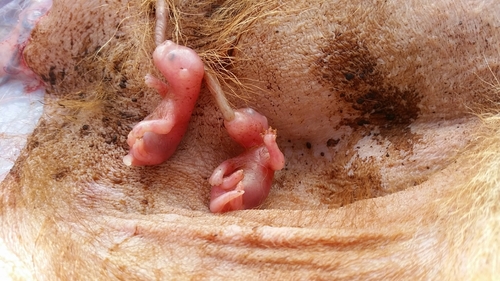
The red kangaroo breeds all year round. The females have the unusual ability to delay the birth of their baby until their previous joey has left the pouch. This is known as embryonic diapause. Copulation may last 25 minutes. While the young joey will permanently leave the pouch at around 235 days old, it will continue to suckle until it reaches about 12 months of age. A doe may first reproduce as early as 18 months of age and as late as five years during drought, but normally she is two and a half years old before she begins to breed.
in Dresden, Germany]]
The female red kangaroo is usually permanently pregnant except on the day she gives birth; she has the ability to freeze the development of an embryo until the previous joey is able to leave the pouch. This is known as embryonic diapause, and will occur in times of drought and in areas with poor food sources. The composition of the milk produced by the mother varies according to the needs of the joey. In addition, red kangaroo mothers may "have up to three generations of offspring simultaneously; a young-at-foot suckling from an elongated teat, a young in the pouch attached to a second teat and a blastula in arrested development in the uterus".
The red kangaroo has also been observed to engage in alloparental care, a behaviour in which a female may adopt another female's joey. This is a common parenting behaviour seen in many other animal species like wolves, elephants, and fathead minnows.
📌 Relationship with humans
The red kangaroo is an abundant species and has benefited from the spread of agriculture and creation of man-made waterholes. Competition with livestock and rabbits poses a threat. They are also sometimes shot by farmers as pests, although in Queensland and New South Wales a permit is required.
Kangaroos dazzled by headlights or startled by engine noise often leap in front of vehicles, severely damaging or destroying smaller or unprotected vehicles. The risk of harm to vehicle occupants is greatly increased if the windscreen is the point of impact. As a result, "kangaroo crossing" signs are commonplace in Australia.
Peak times for kangaroo/vehicle crashes are between 5:00 PM and 10:00 PM, in winter, and after extended dry-weather spells.
📌 Commercial use
Like all Australian wildlife, the red kangaroo is protected by legislation, but it is so numerous that there is regulated harvest of its hide and meat. Hunting permits and commercial harvesting are controlled under nationally approved management plans, which aim to maintain red kangaroo populations and manage them as a renewable resource. In 2023, over half a million red kangaroos were harvested across all of Australia. Harvesting of kangaroos is controversial, particularly due to the animal's popularity. In 2009 the government put a limit of 1,611,216 for the number of red kangaroos available for commercial use. The kangaroo industry is worth about A$270 million each year, and employs over 4,000 people. The kangaroos provide meat for both humans and pet food. Kangaroo meat is very lean with only about 2% fat. Their skins are used for leather.