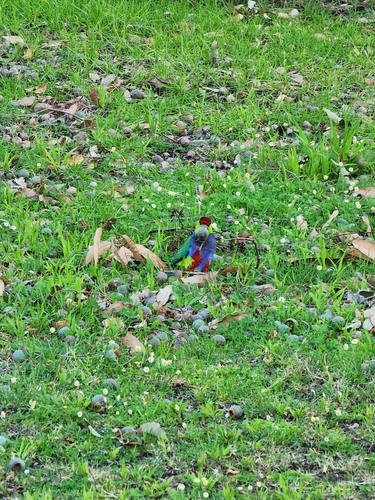
The red-capped parrot is a species of broad-tailed parrot native to southwestern Australia. It was described by Heinrich Kuhl in 1820, with no subspecies recognised. It has long been classified in its own genus owing to its distinctive elongated beak, though genetic analysis shows that it lies within the lineage of the Psephotellus parrots and that its closest relative is the mulga parrot. Not easily confused with other parrot species, it has a bright crimson crown, green-yellow cheeks, and a distinctive long bill. The wings, back, and long tail are dark green, and the underparts are purple-blue. The adult female is very similar though sometimes slightly duller than the male; her key distinguishing feature is a white stripe on the wing under-surface. Juveniles are predominantly green.
📌 Taxonomy
The species was described in 1820 by Heinrich Kuhl, as Psittacus spurius, from an immature specimen collected at Albany, Western Australia by the Baudin expedition (1801–1803) and deposited at the National Museum of Natural History in Paris. The specific epithet spurius is the Latin adjective meaning "illegitimate", and refers to the markedly different adult and immature plumages (hence adults and young appear unrelated). Irish naturalist Nicholas Aylward Vigors named the species Platycercus pileatus in 1830 from an adult male specimen that had been acquired by the Zoological Society of London. The species was placed in the monotypic genus Purpureicephalus—as P. pileatus—by French biologist Charles Lucien Bonaparte in 1854. The generic name is an amalgam of the Latin "purple", and the Ancient Greek "head". In this generic combination, the current name is translated as "bastard red-head". The red-capped parrot's elongated bill and its unusual coloration—lack of cheek patches compared with Platycercus—are the main reasons for its placement in its own genus.
No subspecies are recognised currently. There is no known geographical variation; five birds from Esperance had smaller bills and tarsi than individuals from elsewhere in its range, but the sample was too small to draw any conclusions.
The red-capped parrot is related to other broad-tailed parrots, but relationships within the group had been unclear. In 1938, Australian ornithologist Dominic Serventy proposed that it was the sole survivor of a lineage of eastern Australian origin, with no close living relatives. In 1955, British evolutionary biologist Arthur Cain proposed that the eastern lineage had vanished after being outcompeted by the crimson rosella (Platycercus elegans), and that its closest relative was the horned parakeet (Eunymphicus cornutus) of New Caledonia, which he concluded had adopted a much greener plumage of a wetter climate.
"Red-capped parrot" has been designated the official name by the International Ornithologists' Union (IOC). English ornithologist John Gould used the name "red-capped parakeet" in 1848 based on Vigors' scientific name, which also inspired the old avicultural term "pileated parrot". It has also been called "western king parrot" to distinguish it from the Australian king parrot (Alisterus scapularis) occurring in the east, "purple-crowned parrot", "grey parrot", or "hookbill" for the distinctive upper mandible. The name "pileated parakeet" potentially causes confusion among aviarists with the South American pileated parrot (Pionopsitta pileata).
📌 Distribution and habitat
The red-capped parrot occurs in the Southwest Australia ecoregion in dense to open forest and woodland, and heathland in coastal regions. The distribution range is south from Moore River to the coast to Esperance. Records of the species extend inland from the southern coast, as far as Gingin and Mooliabeenee.
📌 Behaviour
The parrots are found in pairs or small groups of 4 to 6 individuals, or occasionally in larger flocks of 20–30 birds. Rarely a flock of up to 100 birds may be encountered; these are generally composed of juveniles. Birds may associate with Australian ringneck parrots (Barnardius zonarius) or western rosellas (Platycercus icterotis). The red-capped parrot is shy, and often retreats to the upper canopy of trees if disturbed, which has made study of its breeding and social behaviour difficult. Hence many aspects of these are poorly known.
The red-capped parrot is thought to be monogamous, pairs forming long-term bonds generally from around 20 months of age. Younger females have been recorded pairing with older males at 8 or 9 months old, but do not appear able to breed at this age. The male initiates courtship by following the female and making a contact call, as well as performing a courtship display. This involves it raising its crown feathers, ruffling its crown and rump feathers, lowering its wings to display its rump, and raising and flaring its tail feathers. The female often stoops low and gives out a food-begging call. These displays begin before a nest site is chosen and continue through the breeding season until around two weeks after the young have fledged.
📌 Breeding
The breeding season is August to December. The red-capped parrot needs mature trees large enough to have hollows in the trunk or branches. These trees can be on road verges, along water courses, or in paddocks, as well as forest or woodland. Nests are generally apart, and pairs defend them vigorously from other birds, particularly other red-capped parrots, for the duration of nesting. The nest site is a tree hollow generally in an older large tree, such as a marri, jarrah, tuart, flooded gum (Eucalyptus rudis) or paperbark (Melaleuca spp.), at a height between , averaging around above the ground and often north or east-facing. A lower entrance, narrow with a larger hollow, recorded at was considered exceptional. There are often chew marks at the entrance, which is wide. The hollow is deep and is lined with wood dust at the bottom. The female incubates her clutch of usually five, occasionally six (records up to nine), milk-white eggs. The size of each almost spherical egg is . The male attends her from a nearby tree, signalling to leave the nest for food he has brought. Information on the incubation period is limited, but is between 20 and 24 days.
The nestlings are nidicolous—they remain in the nest initially, weighing at birth and gaining, on average, a day. At birth they are covered in white down, which is soon replaced by grey down. Their eyes open by 9–11 days of age, and primary quills appear by 9–15 days and primary feathers proper by 14–20 days. They are fed by the female alone for the first two weeks, then by both parents. They fledge between 30 and 37 days, generally all leaving the nest on the same day. The parents continue to feed them for another two weeks.
📌 Feeding
Marri seeds are the preferred diet, but it also extracts seeds from karri (Eucalyptus diversicolor), woody pear (Xylomelum), Grevillea, Hakea, dryandra (Banksia) and sheoak (Casuarina, Allocasuarina), mangite (Banksia grandis), as well as from grasses, herbs, or shrubs associated with marri-dominated vegetation types. Any viable seed that is consumed may be undigested and dispersed.
Although the red-capped parrot eats fewer introduced plant species than other parrots, it does eat the seeds of slender thistle (Carduus pycnocephalus), sheep thistle (C. tenuiflorus), and variegated thistle (Silybum marianum). The species has also adapted to exploit the introduction of orchard fruit such as apples and pears and the gardens of suburban areas. The fruit of other cultivated introductions are also selected, including almond, nectarine, olive, peaches, plums, pomegranates, and white cedar (Melia azedarach). Insects such as psyllids also form part of their diet.
The red-capped parrot primarily feeds on the ground, clasping the capsule of eucalypts or cones of sheoak with one foot and extracting the seed with their slender hooked beak. Both species prise marri seeds out of their woody capsule by manipulating it with the foot and lower mandible, and inserting the point of the upper mandible at openings in the seed-dispersing valve. The red-capped parrot leaves shallow marks around the opening of the capsule, with little damage to the husk. The species mainly feeds and manipulates objects with its left foot; limited sampling of Australian parrot species indicates that laterality is associated with larger size, and many of these are left-footed, though two other broad-tailed parrot species (crimson rosella and Australian ringneck) are right-footed, and smaller species show no preference.
📌 Parasites and diseases
A parasitic protozoan, Eimeria purpureicephali, was isolated and described from a diseased bird in 2016. It is an intracellular parasite that lives in the host's gastrointestinal system. Species of bird louse recorded on the red-capped parrot include Forficuloecus palmai, Heteromenopon kalamundae and a member of the genus Neopsittaconirmus. Psittacine beak and feather disease virus was isolated and sequenced from a fledgling in 2016.
📌 Conservation
Due to damage to orchard crops, these birds have been classified and shot as pests,
📌 Aviculture
Its attractive colours make the red-capped parrot a desirable species to keep, although it has a reputation for being anxious in captivity and difficult to breed. This may be because of historically high proportion of wild-caught birds entering aviculture.
The first record of successful reproduction in captivity was in England, almost simultaneously by two aviculturalists in 1909, the slightly earlier hatching of one brood saw Mr. Astley awarded a medal by the nation's Avicultural Society.