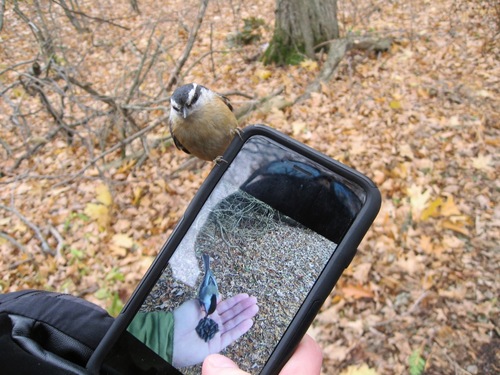
The red-breasted nuthatch is a small songbird. The adult has blue-grey upperparts with cinnamon underparts, a white throat and face with a black stripe through the eyes, a straight grey bill and a black crown. Its call, which has been likened to a tin trumpet, is high-pitched and nasal. It breeds in coniferous forests across Canada, Alaska and the northeastern and western United States. Though often a permanent resident, it regularly irrupts further south if its food supply fails. There are records of vagrants occurring as far south as the Gulf Coast and northern Mexico. It forages on the trunks and large branches of trees, often descending head first, sometimes catching insects in flight. It eats mainly insects and seeds, especially from conifers. It excavates its nest in dead wood, often close to the ground, smearing the entrance with pitch.
π Taxonomy
In 1760, the French zoologist Mathurin Jacques Brisson included a description of the red-breasted nuthatch in his Ornithologie based on a specimen collected in Canada. He used the French name Le torchepot de Canada and the Latin Sitta Canadensis. Although Brisson coined Latin names for the species, these usually do not conform to the binomial system and none of them are recognised by the International Commission on Zoological Nomenclature. In 1766, when the Swedish naturalist Carl Linnaeus updated his Systema Naturae for the twelfth edition, he added 240 species that had been previously described by Brisson.
In the past, the red-breasted nuthatch and four other species, Corsican nuthatch, Chinese nuthatch, Algerian nuthatch and KrΓΌper's nuthatch, were occasionally thought to be a single species. These five make up a well-defined species group known as the "Sitta canadensis group", and are sometimes considered to be a superspecies. The red-breasted nuthatch is monotypic across its extensive range.
π Etymology
Like all nuthatches, the red-breasted nuthatch is assigned to the genus Sitta (Linnaeus, 1758), a name derived from sittΔ (), the Ancient Greek word for the Eurasian nuthatch. The specific epithet canadensis is Neo-Latin for "belonging to Canada". "Nuthatch" is a linguistic corruption of "nuthack", referring to the bird's habit of wedging nuts into cracks in tree bark and hacking at them until they break open. "Red-breasted" is a reference to the rusty colour of the male's underparts.
π Voice
The red-breasted nuthatch's call is high-pitched, nasal and weak. Transcribed as yenk or ink, Its song is a slowly repeated series of clear, nasal, rising notes, transcribed as .
π Habitat and range
Though it is primarily a full-time resident of northern and subalpine conifer forests, the red-breasted nuthatch regularly migrates irruptively, with both the number migrating and the wintering locations varying from year to year. Though formerly resident on Isla Guadalupe, an island off the western coast of Mexico, it appears to have been extirpated there, with the last known record of the species on the island dating from 1971. There is a single vagrant record for Mexico's Isla Socorro. It is an extremely rare vagrant to Europe, with two records in the western Palearctic; one bird successfully overwintered in eastern England.
π Feeding behaviour and diet
Like all nuthatches, the red-breasted nuthatch is an acrobatic species, hitching itself up and down tree trunks and branches to look for food. At feeders, it will take sunflower seeds, peanut butter, and suet. It often wedges food pieces in bark crevices in order to break them up with the bill (as opposed to holding the food in their feet, like the black-capped chickadee does).
Image:Sitta canadensis 5563.JPG|The nuthatch's habit of wedging seeds into cracks and hammering them open has given rise to its common name.
File:Red-breasted Nuthatch (5215329307).jpg|Pine seeds (here, Pinus rigida) are an important component of the diet. Clinton Township, New Jersey.
File:Sitta canadensis High Park hand.jpg|Red-breasted nuthatches are often very confiding, and will readily take offered food from human hands. Toronto, Canada.
π Breeding
The red-breasted nuthatch, like all nuthatches, is monogamous. The male courts the female with a peculiar display, lifting his head and tail while turning his back to her, drooping his wings, and swaying from side to side.
This bird excavates its own cavity nest, above ground (usually around . Excavation is done by both sexes and takes one to eight weeks. The pair smears sap around the entrance hole, presumably to help deter predators. The nest is lined with grass, moss, shredded bark and rootlets. Nest building is done by both sexes, but mostly by females.
The female lays 2β8 eggs (usually 5β6), which are white, creamy or pinkish, and covered with reddish-brown speckles. The eggs measure long by wide. Incubation is done by the female and lasts 12β13 days. The young are altricial and stay in the nest for 2β3 weeks, brooded by the female but fed by both sexes. Normally, there is only one brood per year. Lifespan is around 6 years.
π Conservation status and threats
Because of its large global range and its increasing population, the red-breasted nuthatch is rated as a species of Least Concern by the International Union for Conservation of Nature.