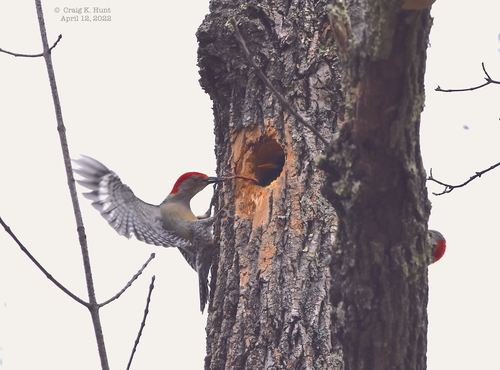
The red-bellied woodpecker is a medium-sized woodpecker of the family Picidae. It breeds mainly in the eastern United States, ranging as far south as Florida and as far north as Canada. Though it has a vivid orange-red crown and nape it is not to be confused with the red-headed woodpecker, a separate species of woodpecker in the same genus with an entirely red head and neck that sports a solid black back and white belly. The red-bellied earns its name from the pale reddish tint on its lower underside.
📌 Taxonomy
The English naturalist Mark Catesby described and illustrated the red-bellied woodpecker in his book The Natural History of Carolina, Florida and the Bahama Islands which was published between 1729 and 1732. Catesby used the English name "The Red-bellied Wood-pecker" and the Latin Picus ventre rubro. When in 1758 the Swedish naturalist Carl Linnaeus updated his Systema Naturae for the tenth edition, he included the red-bellied woodpecker, coined the binomial name Picus carolinus and cited Catesby's book. Linnaeus specified the type locality as America septentrionali (North America). The locality is now restricted to South Carolina. The red-bellied woodpecker is one of 24 species now placed in the genus Melanerpes that was introduced by the English ornithologist William Swainson in 1832. The species is monotypic: no subspecies are recognised.
📌 Vocalizations
Red-bellied woodpeckers are noisy birds, and have many varied calls. Calls have been described as sounding like ' or ' with an alternating ' sound. Males tend to call and drum more frequently than females, but both sexes call. The drum sounds like 6 taps. Often, these woodpeckers "drum" to attract mates. They tap on hollow trees, and even on aluminum roofs, metal guttering and transformer boxes in urban environments, to communicate with potential partners. Babies have a high-pitched begging call of '. They will continue to give a begging call whenever they see their parents for a while after fledging.
📌 Behavior and ecology
, New York City]]
These birds mainly search out arthropods on tree trunks. They may also catch insects in flight. They are omnivores, eating insects, fruits, nuts and seeds. In some parts of their range, they will also consume the eggs of box-nesting Wood ducks.
Their breeding habitat is usually deciduous forests. They nest in the decayed cavities of dead trees, old stumps, or in live trees that have softer wood such as elms, maples, or willows; both sexes assist in digging nesting cavities. Areas around nest sites are marked with drilling holes to warn others away.
Though the species is not globally threatened,
📌 Breeding
In early May, the red-bellied woodpeckers begin breeding activities by drumming patterns, such as slow taps followed by short rapid drumming. The red-bellied woodpeckers use vocal signals to attract and communicate with potential mates. The red-bellied woodpecker excavates holes in trees for nesting and roosting. By excavating cavities, they play an important role in forest communities for other species as well. Recent studies have shown that these woodpeckers experienced low breeding due to cutting sites of dead trees; however, predators are still of main concern. The juvenile red-bellied woodpecker is ready to fledge at 24 to 26 days of age. Natal dispersal has been observed in juvenile red-bellied woodpeckers. The juvenile red-bellied woodpecker remains in its natal area for approximately 27 weeks after fledging. In some cases, the woodpecker may return to its natal area for breeding, depending on predation levels and food resources.
📌 Food and feeding
in Pennsylvania]]
The woodpecker uses its bill as a chisel, drilling into bark or probing cracks on trunk of trees. In this manner, it is able to pull out beetles and other insects from the tree with the help of its long tongue. Field observations indicate that woodpeckers partake extensively in food storage, hiding items such as berries and acorns deep within natural crevices to protect them from interspecific competitors. Breitwisch (1977), and Williams and Batzil (1979), the red-bellied woodpecker spent 20% to 69% of its time foraging on dead or decaying trees. In addition, Breitwisch (1977) The red-bellied woodpecker relies on snags or dying trees for foraging and nesting. It is a major predator of the invasive emerald ash borer in the U.S. Midwest, removing up to 85 percent of borer larvae in a single infested ash tree. The red-bellied woodpecker has also been observed, on occasion, foraging on the ground amongst groups of northern flicker woodpeckers.
📌 Predation
Predators of adult red-bellied woodpeckers include birds of prey such as sharp-shinned hawks and Cooper's hawks, black rat snake, and house cats. Known predators of nestlings and eggs include red-headed woodpeckers, owls, pileated woodpeckers, eastern gray squirrels, fox squirrels, and gray rat snakes. When approached by a predator, red-bellied woodpeckers either hide from it or harass it with alarm calls. They defend their nests and young aggressively, and may directly attack predators that come near the nest.