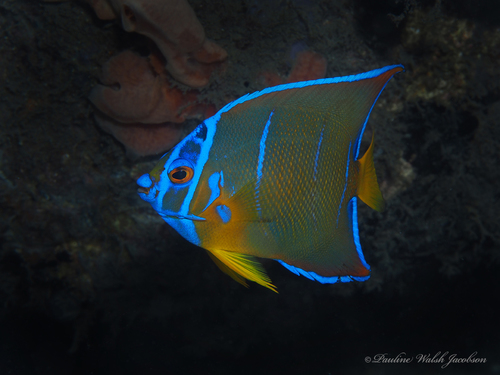
The queen angelfish, also known as the blue angelfish, golden angelfish, or yellow angelfish, is a species of marine angelfish found in the western Atlantic Ocean. It is a benthic warm-water species that lives in coral reefs. It is recognized by its blue and yellow coloration and a distinctive spot or "crown" on its forehead. This crown distinguishes it from the closely related and similar-looking Bermuda blue angelfish, with which it overlaps in range and can interbreed.
📌 Taxonomy
The queen angelfish was first described as Chaetodon ciliaris in 1758 by Carl Linnaeus in the 10th edition of his Systema Naturae, with the type locality given as the "Western Atlantic/Caribbean". In 1802 it was moved by French naturalist Bernard Germain de Lacépède to the genus Holacanthus, the name of which is derived from Ancient Greek ὅλος (hólos), meaning "full", and ἄκανθα (ákantha), meaning "spine". Other common names for the species include "blue angelfish", "golden angelfish" and "yellow angelfish". The closure of the Isthmus of Panama 3.5–3.1 mya led to the splitting off of the Tropical Eastern Pacific species. The closest relative and sister species of the queen angelfish is the sympatric and similar Bermuda blue angelfish (H. bermudensis), from which it split around 1.5 mya. which has features similar to both parent species. The Townsend angelfish is fertile, and individuals can breed both with each other and with the two parent species.
The following cladogram is based on molecular evidence:
|2=
|2=King angelfish
}}
}}
}}
|2=Guinean angelfish
}}
}}
📌 Ecology
, Key Largo, Florida]]
Queen angelfish are found in tropical and subtropical areas of the Western Atlantic Ocean around the coasts and islands of the Americas. They occur from Florida along the Gulf of Mexico and the Caribbean Sea down to Brazil. Their range extends as far east as Bermuda and the Saint Peter and Saint Paul Archipelago. Off St. Thomas Island and Salvador, Bahia, 90% of the diet of adults is sponges. Off the Saint Peter and Saint Paul Archipelago, more than 30 prey species may be consumed, 68% being sponges, 25% being algae, and 5% being bryozoans. Queen angelfish appear to be selective feeders as the proportion of prey in their diet does not correlate with their abundance. On the species level, the angelfish of the Saint Peter and Saint Paul Archipelago target the less common sponges Geodia neptuni, Erylus latens, Clathria calla, and Asteropus niger.
📌 Life cycle
|alt=A pair off Belize, one turning away from the camera]]
Male queen angelfish have large territories with a harem of two to four females. It is observed sometime around a full moon. They then deposit their eggs and semen into the water. The female discharges between 25 and 75 thousand eggs a day. After spawning, the pair split and head to back to the ocean floor.
The transparent eggs are pelagic and remain suspended in the water for 15–20 hours. The hatched larvae have a large yolk sac with no functional eyes, gut or fins, but two days later, the yolk is absorbed, and the larvae have more of a resemblance to fish. These larvae are plankton-eaters and grow quickly. Between the ages of three and four weeks old, when they have reached a length of , they descend to the floor as juveniles. Juvenile angelfish live alone and in territories encompassing finger sponges and coral, where they establish cleaning stations for other fish.
📌 Human interactions
, Spain]]
Queen angelfish are not normally eaten or commercially fished. They are captured mostly for the aquarium trade, where they are highly valued. As juveniles, angelfish can adapt to eating typical aquarium food and hence have a higher survival rate than individuals taken as adults, which require a more specialized diet.
In Brazil, the queen angelfish is the most common marine ornamental fish sold aboard. In 2010, the queen angelfish was assessed as least concern by the International Union for Conservation of Nature, as the species is only significantly fished off Brazil and the wild population appeared to be secure. In 2015, an aquarium-introduced angelfish was found in the Red Sea at Eilat's Coral Beach, Israel. Its kidney was infected with the disease-causing bacterium Photobacterium damselae piscicida, which was not previously recorded in Red Sea fish, raising concerns that it could infect native fish.